
CMC in Detergent: Anti-Redeposition and Grade Selection
CMC in detergent is commonly used as an anti-redeposition agent: it helps reduce the transfer of released soil back onto fabric during washing. For laundry powders, the key question is how a selected grade performs on the intended fabrics, especially cotton, under the actual wash conditions. Grade selection and dosage should be confirmed through comparative trials.
How does CMC help prevent fabric graying?
Sodium carboxymethyl cellulose is an anionic, water-soluble cellulose polymer. Its interaction with cellulosic fabric surfaces can help repel soil in the wash liquor. Reduced soil redeposition can support whiteness retention over repeated washes. Manufacturer literature documents this application in laundry powders; the reported results apply to the grades and conditions tested, rather than every detergent formula.
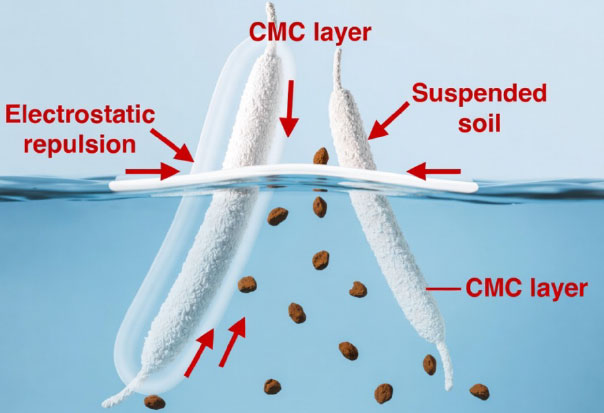
Powder and liquid detergents need different selection checks
- Laundry powder: assess anti-redeposition performance, blending uniformity and dissolution during use. Compare candidate grades at a clearly stated addition basis.
- Liquid laundry detergent: confirm compatibility in the finished surfactant and electrolyte system. Conventional CMC can become unstable in liquid laundry formulations. A powder grade that performs well in a wash test is not automatically suitable for liquid storage.
- Other cleaners: define whether the objective is rheology, suspension or another function before selecting a grade. Laundry anti-redeposition evidence does not establish performance in every dishwashing liquid, cleaning paste or soap bar.
For liquid systems, see our detergent CMC formulation and compatibility guide.
What should you request when selecting detergent-grade CMC?
- Viscosity specification and method: record solution concentration, temperature, instrument and measurement conditions. Compare results obtained by the same method.
- Degree of substitution (DS): request the stated range and evaluate it together with the grade’s application guidance.
- Active content, moisture and salts: clarify whether quoted purity and dosage refer to as-supplied material or dry active polymer.
- Particle size and handling: check mixing behavior, dispersion and dissolution in the planned process.
- Documentation: request the technical data sheet, safety data sheet and a certificate of analysis for the supplied batch.
There is no single viscosity, DS or dose that can be recommended for all detergent products. Use the supplier’s grade-specific guidance to design an initial trial.
A practical anti-redeposition comparison
The following is a proposed qualification workflow. Set acceptance limits for your own product before starting:
- Prepare a control formula without CMC and candidate formulas with defined CMC addition levels. Keep the remaining ingredients and processing conditions consistent.
- Use the intended fabric mix and a repeatable soil challenge. Record detergent concentration, water hardness, wash temperature, time and rinse conditions.
- Assess redeposition on initially clean swatches alongside stain removal from soiled swatches. These are separate endpoints.
- Compare whiteness or color change over the chosen wash cycles. Include repeat measurements and inspect for residue.
- Confirm the selected formula’s manufacturing behavior and storage stability before approving scale-up.
Frequently asked questions
Does CMC replace a hard-water builder?
Do not treat anti-redeposition performance as proof of calcium or magnesium control. Evaluate the builder or chelating system separately and include the intended water hardness in wash trials.
Does more thickening mean better anti-redeposition?
Viscosity and wash performance should be measured separately. Select against the desired wash result and process requirements, rather than viscosity alone.
Can the same result be assumed for cotton and polyester?
No. Test the target fabric mix. Evidence on cotton or other cellulosic fabrics should not be generalized to all synthetic fibers.
Discuss a detergent CMC sample
View our detergent-grade CMC product information and contact SINO-CMC with your product format, fabric mix, surfactant system, water hardness, process and target performance. Request candidate grade information and sample guidance for a controlled comparison.
Technical references
- Nouryon: CMC polymer properties.
- Nouryon: anti-redeposition aids for laundry powders.
- Nouryon: liquid laundry compatibility discussion.
External references explain the application and specific manufacturers’ examples. Their product specifications and performance results are not specifications or guarantees for SINO-CMC grades.
SINOCMC Team