
As consumers increasingly prioritize effective and safe oral hygiene products, the role of high-quality ingredients in toothpaste formulations has become more critical than ever. Sodium Carboxymethyl Cellulose (CMC) stands out as a vital functional additive, playing an indispensable role in toothpaste formulations. Specifically, toothpaste-grade CMC, with its unique properties, has become an ideal choice for modern toothpaste manufacturers.
1. What Benefits does CMC Provide to Toothpaste Formulations?
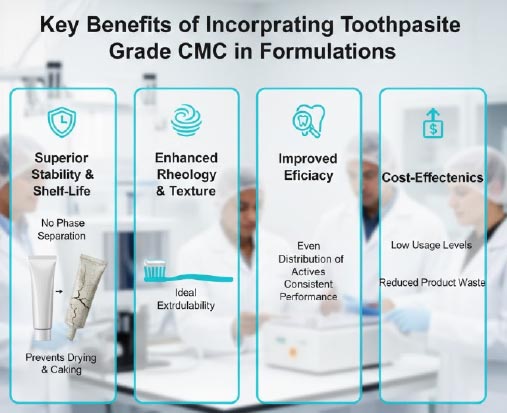
In toothpaste formulations, CMC is far more than just a thickener; it is a vital rheology modifier and binder. The primary challenge in toothpaste production is to keep the abrasive agents (like calcium carbonate or hydrated silica) perfectly suspended in the liquid phase.The inclusion of toothpaste grade CMC offers a multitude of critical benefits.
- Superior Rheology: It provides the “shear-thinning” property, meaning the toothpaste flows easily when squeezed but stays firm on the brush.
- Excellent Dispersibility: It ensures that abrasives and polishing agents are suspended evenly, preventing a “gritty” texture.
- Enhanced Mouthfeel: It contributes to a smooth, delicate, and refreshing sensation during brushing, without any chemical aftertaste.
- Strong Binding Power: It holds the liquid and solid phases together, preventing the common issue of “water separation” or bleeding.
2. How CMC Enhances Stability and Extends Shelf Life
The stability of toothpaste is paramount for both efficacy and consumer satisfaction. Toothpaste-grade CMC plays a critical role in preventing phase separation, where solid components like abrasives and active ingredients might settle out from the liquid phase over time.
- Anti-Syneresis: A common failure in low-quality toothpaste is “bleeding” or water separation. Toothpaste grade CMC has superior water-binding capacity, effectively locking moisture within the gel structure even under fluctuating temperatures during transport and storage.
- Acid and Salt Resistance: Advanced CMC types used in toothpaste are designed to remain stable in the presence of flavoring oils and fluoride salts. This prevents the paste from thinning out or becoming lumpy over time.

3. Is Toothpaste Grade CMC Safe for Oral Care Applications?
Definitely Yes. Toothpaste Grade CMC is non-toxic, non-irritating, and safe for daily oral use. It complies with relevant global regulations and quality standards for oral care products. Derived from natural cellulose, CMC is also biodegradable and environmentally friendly, aligning with the oral care industry’s increasing focus on sustainability and consumer safety.

4. Common Specifications of Toothpaste-Grade CMC
| Property | Specification (High Viscosity) | Specification (Medium Viscosity) |
| Appearance | White to cream powder | White to cream powder |
| Degree of Substitution (DS) | 0.85 – 1.0 | 0.75 – 0.90 |
| Viscosity (1%, 25°C) | 2000 – 4000 mPa.s | 500 – 1500 mPa.s |
| Purity | ≥ 99.5% | ≥ 98.0% |
| Moisture Content | ≤ 10% | ≤ 10% |
Conclusion
Toothpaste Grade CMC is a vital functional ingredient that enhances texture, stability, and user experience in oral care products. As toothpaste formulations continue to evolve, CMC remains a trusted and indispensable component, supporting both product performance and consumer satisfaction.
SINOCMC Team