
Paper Coating CMC Trial: Rheology, Water Retention and Sheet Checks
A paper coating CMC trial should prove more than whether a sample makes the coating color thicker. It should show that the complete formulation can be prepared reproducibly, hold its target solids and flow profile, resist excessive dewatering into the base sheet, run through the intended applicator, and deliver the required coated-paper properties.
Quick answer: Freeze one coating formula and one base paper, then compare the approved control with one CMC candidate at a time. Match the CMC addition basis, solids, preparation temperature, order of addition and conditioning time. Measure low-shear viscosity, a relevant high-shear or application-rate response, water or material retention, drawdown coat weight and defects. Finish with conditioned-sheet tests such as surface strength, roughness or smoothness, gloss, print response and water absorptiveness when relevant. Approve a grade only against written process and paper-property limits.
This guide is for paper-mill technologists, coating formulators and technical buyers qualifying CMC for coated paper. SINOCMC already has a general overview of CMC in coated-paper production and a paper grade CMC product page. The article below owns a narrower intent: how to design and interpret a controlled qualification trial. It does not set a universal formula, dosage or machine-speed claim.
Define the coating process and failure you need to prevent
Record the actual application system before choosing a test: blade, rod, roll, air knife, film press or another method. Note the coating speed, target coat weight, number of layers, base-sheet type, drying sequence and whether the CMC is used mainly for rheology, water or material retention, co-binding, optical-brightener carrying, or a combination. The same CMC grade can behave differently when pigment, latex, starch, salt level, solids or shear history changes.
Start with one decision statement. Examples include: reduce streaks without raising pump load beyond the operating limit; improve retention without losing high-shear flow; hold coat-weight uniformity on a more absorbent base sheet; or match the current paper surface result with a new CMC supply. Turn the statement into measurable acceptance limits. “Looks smoother” is an observation, not a release criterion.
Freeze the formulation and comparison basis
Use the current approved coating color as the control. Keep pigment blend, pigment lot where practical, dispersant, latex or other binder, starch, optical brightener, lubricant, defoamer, biocide, water quality and final solids fixed. If the candidate changes the water demand, record the adjustment rather than quietly adding water until the cup viscosity looks familiar.
Identify each CMC by supplier, grade, lot, physical form, moisture or loss on drying, purity basis, degree of substitution, and the exact viscosity method on the certificate. Compare on a declared basis—for example, as-supplied mass or active CMC solids. A certificate viscosity measured in a dilute CMC solution cannot be treated as the coating color’s machine viscosity. For why concentration and method matter, see the CMC viscosity comparison guide.
Use a small trial matrix that answers one question
When screening grades, keep the CMC addition basis constant. When optimizing level, keep the grade constant. Do not change grade, level, pigment ratio and binder in the same first-pass matrix. Prepare an independent repeat of the leading condition; splitting one batch into two cups does not test preparation repeatability.
| Condition | What changes | What stays fixed | Decision supported |
|---|---|---|---|
| Control | Current approved CMC and level | Formula, base paper, preparation and test methods | Establishes the production reference. |
| Candidate A | One identified CMC grade | CMC addition basis and every other ingredient | Shows the grade effect. |
| Candidate B | Second grade, or second level in a separate matrix | Solids, pH, temperature and shear history | Shows whether the response is systematic. |
| Repeat | Fresh batch of the leading condition | Target settings and acceptance methods | Checks preparation robustness. |
Choose candidate levels from the existing formula, supplier discussion and plant constraints. Broad dosage statements from an application page are not production limits. Record actual weighed masses and calculate final solids after every addition.
Control CMC hydration and the order of addition
Write a batch sheet before mixing. Include vessel geometry, batch mass, water source, temperature, agitator and impeller, speed or tip-speed basis, addition order, addition time, hydration time and the point at which pigments and electrolytes enter. Add the CMC in a way that avoids dry pockets or locally overconcentrated gel. If the plant uses a premix, make the lab premix on the same concentration basis and document its age.
Take observations at fixed times: undispersed particles, foam, air entrainment, wall build-up, temperature rise and whether the batch reaches a stable viscosity. A candidate that meets final viscosity only after an impractical hydration time may fail the process even if the conditioned sample later looks acceptable.
Measure a flow profile, not one viscosity number
Low-shear viscosity helps describe storage, pumping start-up and settling behavior, but the applicator can expose the coating color to much higher shear. Record the instrument, geometry or spindle, speed or shear rate, temperature, sample age, measurement sequence and whether the reading is taken on an increasing or decreasing ramp. If the mill has a validated high-shear method, use it. TAPPI’s current standards program lists separate methods for high-shear capillary viscosity of coating color and for coating-clay slurry viscosity, underscoring that one low-shear reading does not describe the whole process.
Compare the complete curve or agreed operating points: low-shear build, application-range viscosity, recovery after shear and time stability. Watch for an acceptable cup or spindle value paired with poor high-shear flow, excessive thixotropy, rapid drift or sensitivity to small temperature changes.
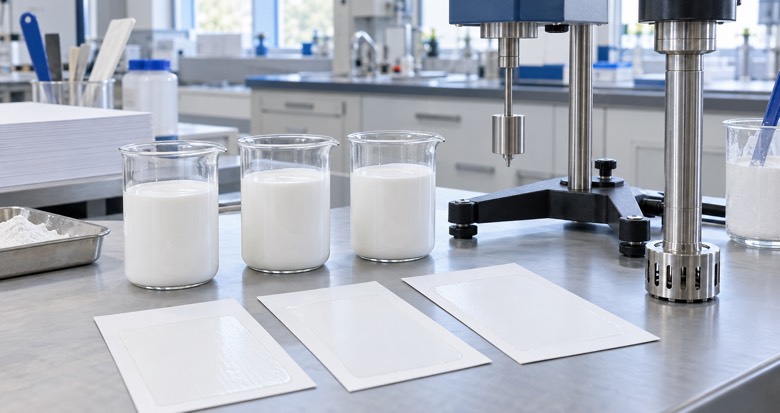
Separate water retention from bulk thickening
A more viscous coating color is not automatically better at controlling liquid movement into the base sheet. Research presented through TAPPI notes that low-shear viscosity can correlate poorly with liquid-phase behavior and that faster dewatering measurements can be more informative for some formulations. Another paper in the Japan TAPPI Journal argues for the broader term “material retention,” because water is not the only mobile component: fine pigment, latex, optical brightener and lubricant can also move.
Use the mill’s established water-retention or dewatering method and report the device, pressure, time, filter or base sheet, temperature and result units. Keep base paper and coating solids constant. If no validated method exists, treat a lab screening result as comparative only; do not convert it into a universal pass/fail claim.
Interpret retention with rheology. A candidate may improve a static retention number but create excessive high-shear resistance, filter build-up or poor leveling. The useful condition is the one that balances retention with applicator runnability and final-paper quality.
Run controlled drawdowns before the machine trial
Condition the same base-paper lot, mark machine and cross directions, and randomize or blind sample order where practical. Apply each color with the same rod, blade or lab coater settings. Record wet film target, actual dry coat weight, drying temperature and time, number of passes, and conditioning before testing. Measure multiple positions across each sheet so one clean area does not hide edge or streak defects.
Inspect coverage, streaks, scratches, ribbing, skips, pinholes, foam craters, mottling, blade lines, dusting and curl. Photograph under fixed lighting. If a defect appears, keep a retained wet sample and coated sheet. Changing CMC level immediately can destroy the evidence needed to distinguish dispersion, foam, pigment interaction, base-sheet absorption and applicator setup.
Assess runnability at pilot or mill scale
A bench drawdown cannot reproduce circulation time, pump shear, filtration, temperature drift, high-speed metering, dryer load or web behavior. For the leading condition, run a staged pilot or controlled machine trial. Log make-down time, screen or filter pressure, recirculation viscosity, solids and temperature, foam, deposits, breaks, misting or spitting, streak frequency, coat-weight profile and cleaning demand.
Compare the beginning, stable middle and end of the run. Take wet-color samples from defined locations and coated-paper samples across the web and through time. If the candidate needs a different operating window, document that change explicitly; do not report it as a drop-in equivalent.
Test the coated sheet against the product requirement
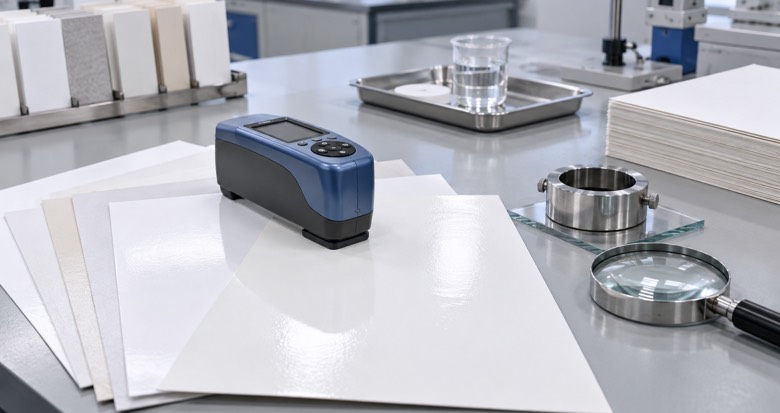
Select paper tests before seeing the result. Depending on the grade, the plan may include dry coat weight, moisture, surface strength or pick resistance, roughness or smoothness, gloss, brightness, opacity, porosity or air resistance, print density, ink set, mottling, and water absorptiveness. ISO 535 specifies the Cobb method for water absorptiveness under defined conditions; it does not apply to every paper type, so confirm scope before using it.
Use the same conditioning atmosphere, instrument settings, paper side, direction and number of replicates for every condition. Report mean and variation, not only the best sheet. TAPPI’s wax-pick method also requires identifying whether disturbance in coated paper occurs in the coating, the base stock or both. That distinction matters when diagnosing whether a surface-strength failure belongs to the coating formula or the substrate.
Diagnose common trial failures one variable at a time
- Viscosity rises during circulation: check temperature, evaporation, solids, shear history, microbial control and delayed CMC hydration before changing grade.
- Good low-shear viscosity but poor application: examine high-shear response, extensional behavior, foam, filtration and applicator settings.
- Rapid dewatering or mottling: compare base-sheet absorption, liquid-phase retention, coating solids and mobile-component migration.
- Streaks or blade lines: inspect dispersion, agglomerates, screen residue, air, deposits and local solids before assigning the defect to CMC.
- Good runnability but weak surface strength: verify coat weight, binder distribution, drying history, base-sheet failure mode and test conditioning.
- Lab pass but machine failure: compare batch scale, mixing energy, circulation age, temperature, filtration and actual shear exposure.
Change one suspected cause per follow-up. Preserve the control and retained samples. This is slower than adjusting several settings at once, but it produces a decision that can survive scale up and supplier review.
Bridge the selected CMC to a commercial batch
Freeze the approved CMC grade and lot criteria, addition basis, hydration procedure, coating formula, operating window, test methods and paper-property limits. Define which changes require requalification: supplier or production site, CMC grade, physical form, viscosity specification or method, degree-of-substitution range, pigment or binder system, base paper, solids, applicator or major process equipment.
Release the first commercial lot through the same evidence chain: certificate review, incoming identity, controlled make-down, coating-color checks, run data and final-paper testing. The broader sample to commercial batch approval workflow explains how to preserve the bridge from lab evidence to purchasing. Store retained samples and deviations with the approval record.
What a technical buyer should send with an inquiry
Share the coating application method, base-paper type, pigment and binder system, coating solids, pH, preparation and operating temperatures, target low- and high-shear methods, coat weight, machine or pilot speed, current CMC grade, current failure mode and final-paper acceptance tests. If information is confidential, provide ranges and the decision criteria rather than customer identities or proprietary formulas.
Ask the supplier for a clearly identified sample lot, certificate with test methods, physical-form and particle-size information when relevant, moisture or loss on drying, purity basis, degree of substitution, viscosity method and recommended hydration guidance. A useful sample is one that can be traced into a reproducible trial.
Frequently asked questions
Can I approve paper grade CMC from certificate viscosity alone?
No. Certificate viscosity is a raw-material quality value under a stated solution method. Coating performance also depends on solids, pigment and binder interactions, water quality, shear, temperature, base paper and applicator conditions.
Should candidate CMC grades be compared at equal mass?
Use a declared and justified basis. Equal as-supplied mass is simple, but active solids may differ if moisture or purity differs. Record both the weighed mass and the calculated active basis so the comparison can be reproduced.
Is the highest low-shear viscosity the best result?
No. Excessive low-shear viscosity can hurt make-down, pumping or leveling, while still failing to describe application-range behavior. Approve the flow profile and machine window, not the largest single number.
Does better water retention guarantee better coated paper?
No. Retention must be balanced with rheology, coat-weight control, drying and sheet properties. A candidate can improve one comparative retention result yet create another process or quality problem.
Can a drawdown replace a machine trial?
No. Drawdowns are useful for screening coverage and sheet properties, but they do not reproduce circulation, filtration, high-speed shear, metering, dryer load or web behavior. Use staged pilot or machine evidence before commercial approval.
Which coated-paper tests should be included?
Choose tests from the product requirement and known failure mode. Typical options include coat weight, surface strength, roughness or smoothness, gloss, optical properties, print response and water absorptiveness. Use applicable standard methods and fixed conditioning.
Plan a decision-ready paper coating CMC trial
SINOCMC can review a non-confidential trial brief and discuss a paper grade CMC sample for your own coating qualification. Include the application method, formula ranges, solids, shear and temperature conditions, target paper properties and current control grade. Contact SINOCMC with the brief; final approval should follow your mill’s controlled tests and commercial-batch evidence.
Technical sources
- TAPPI. 2026 Standards Schedule. The coating section lists separate methods for high-shear capillary viscosity of coating color and coating-clay slurry viscosity.
- Zeyringer E, Eichinger R. A new method to determine the water retention of coating colours and its impact on mottling of coated papers. TAPPI Advanced Coating Fundamentals Symposium. 2010. The work discusses liquid-phase viscosity and fast dewatering measurements; it is not a result for the CMC samples in this article.
- Conceição S, Santos NF, Velho JL, Ferreira JMF. Properties of paper coated with kaolin: The influence of the rheological modifier. Applied Clay Science. 2005;30:165–173. The study examined CMC, kaolin, coating-color rheology and coated-paper properties in its own formulations.
- Piilola T. Material Retention—A New Concept for CMC. Japan TAPPI Journal. 2006;60:1342–1347. The paper discusses movement of water and other mobile coating components.
- ISO. ISO 535:2023, Paper and board—Determination of water absorptiveness—Cobb method. Confirm the standard’s scope and laboratory requirements for the paper being tested.
- TAPPI. ANSI/TAPPI T 459 om-21, Surface strength of paper (wax pick test). The method distinguishes coating, base-stock or combined disturbance in coated paper.