
Wet Pet Food CMC Trial: Gravy Stability, Filling and Retort Checks
A wet pet food CMC trial should show whether one identified grade works through the buyer’s complete gravy, filling and thermal-process sequence—not merely whether a fresh CMC solution reaches a target viscosity. Qualification should connect the incoming CMC lot to controlled hydration, pumpable flow, chunk suspension, fill consistency, the validated heat process, cooling, storage and commercial-batch release.
Quick answer: Freeze one wet pet food formula, ingredient lots, water, mixing sequence, particle size and container format. Compare the approved control with one identified CMC candidate at the same declared addition basis. Measure the hydrated base and complete gravy at fixed temperature and shear history; then check filling, piece distribution and container-to-container weight. Run only the factory’s authorized thermal process, evaluate the cooled product at defined ages and repeat the leading condition independently. Approve the CMC only after a controlled pilot or production batch meets both quality and food-safety controls.
This guide is for pet food manufacturers, food-additive distributors, formulators and technical buyers qualifying wet pet food CMC. SINOCMC already publishes a broad introduction to sodium carboxymethyl cellulose in pet food and a food grade CMC product page. This article owns a narrower intent: designing and interpreting a factory-relevant qualification trial for wet formats such as chunks in gravy, loaf or pâté. It does not prescribe a universal dosage, formulation, nutritional claim, legal status or thermal schedule.
Define the product and the approval decision
“Wet pet food” is not one rheological system. A thin gravy around uniform chunks, a fibrous stew, a pumpable emulsion, a loaf and a smooth pâté place different demands on hydration, shear response, filling and post-process texture. Record the species and life-stage claim, product format, protein and fat sources, mineral and salt system, particle-size distribution, moisture, target pH and water activity, container type, fill method, thermal process, storage life and destination market before choosing tests.
Write one decision statement. Examples include: qualify a second-source CMC without changing the approved formula; reduce free liquid after cooling while keeping the current fill rate; improve gravy suspension without increasing pump load beyond the operating window; or hold container-to-container piece distribution through a longer filling run. Convert the statement into numerical or observable acceptance limits. “Looks thicker” is not a release criterion unless the temperature, test geometry, shear history, time and acceptable range are defined.
Keep safety and quality decisions separate. A hydrocolloid trial can assess flow, separation and texture, but it cannot validate commercial sterility. In the United States, FDA guidance notes that some thermally processed low-acid animal foods in hermetically sealed containers are subject to 21 CFR part 113 in addition to animal-food CGMP requirements. Use the scheduled process and process authority required for the product and market. Never change a retort schedule because a bench sample appears similar.
Freeze the formula, raw materials and comparison basis
Use the current approved formula and hydrocolloid system as the control. Keep meat or fish source and lot, protein preparation, fat, broth or water, starch, gums, emulsifier, mineral premix, palatant, color, preservatives where permitted, chunk recipe and all other ingredients fixed. Record raw-material temperature, frozen-thaw history and hold time. Protein extraction, salt concentration, fat state and particle size can change apparent viscosity and separation enough to hide the CMC effect.
Identify each CMC by supplier, grade, lot, physical form, purity basis, moisture or loss on drying, degree of substitution and certificate viscosity method. Compare on a declared basis—for example, as-supplied mass or active CMC solids. Do not treat two identical-looking powders as interchangeable. The food grade CMC COA review guide explains how to connect certificate values to buyer release checks without turning the certificate into an application guarantee.
A solution viscosity number is useful only with its method. Concentration, dry or as-received basis, hydration, temperature, instrument geometry, spindle or shear rate and endpoint all matter. The 1% versus 2% CMC viscosity guide explains why values produced by different methods are not directly convertible. In wet pet food, proteins, salts, fats, particles and thermal history add further interactions; application testing must decide the grade.
Use a trial matrix that changes one factor
Screen candidate grades at one fixed addition basis first. Optimize addition level only after identifying the most suitable grade. Changing CMC, water, starch, another gum and mixing energy together makes the result impossible to attribute. Prepare an independent repeat of the leading condition; splitting one kettle into two cups does not test preparation repeatability.
| Condition | What changes | What stays fixed | Decision supported |
|---|---|---|---|
| Control | Current approved CMC or hydrocolloid system | Formula, water, mixing, particles, fill and process | Establishes the production reference |
| Candidate A | One identified CMC grade | CMC addition basis and every other input | Shows the grade effect |
| Candidate B | Second grade, or second level in a separate matrix | Formula, temperature and test sequence | Checks whether the response is systematic |
| Repeat | Fresh preparation of the leading condition | Target settings and acceptance methods | Tests preparation robustness |
Select levels from the approved formula, supplier discussion, the factory’s risk assessment and the legal conditions for the destination market. Do not copy an addition rate from another species, format or regulatory region. Record actual weighed masses and calculate the final basis after moisture corrections.
Control CMC dispersion and hydration
Write the make-down procedure before weighing. Record batch size, vessel geometry, impeller type and diameter, water composition, water temperature, order of addition, powder feed time, mixing speed, mixing duration, scrape-down, hydration hold and the timer start point. If production preblends CMC with salt, starch or another dry carrier, reproduce that step. If the plant adds powder directly into a protein slurry, the bench trial should challenge that real route rather than an idealized separate solution only.
Watch for floating powder, fisheyes, wall deposits, entrained air and delayed hydration. Sample at planned times and examine both the bulk fluid and a thin spread. A candidate that eventually gives a smooth high viscosity after an impractical laboratory hold may fail the factory cycle. Do not add unrecorded water or increase mixing until the result looks right; document any rescue step as a new condition.
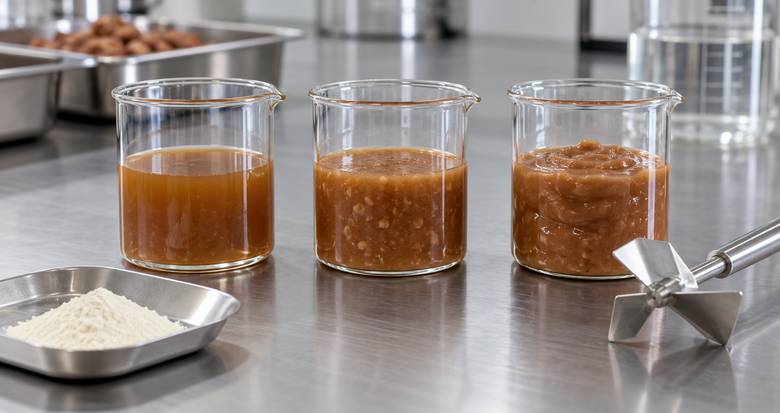
Measure the hydrated CMC base only as an intermediate control. Record the test temperature and shear history, then repeat relevant measurements after proteins, fat, salts and other hydrocolloids are present. Ionic strength, competitive water binding and dispersed solids can change the result. Approval belongs to the complete product system.
Measure flow at the points that matter to production
Choose tests that represent the operation. A rotational viscometer or rheometer can describe apparent viscosity or a flow curve; a line-spread, Bostwick-type consistency test or timed flow method can support rapid plant comparisons when its procedure is controlled. For a particulate gravy, also record particle loading and whether the sample is representative. Report the apparatus, geometry, speed or shear program, temperature, sample age and result units.
Test more than one process point: after hydration, after the complete gravy is mixed, at the filler feed, near the end of the expected holding period and after any permitted recirculation or shear step. A single low-shear reading may miss pump thinning, structure recovery or time-dependent build. Keep the sampling position and delay consistent.
Define both lower and upper limits. Too little structure may allow fat or solids to separate and may produce uneven piece distribution. Too much structure may slow pumping, cause poor deaeration, disturb accurate fill, leave residue in pipework or create an overly pasty finished product. The correct target is the operating window that meets the buyer’s process and finished-product criteria, not the highest possible viscosity.
Check suspension, separation and chunk distribution
For chunks in gravy, use a fixed container or graduated vessel and a defined hold time at the relevant temperature. Record free liquid, fat ring, sediment, chunk flotation or settling and the ease of redispersion. Photograph samples from the same distance and lighting. If a centrifuge or accelerated hold is used, state that it is an internal comparative screen; it does not replace the product’s real storage evaluation.
Run the filler long enough to expose start, middle and end behavior. Collect containers at predefined intervals. Measure total net weight, drained or separated piece weight when appropriate, gravy-to-piece ratio and piece-size distribution. Report the spread across containers, not only the average. A stable kettle sample can still fail if the feed hopper, recirculation loop or filler separates the product.
Check air and headspace where relevant to the established process. Foam can alter apparent volume, filling accuracy and heat transfer. Use the plant’s validated controls for vacuum, closure and headspace; do not infer container integrity from gravy viscosity.
Protect the validated thermal process
Hydrocolloids can change consistency, and consistency can influence heat movement in a container. A published wet pet food study comparing gum systems found differences in batter consistency and heat-penetration metrics under its specific formula and retort conditions. That evidence supports caution, not a transferable schedule. Any meaningful formulation or flow change should be reviewed under the factory’s thermal-process change control and, where required, by the process authority.
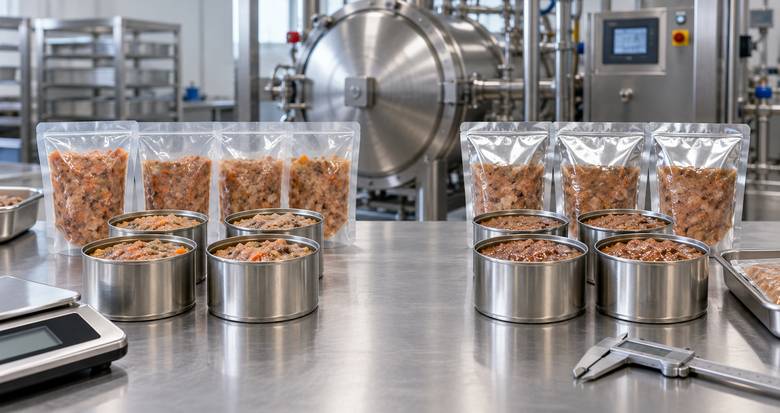
Run pilot containers only under the authorized equipment, loading pattern, container orientation, fill weight, headspace, closure and thermal program. Record pre-process product temperature and the time between filling and processing. Do not lower process severity because a candidate appears thinner, and do not approve a thicker formulation solely because the same machine recipe was used.
Research on model CMC solutions has shown that prolonged heat treatment can reduce apparent viscosity, while another study found temperature- and time-dependent changes in molecular weight and viscosity. The size of the effect depends on grade, medium, pH, oxygen, time and temperature. Therefore, compare each candidate before and after the real process instead of applying a universal retention factor.
Evaluate the cooled product at defined ages
Set the first evaluation after the product has cooled and equilibrated for a defined period. Recheck at later points that match the factory’s development plan. Use consistent opening temperature and handling. For each container, record free liquid, oiling-off, sediment, piece integrity, gravy cling, spoon or extrusion behavior, loaf release, firmness, adhesiveness, color and odor under the buyer’s approved sensory procedure.
Measure only what supports the decision. Texture-profile analysis, back-extrusion, yield stress, line spread, syneresis, drained weight, colorimetry or microscopy can help when methods are repeatable and tied to acceptance limits. Use multiple containers and batches so that one attractive sample cannot hide fill variation. Keep palatability and nutritional adequacy as separate validated programs; a CMC rheology trial cannot establish either one.
Include storage challenges justified by the product: expected warehouse temperature, transport vibration, freeze exposure only if realistic, and open-container stability only when it matches use instructions. Do not replace the shelf-life plan with an accelerated screen unless the buyer has validated the relationship.
Connect application approval to incoming QC
The final approval record should identify the CMC grade and lot, specification, certificate method, retained sample, addition basis, make-down instructions, formula version, pilot or production batch, thermal-process review, quality results, acceptance limits and approvers. Define which incoming checks release routine lots and which changes trigger a new application trial.
Typical requalification triggers include a changed CMC grade or manufacturing source, revised viscosity or degree-of-substitution range, different particle form, meaningful formula or raw-material change, new mixer or filler, different container, changed thermal process, or a new destination-market requirement. The sample to commercial batch approval workflow shows how to connect an approved laboratory sample to a representative commercial lot.
Diagnose common trial conflicts
- Fresh gravy passes but the cooled product releases water: check hydration completion, protein and salt variation, thermal history, cooling, the full hydrocolloid system and storage age.
- Suspension improves but filling becomes unstable: review product temperature, pump shear, recirculation, air, hopper geometry and the upper flow limit.
- Bench samples match but container ratios drift: investigate chunk-size distribution, feed-hopper segregation, line residence time and sampling position.
- Pre-process viscosity is high but post-process structure is low: verify test temperature and method, then examine heat exposure, pH, oxygen and interactions with the complete formula.
- Laboratory repeat passes but production varies: check powder feeding, wetting, mixing energy, hydration time, load cells, batch temperature and ingredient-lot variation.
What a technical buyer should send with an inquiry
Share the product format, target animal and market, gravy or loaf composition ranges, protein and fat system, salts and other hydrocolloids, batch and trial scale, current CMC grade and addition basis, water and mixing sequence, target temperature, hold time, pump and filler type, container, thermal-process change-control requirement, current failure mode and acceptance tests. Include non-confidential control results. If the formula is confidential, provide ranges and decision limits rather than customer identity or proprietary percentages.
Frequently asked questions
Can a CMC solution viscosity approve a wet pet food grade?
No. It is a raw-material control under a stated method. The finished system also depends on proteins, fat, salts, other gums, particles, hydration, shear, filling, heat and cooling.
Should candidates be compared at equal dosage or equal fresh viscosity?
Start at an equal declared addition basis to reveal the grade effect. If the process must meet a defined flow window, run a second documented optimization matrix. Do not combine the two comparison bases.
Does thicker gravy always improve chunk suspension?
No. Suspension also depends on particle size and density, yield behavior, time, temperature, shear and equipment. Excessive structure can make pumping and accurate filling worse.
Can the same retort schedule be assumed after changing CMC?
No. Follow the factory’s process-authority and change-control requirements. A formulation or rheology change may require review or new heat-penetration evidence. A blog or supplier data sheet cannot authorize the schedule.
When should post-process texture be measured?
Use predefined ages after cooling and equilibration, then repeat at later development or shelf-life points. Compare containers at the same temperature and handling history.
Which regulatory status applies to CMC in pet food?
That depends on the destination market, product and conditions of use. Confirm the current regulation, additive identity, specification, labeling and any maximum level with the buyer’s regulatory team. Do not use a supplier article as legal approval.
Plan a decision-ready wet pet food CMC trial
SINOCMC can review a non-confidential trial brief and discuss a food grade CMC sample for the buyer’s own wet pet food qualification. Include the format, complete hydrocolloid system, mixing and filling process, container, thermal-process change-control needs, current control and acceptance limits. Contact SINOCMC with the brief; final approval should follow the buyer’s controlled laboratory, food-safety and commercial-batch evidence.
Technical sources
- U.S. Food and Drug Administration. Guidance for Industry #235: Current Good Manufacturing Practice Requirements for Food for Animals. The guidance describes 21 CFR part 507 and notes additional requirements for some low-acid canned animal foods.
- Electronic Code of Federal Regulations. 21 CFR § 582.1745, Sodium carboxymethylcellulose. Buyers should confirm current conditions of use for the destination market and product.
- European Commission. Commission Implementing Regulation (EU) 2025/157. The regulation concerns authorization of sodium carboxymethyl cellulose as a feed additive; the buyer remains responsible for current EU conditions and labeling.
- FEDIAF. Guide to Good Practice for the Manufacture of Safe Pet Food. Its scope includes wet pet food in cans, trays and pouches and emphasizes a food-safety management system.
- Alvarenga IC, et al. The effects of guar gum and other select gums and gelling carbohydrates on appearance, texture, and heating characteristics of wet pet foods. The specific study found gum-system differences in consistency and heat-penetration metrics; its formula and process are not universal values.
- Rao MA, Walter RH, Cooley HJ. Effect of Heat Treatment on the Flow Properties of Aqueous Guar Gum and Sodium Carboxymethylcellulose Solutions. Journal of Food Science. 1981;46:896–899.
- Laine C, et al. Thermally induced degradation of NaCMC in water and effects of NaHCO3 on acid formation and charge. Food Hydrocolloids. 2018;74:32–36.