
CMC Viscosity Grades: How to Compare 1% and 2% Solution Results
A quotation says “2,000 mPa·s.” A second supplier offers “2,000 mPa·s” at a lower price. The numbers look identical, but one value was measured in a 1% sodium carboxymethyl cellulose (CMC) solution and the other in a 2% solution. These are not equivalent viscosity grades.
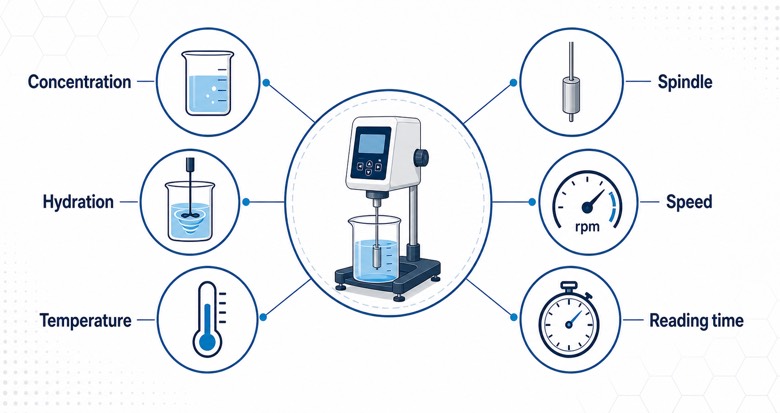
This is a common source of specification errors for food-ingredient distributors, industrial formulators, procurement teams, and incoming-quality laboratories. A CMC viscosity result is not a standalone property such as net weight. It is an apparent viscosity measured on a prepared solution under defined conditions. Change the CMC concentration, moisture basis, preparation method, temperature, instrument, spindle, speed, or reading time, and the reported value may change.
Quick answer: Do not convert a 1% result to a 2% result with a universal multiplier. First obtain the complete test method. Compare offers only after both samples are tested at the same solids basis, solution concentration, preparation procedure, temperature, instrument geometry, speed, and reading time. Then confirm the shortlisted grade in the buyer’s real formulation and process.
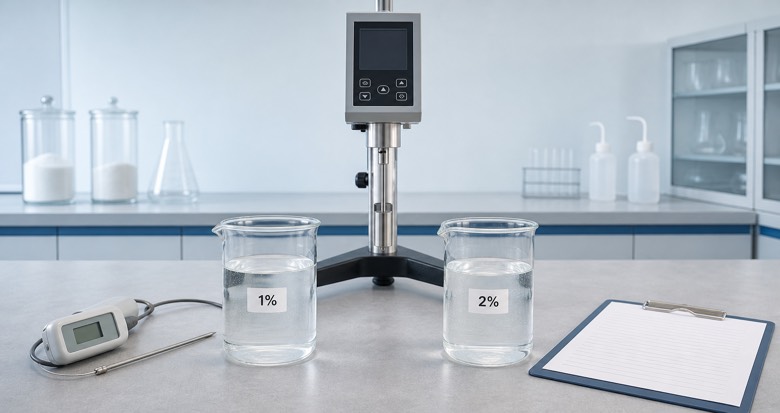
What a CMC viscosity grade actually means
Commercial labels such as low viscosity, medium viscosity, high viscosity, and ultra-high viscosity are useful only inside a stated method. They are not universal grade names. “High viscosity” at 1% may describe a very different polymer from “high viscosity” at 2%, even when both technical data sheets use the same unit.
The reported value normally refers to the viscosity of an aqueous CMC solution. It may be expressed in mPa·s or cPs; these units are numerically equivalent. The number still needs a test definition. At minimum, the report should state:
- solution concentration and whether it is weight/weight or weight/volume;
- whether the CMC quantity is calculated as received or on a dry basis;
- water quality, sample dispersion, mixing, hydration, and conditioning procedure;
- test temperature;
- viscometer type or model, spindle or measuring geometry, and speed;
- reading time or endpoint and, where relevant, the instrument’s torque range;
- replicate result and acceptance rule.
ASTM D1439 covers test methods for sodium carboxymethylcellulose, including moisture and viscosity. Its public summary also notes that moisture and purity affect the amount of active polymer used in a formulation. The International Organisation of Vine and Wine (OIV) CMC monograph similarly bases its viscosity determination on dry matter and warns that results obtained by its method are not necessarily identical to results from other instrument types.
Why 1% and 2% CMC viscosity values are not directly convertible
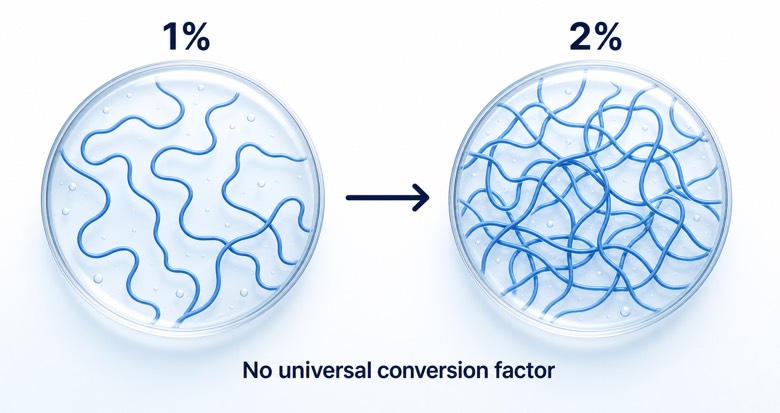
A 2% solution contains twice the CMC solids of a 1% solution only when both are prepared on the same basis. That does not mean its viscosity will be twice as high.
CMC chains occupy space in water and interact with one another. As concentration rises, the chains begin to overlap and entangle more strongly. The resulting increase in viscosity is usually nonlinear and depends on molecular weight distribution, degree and uniformity of substitution, ionic environment, temperature, and the shear applied during measurement. Two grades can therefore have very different 1%-to-2% relationships.
Many CMC solutions also show shear-thinning behavior: their apparent viscosity decreases as shear rate increases. ISO 2555 explains the broader measurement principle clearly—apparent viscosity for a non-Newtonian liquid depends on the velocity gradient used during the test. This is why spindle and rotational speed belong beside the viscosity number, not in a separate optional note.
A universal statement such as “multiply the 1% value by two” or “divide the 2% value by two” can therefore misclassify a grade. A supplier-specific correlation curve may be useful for internal screening, but it should be built from actual measurements of that grade family under controlled conditions. It should not be assumed to apply to another supplier, another molecular-weight range, or another formulation.
Why laboratories use different solution concentrations
The test concentration is usually selected so that the solution falls within a practical measurement range. A very high-viscosity CMC may be difficult to measure at 2% because the solution produces excessive resistance or is hard to prepare uniformly. A low-viscosity grade may produce too little torque at 1%, so a higher concentration is used to obtain a stable reading.
This does not make 1% inherently better than 2%. It means the chosen method must suit the material and the instrument. The OIV monograph, for example, states that the test concentration should allow measurement within the method’s viscosity limits and lists different concentration ranges for particular CMC categories. U.S. 21 CFR 182.1745 gives a separate regulatory example by specifying a minimum viscosity for a 2% by-weight aqueous solution at 25°C. These references demonstrate why concentration is part of the specification itself.
Start with the concentration basis
Weight/weight is not the same as weight/volume
A 1% w/w solution contains 1 g of CMC solids per 100 g of final solution. A 1% w/v preparation contains 1 g per 100 mL of final solution. They should not be treated as interchangeable without a validated method, especially when precise comparison is required.
Dry basis is not the same as as-received basis
CMC powder contains some moisture. If one laboratory weighs the powder as received while another corrects to dry solids, the actual polymer concentration differs. This can create a meaningful viscosity difference even when both reports say “1%.”
For a dry-basis preparation:
As-received sample mass = required dry CMC mass ÷ dry-matter fraction
Illustrative calculation: to make 500 g of a 1.00% w/w dry-basis solution, the preparation requires 5.00 g of dry CMC solids. If the lot contains 8.0% moisture, its dry-matter fraction is 0.92. The laboratory would weigh 5.00 ÷ 0.92 = 5.435 g of as-received powder and add water to a final solution mass of 500.000 g. This example explains the calculation only; the approved product method should define how moisture is measured and when the correction is applied.
The eight conditions that must match before comparing CMC COAs
- Concentration: 1%, 2%, 4%, or another level, with w/w or w/v stated.
- Solids basis: dry basis or as-received basis, including the moisture result used for any correction.
- Water: defined quality, temperature, and relevant ionic conditions. Salts and other dissolved substances can change polymer behavior.
- Dispersion and hydration: addition sequence, agitation equipment, mixing speed, mixing time, rest time, and how complete hydration is confirmed.
- Temperature: both conditioning and measurement temperature. A sample should be equilibrated rather than measured while temperature is still drifting.
- Instrument and geometry: viscometer family or model, spindle, container geometry, sample volume, and use of any guard leg or adapter.
- Speed and endpoint: rpm or defined shear rate, plus the time or stable-reading rule used to record the result.
- Data quality: suitable torque or measurement range, absence of bubbles and lumps, replicate agreement, calibration status, and rounding rule.
AMETEK Brookfield’s current accuracy guide recommends matching the spindle to the expected range, controlling temperature, allowing equilibration, keeping the sample homogeneous and bubble-free, and documenting spindle, speed, temperature, and sample preparation. These are practical controls for any buyer trying to reproduce a supplier’s rotational-viscometer result.
A buyer’s comparison matrix
Before ranking quotations, place every viscosity claim into one table. Do not fill missing cells with assumptions.
| Field | Offer A | Offer B | Buyer action |
|---|---|---|---|
| Reported viscosity | 2,000 mPa·s | 2,000 mPa·s | Do not declare equivalence yet |
| Solution concentration | 1% w/w | 2%; basis not stated | Request a complete method or retest |
| Solids basis | Dry basis | Not stated | Confirm moisture correction |
| Temperature | 25°C | Room temperature | Retest at one controlled temperature |
| Instrument settings | Model, spindle, and rpm listed | Brookfield only | Obtain spindle, speed, and endpoint |
| Commercial decision | Not comparable from the documents supplied | Use same-method testing and application trials | |
The values above are illustrative, not SINOCMC product specifications or test results. Their purpose is to show that identical digits can describe different materials when the method fields differ.
How to compare two CMC grades without guessing
Step 1: Define the application target
Describe the finished product and what CMC must do: build body, suspend particles, retain water, control ice crystals, improve binding, reduce syneresis, or support processing. Include pH, salts, sugar, protein, temperature history, shear, hydration time, target texture, and any reference grade.
Step 2: Normalize the documents
Request the technical data sheet, recent lot COA, and full viscosity method. SINOCMC’s food-grade CMC COA guide explains how viscosity fits with degree of substitution, purity, pH, moisture, and other release data. If a field is missing, mark it “not stated” rather than assuming a familiar laboratory convention.
Step 3: Run a same-method laboratory screen
Prepare both samples in the same laboratory using one written method. Record actual moisture, weights, water, dispersion observations, hydration time, temperature, instrument, spindle, speed, torque or range, reading time, and replicate results. If the material falls outside the selected instrument range, revise the method for both samples and restart the comparison.
SINOCMC’s existing food-grade CMC viscosity test guide provides a practical preparation sequence. The procurement specification should still state the exact approved version and any customer-specific differences.
Step 4: Test the real formulation
A water-solution viscosity screen cannot reproduce every effect of acid, salt, sugar, protein, surfactant, heat, homogenization, storage, or freeze-thaw conditions. Evaluate the grade at the intended addition level and with the intended process. Measure the finished product against its own quality targets, not only the raw-material CMC solution.
Step 5: Approve a specification and change-control route
After laboratory and pilot approval, write the viscosity range together with the full method or an unambiguous controlled reference. Link the approved grade, sample lot, commercial lots, COA fields, packaging, and notification requirements. For incoming inspection and disputes, use a defined sampling and retention procedure such as the framework in SINOCMC’s CMC acceptance guide.
Common purchasing mistakes
- Comparing only the largest number: a higher reported viscosity is not automatically a stronger grade when concentrations differ.
- Treating “Brookfield” as a complete method: spindle, speed, temperature, sample preparation, and endpoint still matter.
- Ignoring moisture basis: two nominal 1% preparations may contain different active-polymer solids.
- Converting by a fixed factor: concentration-viscosity behavior is grade-specific and often nonlinear.
- Approving on water viscosity alone: the finished formulation can change CMC performance.
- Changing method after approval: a new instrument or setting can create an apparent batch shift even when the material is unchanged.
What to send with a CMC viscosity inquiry
A technically useful inquiry lets the supplier recommend and quote the correct comparison grade. Send:
- application and target function;
- current or target viscosity value with the complete test method;
- finished-product pH and relevant salt, sugar, protein, or surfactant conditions;
- addition level, mixing equipment, processing temperature, shear, and hydration time;
- reference sample or reference grade, where legally and practically available;
- required food or industrial specification, destination market, trial quantity, annual demand, and packing needs.
For food applications, review the SINOCMC food-grade CMC overview. For broader supplier qualification, use the 10-point food-grade CMC buyer checklist.
Frequently asked questions
Is a 2% CMC viscosity result approximately twice the 1% result?
No universal relationship exists. CMC solution viscosity commonly increases nonlinearly with concentration, and the relationship varies with grade and test conditions. Measure both concentrations if both values are needed.
Which test concentration is better for CMC: 1% or 2%?
Neither is universally better. The method should place the sample in a reliable instrument range and should be appropriate for the agreed specification. High-viscosity grades are often tested at lower concentration than low-viscosity grades.
Can I compare two results if both use mPa·s?
Not from the unit alone. Confirm concentration, solids basis, preparation, temperature, instrument, spindle or geometry, speed, endpoint, and data-quality controls.
Are cPs and mPa·s the same?
They are numerically equivalent: 1 cPs equals 1 mPa·s. Matching units does not make different test methods comparable.
Can Brookfield and another rotational viscometer give the same CMC result?
They may correlate under a validated procedure, but equivalence should not be assumed. Geometry, shear conditions, container setup, and calculation can differ. Establish a documented method comparison before changing instruments.
Should viscosity alone decide the CMC grade?
No. Grade selection can also depend on degree of substitution and its uniformity, purity, particle form, dispersibility, acid or salt conditions, process shear, and finished-product performance.
Conclusion: compare the method before the number
A CMC viscosity value becomes useful purchasing information only when its test conditions are attached. A 1% result and a 2% result cannot be made comparable by a universal calculation. Normalize the method, test both samples under the same conditions, verify the real formulation, and then write the approved method into the commercial specification.
Need a comparable CMC recommendation? Contact the SINOCMC Team with your application, current viscosity method, pH, process conditions, trial quantity, and destination market. We can review the information needed for a technically aligned sample and quotation. Final suitability remains subject to your laboratory, regulatory, and production approval.
Authoritative references
- ASTM D1439-22, Standard Test Methods for Sodium Carboxymethylcellulose
- OIV, Monograph on Carboxymethylcellulose (Cellulose Gum)
- ISO 2555:2018, Determination of Apparent Viscosity Using a Single-Cylinder Rotational Viscometer
- AMETEK Brookfield, How to Get Accurate Viscosity Readings
- 21 CFR 182.1745, Sodium Carboxymethylcellulose