
How to Choose a Sodium Carboxymethyl Cellulose Manufacturer: 10 Checks for Food-Grade CMC Buyers
A low price per kilogram can become expensive when a shipment arrives with the wrong viscosity, inconsistent hydration, or documentation that your customer cannot accept. For food-grade sodium carboxymethyl cellulose (CMC), supplier evaluation should therefore begin with evidence—not with the quotation alone.
This guide gives food manufacturers, ingredient distributors, and procurement teams a practical way to compare a sodium carboxymethyl cellulose manufacturer or supplier. It focuses on the checks that affect formulation performance, regulatory review, delivery reliability, and total purchasing cost.
Quick answer: A reliable food-grade CMC source should be able to connect every quotation to a defined specification, a reproducible test method, valid food-safety documents, representative samples, traceable commercial lots, and a clear corrective-action process. If any of these links is missing, the apparent price advantage may not survive the first production run.
Manufacturer or supplier: which is better for CMC buyers?
“Manufacturer” and “supplier” describe different roles, and neither word proves quality by itself.
- A manufacturer controls production, process settings, in-process inspection, batch release, and often product development.
- A supplier or distributor may offer export documentation, smaller quantities, local stock, mixed shipments, flexible payment terms, and access to more than one production source.
For buyers, the important question is not which word appears in the company description. It is whether the seller can show who manufactures the CMC, where it is produced, which site is covered by the certificates, how each lot is tested, and who is responsible when a batch does not meet the agreed specification.
If a company presents itself as a manufacturer, ask for manufacturing-site documents and batch-control evidence. If it operates as a supplier, ask how the approved factory is controlled and whether the source can change without your written approval.
The 10-point food-grade CMC manufacturer checklist
| Check | Evidence to request | Warning sign |
|---|---|---|
| 1. Application definition | Grade recommendation tied to product, pH, salt, process and target texture | One grade is recommended for every application |
| 2. Regulatory identity | Specification for the destination market, product identity and purity basis | “Food grade” is stated without a referenced specification |
| 3. Certificate scope | Valid certificate, site name, address, scope and issuing body | Certificate belongs to another company or does not cover the manufacturing site |
| 4. Comparable COA | COA with viscosity method, DS, purity, pH, moisture and required contaminants | Only pass/fail results or no test conditions |
| 5. Batch consistency | Several recent lot results, control ranges and retained-sample procedure | Only one “typical” data sheet is available |
| 6. Representative sample | Sample lot linked to specification and future commercial supply | Sample cannot be traced or differs from the quoted grade |
| 7. Traceability and packing | Lot code, production date, shelf life, inner liner and storage instructions | Unclear relabeling or damaged/moisture-sensitive packing controls |
| 8. Capacity and lead time | Written production window, stock status and realistic dispatch date | Lead time changes only after the order is placed |
| 9. Commercial terms | MOQ, Incoterm, payment terms, inspection terms and claim procedure | Important conditions appear only after price confirmation |
| 10. Technical response | Named contact, trial support, change control and corrective-action process | The seller avoids technical questions or quality claims |
1. Define the application before requesting a price
A useful quotation starts with the application. “Food-grade CMC, high viscosity” is not enough information because the same viscosity label can refer to different solution concentrations and test conditions.
Give the manufacturer or supplier at least the following:
- final product, such as an acidic beverage, neutral dairy drink, sauce, bakery filling, ice cream, or processed meat;
- target function: thickening, suspension, water retention, ice-crystal control, binding, or emulsion stability;
- formulation pH and approximate salt, sugar, protein, or acid level;
- processing sequence, temperature, shear equipment, and available hydration time;
- target viscosity or reference grade, including the test method;
- trial quantity, annual demand, packing preference, and destination port.
In our export work, quotations move much faster when these details arrive with the inquiry. They also reduce the risk of comparing two prices for products that are not technically equivalent.
2. Confirm what “food grade” means in the destination market
Sodium CMC is also known as cellulose gum, sodium carboxymethylcellulose, Na-CMC, or INS 466. The FAO/JECFA specification identifies sodium carboxymethyl cellulose as INS 466 and describes commercial material that can be further specified by viscosity. The current U.S. eCFR provision for sodium carboxymethylcellulose includes a dry-basis purity requirement and recognizes its use under good manufacturing practice.
These references are useful starting points, but the purchase specification must still match the destination country, food category, customer standard, and intended use. Ask the seller to state which specification the offered grade is designed to meet. Do not accept “international standard” as a substitute for a named requirement.
For reference, see the FAO/JECFA sodium carboxymethyl cellulose entry and 21 CFR 182.1745. Buyers remain responsible for confirming applicable local rules.
3. Verify certificates—not just certificate names
ISO 9001, ISO 22000, BRCGS Food Safety, Halal, Kosher, and market-specific documents may all be relevant, depending on your customers. However, a certificate list is only the beginning.
Check four details on every certificate:
- Legal entity: Does the name match the manufacturer or the company in your supply chain?
- Site address: Is the actual production site covered?
- Scope: Does it include the relevant food ingredient or CMC activity?
- Validity: Is the certificate current, and can the issuing body be verified?
ISO 22000 sets requirements for a food-safety management system across the food chain. BRCGS Food Safety provides a framework covering product safety, integrity, legality, quality, and operational controls for food and food-ingredient manufacturing. Certification strengthens an evaluation, but it does not replace product-specific COA review and application testing.
4. Make every COA technically comparable
For food-grade CMC, the COA commonly includes appearance, viscosity, degree of substitution (DS), purity, pH, loss on drying, and relevant heavy-metal or microbiological limits. Your agreed list may be longer or shorter depending on the market and application.
The most common purchasing mistake is comparing viscosity numbers without comparing the method. A result is meaningful only when the following are defined:
- CMC concentration, for example a 1%, 2%, or 4% solution;
- water quality and preparation method;
- hydration time;
- measurement temperature;
- instrument, spindle, and speed where applicable.
A “2,000 mPa·s” grade measured in a 1% solution is not directly comparable with the same number measured in a 2% solution. Ask for the full method before deciding that two grades are equivalent. SINOCMC’s food-grade CMC viscosity testing guide explains why consistent preparation and measurement conditions matter.

5. Look beyond a single typical specification
A technical data sheet describes a product target. It does not show how tightly recent commercial batches have been controlled.
Request anonymized results from three or more recent lots for the parameters that matter to your process. Compare the actual values—not only whether each line says “Pass.” If your final product is sensitive to viscosity or acid stability, agree on a workable control range rather than relying on a very broad catalog range.
Also ask whether the supplier keeps retention samples, how long they are stored, and how a complaint is investigated. Retention samples allow both parties to compare the shipped lot with the material used in the buyer’s trial.
6. Use a two-stage sample approval process
A free laboratory sample is useful, but it should not be the final approval step.
- Laboratory screening: Confirm dispersion, hydration, viscosity, compatibility, taste impact, and stability in the intended formulation.
- Pilot or production trial: Test a larger quantity under normal mixing, temperature, holding-time, and filling conditions.
Record the sample lot number, specification version, test conditions, addition level, and result. Before the commercial order, confirm that the approved sample and the shipment are produced to the same agreed specification.
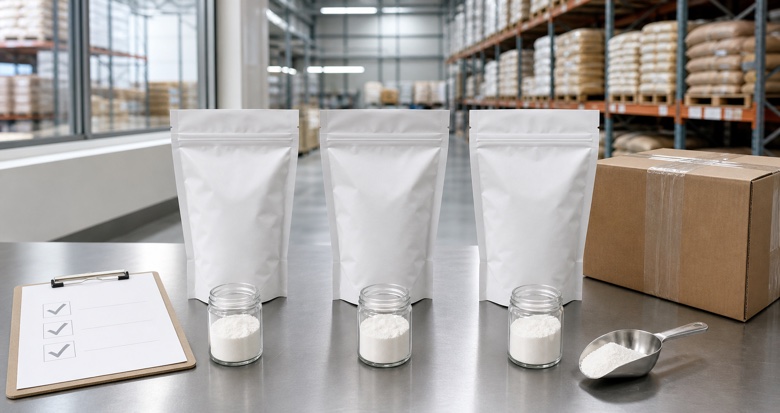
For early trials, SINOCMC can support quantities from laboratory samples to 1 kg, 5 kg, and 25 kg packs, subject to the grade and destination. The food-grade CMC trial and sample page lists the information needed to match a sample to the buyer’s viscosity, DS, and purity requirements.
7. Check DS, particle form, and application stability
Viscosity alone does not define CMC performance. Degree of substitution and substitution uniformity affect solubility and compatibility, while particle form influences dispersion speed, dust, and lump formation.
For acidic or salty systems, ask for evidence from a relevant application test—not only a neutral-water viscosity result. For fast industrial mixing, granular or instant-dispersing CMC may offer operational advantages even when its basic chemical specification is similar to a fine powder.
See SINOCMC’s overview of food-grade CMC viscosity, DS, and particle size and its DS determination method for additional technical context.
8. Audit traceability, packaging, and storage controls
Food-grade CMC is hygroscopic. Packaging and storage conditions can therefore affect handling and performance even when the material passed release testing.
Confirm that each package shows the product name, grade, lot number, net weight, production date, and shelf-life information required by your market. Check the inner liner, sealing method, pallet protection, and container-loading plan. Food-grade material should be protected from moisture, damaged bags, strong odors, and incompatible cargo.
If you need private-label packaging, agree on artwork approval, traceability markings, minimum printing quantity, and responsibility for unused bags before placing the order. SINOCMC’s CMC packaging guide shows common bag and container-loading options.
9. Put delivery and commercial conditions in writing
Price comparison should use the same delivery basis. Confirm the Incoterm, port, packing, pallet requirement, quantity tolerance, inspection cost, documentation fee, and payment condition.
Ask whether the quoted lead time means production completion, port delivery, or vessel departure. For customized grades and printed bags, request a separate timeline for product manufacturing and packaging preparation.
Flexible terms such as T/T, L/C, D/P, or open-account periods can support cash flow, but they depend on credit review, order history, country risk, and transaction structure. Treat payment terms as part of the total offer rather than assuming they apply to every first order.
10. Agree on change control and problem resolution
A professional supplier should notify the buyer before changing the manufacturing source, agreed raw-material basis, specification, test method, or packaging that could affect approval.
Before the first order, ask what happens if a lot is outside specification or fails in the agreed application test. A workable claim process should define:
- the evidence required from both parties;
- the role of retained samples and third-party testing;
- response and investigation time;
- corrective and preventive action;
- replacement, credit, or other remedy when responsibility is confirmed.
This discussion is easier before an order than after a production line is waiting for material.
A short RFQ template for faster, comparable quotations
Copy the following information into your next CMC inquiry:
- Application:
- Required function:
- Target viscosity and full test method:
- Required DS and purity:
- pH, salt, acid, protein, or other critical conditions:
- Powder, granular, or instant form:
- Required certificates and market:
- Trial quantity and estimated annual demand:
- Packing and private-label requirement:
- Destination port, Incoterm, and required delivery date:
Providing these details lets a supplier quote the lowest suitable grade instead of simply offering the lowest-priced item in its catalog.
Frequently asked questions
Is buying directly from a CMC manufacturer always better?
No. Direct production control can be valuable, but a qualified supplier may provide smaller quantities, mixed loading, export documentation, technical coordination, and flexible commercial terms. Verify the manufacturing source and quality responsibility either way.
Which documents should I request before ordering food-grade CMC?
Start with the product specification, representative COA, safety data sheet, valid food-safety and quality certificates, allergen or market declarations where required, packing information, and traceability details. The final list depends on your country and customer requirements.
How many batches should I compare?
Three recent commercial lots are a practical starting point. For a highly sensitive formulation or strategic supply agreement, review more history and agree on narrower control limits for critical parameters.
Why can two CMC grades have the same viscosity but perform differently?
The test concentration, hydration method, temperature, instrument settings, DS, substitution uniformity, particle size, and formulation environment can all change the result. Compare complete specifications and test methods, then confirm performance in your own formulation.
Can SINOCMC arrange samples and third-party inspection?
Depending on the grade and destination, SINOCMC can support laboratory samples, small trial quantities, pre-shipment samples, customized specifications, and third-party testing arrangements. Share your application and measurement method so the technical and commercial offer can be prepared without unnecessary back-and-forth.
Final recommendation
Choose a sodium carboxymethyl cellulose manufacturer or supplier by the quality of the evidence connecting its factory, specification, sample, commercial lot, and after-sales responsibility. Price still matters—especially in competitive distribution markets—but it should be compared only after the technical offers are truly equivalent.
If you are evaluating food-grade CMC for a new or existing formulation, send SINOCMC your application, viscosity test method, critical parameters, trial quantity, annual demand, and destination. We can prepare a focused grade recommendation, sample plan, and commercial quotation. Contact the SINOCMC team.