
How to Read a Food-Grade CMC COA: A Buyer’s Batch-Release Guide
A food-grade CMC certificate of analysis can look reassuring while still leaving the buyer with unanswered questions. A line may say “viscosity: pass,” but omit the solution concentration. A purity result may be reported on a dried basis while the shipment is received as-is. A batch may meet a broad regulatory identity specification yet still fall outside the tighter range approved for an acidic beverage or a filling line.
This guide explains how distributors, food factories, procurement teams, and quality teams can read a food-grade CMC COA as a batch-release document—not as a marketing sheet. It focuses on the connection between the specification, the actual result, the test method, and the buyer’s approved application.
Quick answer: Read a food-grade CMC COA in four passes. First, confirm that the document identifies the correct manufacturer, grade, and batch. Second, compare the specification column with the specification approved in your purchase contract. Third, check the actual result, unit, basis, and test method—not only “Pass.” Fourth, review the application-critical items, especially viscosity, degree of substitution (DS), purity, loss on drying, pH, and any market- or customer-specific contaminant requirements. A COA can support batch release, but it cannot replace incoming inspection or an application trial.
What a CMC COA can—and cannot—prove
A certificate of analysis records quality results for a defined material or batch. It should help the buyer answer three practical questions:
- Is this the material and batch that we ordered?
- Was it tested against the specification we approved?
- Do the reported results support release for our intended use?
A COA is not the same as a technical data sheet (TDS), safety data sheet (SDS), food-safety certificate, allergen statement, or regulatory declaration. A TDS usually describes a product range or typical properties. A COA should report results for a specific batch. An ISO, BRCGS, Halal, or Kosher certificate addresses a management system, site, process, or religious requirement; it does not replace batch-specific analytical results.
A COA also does not prove that CMC will stabilize a particular beverage, retain water in a bakery filling, or hydrate correctly in the buyer’s process. Those decisions require a representative sample and a controlled application trial.
Start with identity and traceability
Before reviewing any number, confirm that the COA belongs to the material in front of you. At minimum, the document and package information should allow the buyer to connect the following:
- product name and commercial grade;
- manufacturer or responsible releasing entity;
- batch or lot number;
- production or release date, where applicable;
- referenced specification or document revision;
- package or shipment identification;
- authorized quality approval.
The batch number on the COA should match the lot marking on the bags and the commercial documents. If a distributor repacks the material, the original manufacturing lot and the new packing lot should remain traceable. A COA with no lot number, no grade, or only a copied “typical” table should not be treated as batch evidence.
Read all four parts of every result
Most COA rows contain four pieces of information. A result is only comparable when all four are understood.
| COA field | What it tells the buyer | Review question |
|---|---|---|
| Test item | The property being evaluated | Is this the same parameter named in our approved specification? |
| Specification | The allowed range, minimum, maximum, or acceptance statement | Does it match the contract and destination-market requirement? |
| Result | The measured value or reported outcome for this batch | Is it an actual value, “Pass,” “ND,” or a less-than result? |
| Method and unit | How the result was produced and expressed | Are the method, concentration, basis, temperature, and unit comparable? |
When the method is printed only as an internal code, ask for the method title or a cross-reference to the agreed standard. The buyer does not always need the full laboratory procedure, but the conditions that materially affect comparison must be visible or available.
How to interpret the main food-grade CMC parameters
Appearance and identification
Appearance is a first screening check, not proof of chemical identity. Food-grade sodium carboxymethyl cellulose is generally described in official specifications as a white to slightly yellowish, hygroscopic powder, granule, or fibrous material. The accepted description should match the contracted form.
If the product is ordered as fine powder, granular CMC, or an instant-dispersing form, make that distinction clear in the product grade or particle-size requirement. “Appearance: conforms” does not tell the receiving team whether the physical form is correct for the dosing system.
Viscosity
Viscosity is usually the most misunderstood line on a CMC COA. The number alone is not a grade definition. At minimum, the comparison needs:
- CMC concentration, such as 1%, 2%, 4%, or another stated level;
- whether the concentration is weight/weight or weight/volume;
- water quality and preparation sequence;
- mixing and hydration time;
- measurement temperature;
- instrument type and, where relevant, spindle and speed.
A result measured in a 1% dispersion is not directly interchangeable with a result measured at 2%. Changing concentration changes polymer interaction and apparent viscosity, often by far more than a simple two-times factor. The U.S. provision in 21 CFR 182.1745, for example, refers to a 2% by-weight aqueous preparation at 25 °C, while commercial grades may be sold using other agreed methods. This is why the purchase specification must name the exact method.
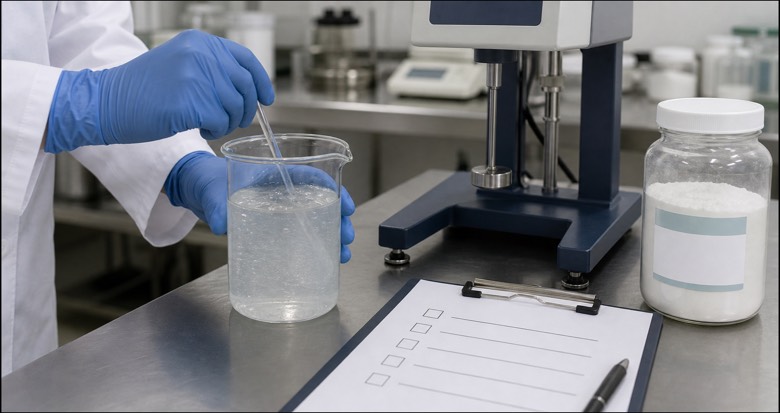
SINOCMC’s food-grade CMC viscosity testing method provides additional laboratory context. Use it as a method reference, while keeping the full buyer-approved conditions on the specification.
Degree of substitution (DS)
DS is the average number of carboxymethyl groups attached per anhydroglucose unit in the cellulose chain. It helps define chemical identity and can influence hydration, solubility, salt response, and performance in acidic systems. It is not a substitute for viscosity.
Official identity specifications do not all use the same boundary. FAO/JECFA Monograph 11 describes a DS range of 0.20 to 1.50, while the current U.S. provision includes a maximum substitution of 0.95. These are regulatory identity references, not a recommendation that every value within the broad range will perform the same way in a buyer’s formulation.
For a sensitive application, the contractual range may need to be narrower than a regulatory identity range. The agreed method also matters. See SINOCMC’s CMC degree-of-substitution determination method for the measurement principle used in an existing technical article.
Purity or assay
Purity should always be read together with its calculation basis and method. “99.5% minimum” may be reported on a dried or anhydrous basis. It is therefore not automatically the percentage of active material in an as-received bag.
In the FAO/JECFA monograph, the assay is stated on a dried basis and is calculated with reference to defined process-related components. A supplier or customer method may use different wording. Ask these questions:
- Is the result on a dried basis or as received?
- Which components are included or subtracted in the calculation?
- Does “purity” refer to assay, active polymer, or another internal definition?
- Is the specification the one required by the destination market and customer?
SINOCMC’s existing food-grade CMC purity testing article explains one laboratory approach. The COA should still state or reference the method used for the shipped batch.
Loss on drying
CMC is hygroscopic, so loss on drying is important for storage, handling, flow, and dry-basis calculations. It is a method-defined result: the sample mass, temperature, time, and endpoint affect the value. Do not compare a “moisture” value and a “loss on drying” value as if they are automatically identical.
A compliant loss-on-drying result does not rule out poor handling after release. Damaged liners, humid storage,