
Acidic Beverage CMC Troubleshooting: Sediment, Separation and Viscosity Loss
Acidic beverage CMC troubleshooting should begin with the process record, not with an immediate increase in dosage. Sediment, a serum layer, flocs, weak suspension or unexpected viscosity loss can all appear after acidification, but they do not necessarily have the same cause. A useful investigation separates four variables: CMC hydration, order and rate of addition, the beverage’s pH and protein/mineral system, and the heat-shear history.
This guide is written for beverage developers, quality teams and ingredient buyers. It does not prescribe a universal CMC dosage or imply that every acidic beverage can use the same grade. Fruit drinks, acidified dairy beverages, plant-protein drinks and pulp suspensions have different continuous phases and failure mechanisms. The objective is to identify the next controlled trial and the information a supplier needs to make a responsible grade recommendation.
First identify the defect precisely
“Unstable” is not a diagnosis. Photograph the sample against the same background and record the fill date, storage temperature and elapsed time. Then classify what is visible.
| Observed defect | First questions to ask | Useful comparison |
|---|---|---|
| Powder lumps or fish-eyes | Was CMC added too quickly? Did powder meet acid, sugar syrup or salts before wetting evenly? | Sieve the batch and compare with a fully prehydrated control. |
| Clear serum layer | Did suspended solids settle, did protein aggregate, or is the continuous phase simply too low in viscosity? | Measure layer height over time and examine the sediment. |
| Flocs or curd-like particles | Does the system contain dairy or plant protein? At what pH did particles first appear? | Run a pH ladder at the same formula and processing history. |
| Viscosity loss after acidification | Was the initial viscosity measured before full hydration? Did the sample experience different temperature or shear? | Measure pre-acid and post-acid samples with one locked method. |
| Ring, pulp sediment or floating particles | Are particle density, size and oil content different between batches? Is the issue suspension rather than protein stability? | Use matched particle loading and a time-series photo set. |
| Excess foam or air | Was the vortex pulling air? Was the sample evaluated before deaeration? | Compare density and appearance before and after controlled deaeration. |
Do not combine all of these observations into one pass/fail result. A sample can have acceptable viscosity yet still show protein flocculation. It can also look smooth immediately after production and develop sediment after heat treatment or storage. Define the defect and the time of onset before changing the formulation.
Check CMC dispersion and hydration before blaming acid resistance
Sodium carboxymethyl cellulose must first be distributed through the liquid and given enough water and time to hydrate. If the outer surface of a powder agglomerate hydrates rapidly, it can form a gel layer around dry powder. Acid, high dissolved solids and concentrated electrolytes can make recovery more difficult. The result may be visible lumps, low effective yield or misleading viscosity readings.
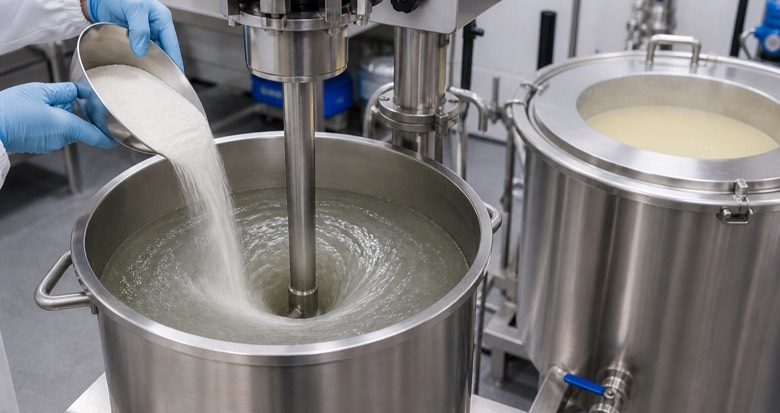
For the first diagnostic batch, use the same CMC lot and formula as the failed batch, but make the hydration step observable:
- Confirm the actual powder weight, solution concentration and dry-matter basis.
- Create adequate liquid movement before adding powder. Avoid pouring the full charge into one point.
- Record powder-addition time, mixer geometry, speed, water temperature and hydration time.
- Inspect for dry cores rather than judging only the smoothness of the vessel surface.
- Measure the hydrated solution using a locked viscosity method before introducing acid or concentrated salts.
- Add the acidic phase gradually in a repeatable way while monitoring pH and appearance.
This sequence is a diagnostic control, not a universal production instruction. A plant may use dry blending, a slurry, an eductor or a high-shear system successfully. What matters is proving that the selected method produces a repeatable, fully hydrated intermediate under the plant’s real water quality and mixing conditions.
When comparing solution results, keep concentration, temperature, instrument, spindle or geometry, speed and measurement endpoint identical. The separate SINO-CMC guide to comparing 1% and 2% CMC viscosity results explains why values from different methods should not be converted casually.
Control the order and rate of acid addition
Two batches with the same final pH can travel through very different local pH conditions. A concentrated acid stream can create a short-lived low-pH zone before the vessel becomes uniform. If CMC, protein or minerals are not evenly distributed at that moment, local aggregation may occur even though the final bulk pH looks correct.
Record both the path and the endpoint: acid concentration, addition location, addition time, agitation during dosing, batch temperature and the delay before the next operation. Then compare a slow, well-distributed addition with the current production method while holding the final pH constant. If only the controlled-addition sample improves, the next work should focus on mixing and dosing scale-up rather than changing CMC grade immediately.
Do the same for concentrated mineral salts, juice concentrates and sweetener syrups. An ingredient that changes ionic strength or available water can affect dispersion and colloidal behavior. The order should therefore be documented in the batch sheet, not left as operator memory.
Separate fruit-drink suspension from protein instability
In a non-protein fruit drink, the main questions may be continuous-phase viscosity, pulp particle size and density, oil emulsion stability and the beverage’s acid/salt load. In an acidified dairy or plant-protein beverage, the protein surface and aggregation behavior add another mechanism.
Acidified milk systems deserve particular care near the casein isoelectric region. Research on acidified protein drinks describes aggregation and sedimentation challenges around low pH and shows that hydrocolloid type and amount affect particle size, rheology and sensory properties. That evidence supports controlled formulation trials; it does not justify copying one study’s dosage into a different recipe.
Use a small pH ladder rather than one target sample. For example, prepare matched samples that differ only in final pH, using the same acid-addition rate, CMC hydration state, protein level and heat treatment. Track visible flocculation, particle size if available, serum separation, viscosity and sensory texture. If the defect occurs only in a narrow pH window, the protein-colloid interaction may be more important than bulk viscosity.
The SINO-CMC article on CMC in acidic beverages covers the general application background. This troubleshooting guide deliberately focuses on the investigation workflow. A future protein-beverage article should address full stabilizer-system design separately rather than expanding this page into another broad application overview.
Reproduce the complete heat and shear history
A bench sample that is mixed cold and observed immediately is not equivalent to a commercial beverage that is homogenized, pasteurized or sterilized, pumped, filled and stored. Temperature changes viscosity during processing and can alter protein behavior. Homogenization and high shear can improve dispersion or particle-size distribution, but excessive or poorly timed shear can also change structure and incorporate air.
Build a simple process map with actual values:
- ingredient and water temperatures;
- mixing equipment, speed and duration at each stage;
- acid and salt dosing point and rate;
- homogenization pressure or equivalent shear condition;
- heating temperature, holding time and cooling rate;
- deaeration and filling temperature;
- sample storage temperature and evaluation age.
When the defect appears only after heating, compare pre-heat and post-heat samples from the same batch. When it appears only after storage, use scheduled checkpoints rather than opening different bottles at random. A valid supplier trial should bridge laboratory and production conditions; the CMC sample approval process provides a framework for that scale-up record.
Use a one-variable troubleshooting matrix
Changing CMC grade, dosage, acid level, homogenization and heat treatment in the same trial may produce a better drink, but it will not show which change mattered. Begin with a small matrix that preserves a control.
| Trial | Variable changed | What it tests |
|---|---|---|
| Control | Current formula and process, reproduced exactly | Whether the defect is repeatable. |
| A | Fully documented prehydration | Whether incomplete CMC hydration is the main cause. |
| B | Slower, better-distributed acid addition | Whether local low-pH exposure drives the defect. |
| C | One controlled final-pH step | Whether the failure is sensitive to the pH window. |
| D | One controlled heat or shear step | Whether processing history triggers the failure. |
| E | Alternative CMC grade at equal dry dosage | Whether grade chemistry or molecular profile matters after process variables are controlled. |
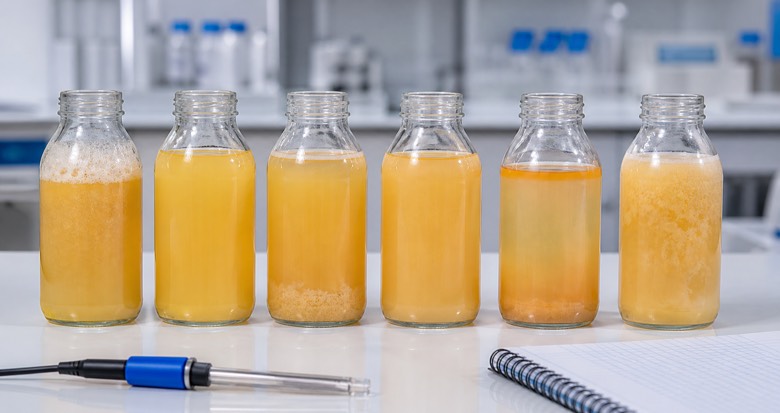
Evaluate each trial with predefined criteria. Useful measures include bulk pH, viscosity using one method, sediment or serum height, redispersibility, particle size where relevant, appearance after heat treatment and observations at planned storage intervals. Sensory assessment is important, but it should not replace physical measurements.
When a different CMC grade is a reasonable next trial
Once hydration and processing controls are stable, grade selection becomes more informative. Discuss the final beverage pH, protein type and level, soluble solids, mineral content, desired mouthfeel, heat treatment and homogenization with the supplier. Include the exact test method behind any viscosity number.
Degree of substitution, substitution uniformity and molecular-weight distribution can affect behavior, but a single certificate value does not predict every formulation outcome. SINO-CMC’s AVR overview also notes that acid-viscosity results depend on solution concentration and should be interpreted with the method. Use those data to narrow candidates, then confirm performance in the actual beverage.
For regulatory identity and permitted-use review, sodium carboxymethyl cellulose is listed by Codex as INS 466 with functional classes including stabilizer and thickener. Buyers must still confirm that the intended use and level comply with the rules that apply to the destination market and product category. A supplier recommendation is not a substitute for the manufacturer’s regulatory assessment.
What to send your CMC supplier
A useful technical request protects confidential formula details while giving enough context for a relevant recommendation. Send:
- beverage type and whether dairy, plant or other protein is present;
- target and measured pH before and after heat treatment;
- total soluble solids and important salt or mineral loads;
- current CMC grade, lot, dry dosage and addition method;
- water temperature, hydration time and mixing equipment;
- acid concentration, order, dosing time and mixing condition;
- homogenization, heating, cooling and filling conditions;
- photos and measurements at consistent storage ages;
- a retained control and, when possible, a sample of the failed batch.
Ask for a specification and sample recommendation that states the test basis. The food-grade CMC page provides the product-family context, while a commercial decision should follow controlled application trials and an agreed approval record.
Frequently asked questions
Why did viscosity fall immediately after acid was added?
Possible causes include incomplete initial hydration, local exposure to concentrated acid, a different temperature or measurement method, and a grade that is not suitable for the system. Rebuild a fully hydrated control and measure before and after acid addition using one locked method.
Should we simply add more CMC when sediment appears?
Not as the first response. Sediment may come from pulp density, protein aggregation, incomplete hydration or processing history. More CMC can change mouthfeel and cost without correcting the cause. Identify the sediment and run a controlled comparison first.
Does the final pH tell us whether the process is safe?
No. Two batches can reach the same final pH through different local-pH paths. Record acid concentration, dosing point, rate and mixing. For microbiological and regulatory safety, follow the validated controls for the specific beverage; this article addresses physical stability only.
Can the same CMC grade work in fruit juice and acidified milk?
It may perform differently because the systems contain different particles, proteins, minerals, soluble solids and process conditions. Do not assume a grade transfers directly. Compare candidates in each complete formulation.
When should heat treatment be included in the lab trial?
As early as practical when the commercial process includes heating. A cold bench sample may not reveal heat-related protein aggregation or the final viscosity after processing. Match time, temperature, cooling and shear as closely as the laboratory can support.
What is the minimum information needed for a supplier trial?
Provide beverage type, protein status, target pH, soluble solids, key salts, current CMC and dosage, hydration method, order of addition, heat and shear conditions, defect photos and the time of onset. More complete process data usually reduce unproductive trial rounds.
Turn the next trial into evidence
Successful acidic beverage CMC troubleshooting is a sequence of controlled comparisons. Define the defect, verify hydration, document the pH path, separate protein behavior from simple suspension, reproduce heat and shear, and change one variable at a time. Only then decide whether the process, dosage, stabilizer system or CMC grade needs to change.
If you are evaluating CMC for an acidic beverage, contact SINO-CMC with your process summary and target properties. We can review the information, suggest a relevant sample for your own validation and align the comparison method before a commercial order. Final formulation, safety and regulatory decisions remain with the beverage manufacturer.