
CMC in Protein Beverages: A Stability Trial Guide for Dairy and Plant-Based Drinks
CMC in protein beverages should be evaluated as one part of a complete stabilizer and process system, not as a universal cure for sedimentation. Dairy proteins, soy, pea, oat and nut ingredients do not respond identically to pH, minerals, heat or shear. A useful trial therefore starts by defining the protein system and the failure mode, then controls CMC hydration, homogenization, thermal treatment and storage before comparing grades or dosages.
Quick answer: Build one reference formula, record its protein source and level, pH, soluble solids, fat, mineral load and process conditions, and prepare matched samples that change only one variable at a time. Evaluate separation, sediment, creaming, flocculation, viscosity, redispersibility and mouthfeel at fixed checkpoints. Include the intended heat treatment and homogenization in the lab plan. Only after the process is repeatable should you decide whether CMC alone, a CMC-based blend or a different stabilizer architecture is appropriate.
This guide is for beverage developers, quality teams and ingredient buyers working with neutral or mildly acidic dairy and plant-protein drinks. Acidified milk and fruit-protein beverages have additional low-pH mechanisms; those are covered in the separate SINO-CMC guide to acidic beverage CMC troubleshooting. The objective here is to design an efficient stability trial without copying an unrelated formula or treating a certificate value as a finished beverage specification.
Map the protein beverage before choosing a stabilizer
“Protein beverage” is a commercial category, not one colloidal system. A dairy drink may contain casein micelles, whey proteins, milk fat and added minerals. A plant-based drink may contain soluble protein, insoluble cell-wall particles, starch, oil droplets and fiber. Protein fortification can increase interactions during heating and storage. Sweeteners, cocoa, flavor emulsions, salts and vitamin-mineral premixes add further variables.
Before requesting a CMC sample, document the formulation at a level that protects confidential details but still describes the system:
- protein source, supplier, declared protein content and actual use level;
- target pH before and after thermal processing;
- fat, total solids and important sugars or polyols;
- calcium, phosphate, sodium and other relevant mineral additions;
- insoluble particles such as cocoa, cereal or nut solids;
- emulsifier, other hydrocolloids and their order of addition;
- mixing, hydration, homogenization, heat treatment, cooling and filling conditions;
- packaging, storage temperature and intended shelf life.
This map prevents a common comparison error: two products may carry the same protein claim but differ in particle load, ionic environment and thermal history. A stabilizer that performs in one cannot be assumed to transfer directly to the other.
Define the instability mechanism, not just the appearance
A clear layer or bottom deposit is an observation, not a root cause. Photograph samples at the same age, temperature and lighting, then separate the possible mechanisms.
| Observed change | Questions to ask | Useful measurement |
|---|---|---|
| Fine bottom sediment | Are insoluble plant particles, cocoa or aggregated protein settling? | Sediment height, dry solids, microscopy or particle-size data where available |
| Clear serum layer | Did particles settle, or did the continuous phase separate from a weak network? | Layer height over time and redispersibility |
| Creaming or top ring | Is fat or an emulsion phase rising? Did homogenization change? | Cream layer, droplet size and homogenization record |
| Flocs or curd-like particles | Did pH, minerals or heat reduce protein stability? | pH path, heat history, particle size and visual scoring |
| Gelation or rapid viscosity rise | Is the system over-structured, or did heat promote protein aggregation? | Flow curve, pour test and pre-/post-heat viscosity |
| Chalky or heavy mouthfeel | Is the dosage or viscosity profile masking particles rather than stabilizing them? | Sensory comparison at equal temperature and shear history |
One sample can show more than one failure. For example, a plant-protein drink can have both fine insoluble sediment and a weak oil emulsion. Increasing bulk viscosity may slow settling but may not correct interfacial instability. Define which result must improve and which properties must remain unchanged.
Decide what role CMC should play
Sodium carboxymethyl cellulose is an anionic, water-soluble cellulose derivative used for functions that include thickening and stabilization. In a protein beverage, it can increase continuous-phase viscosity, influence suspension and change the beverage’s flow and mouthfeel. Under some pH and protein conditions, interactions between CMC and protein surfaces also matter. These effects depend on formulation and process; “higher viscosity” is not the same as “better stability.”
A trial should state the intended role. Is CMC being tested to slow particle settling, support an emulsion, protect an acidified protein system, modify mouthfeel or help a blend reach a particular flow profile? If several roles are required, a mixed stabilizer system may be more suitable than asking one polymer to solve every mechanism.
Do not copy a dosage from a milk, soy or cereal beverage into another formula. Published studies use specific proteins, pH values, heat treatments and equipment. Their results can identify variables worth testing, but they are not production instructions. The existing SINO-CMC page on general food-product specifications and dosage provides broad application context; the final selection still requires formulation-specific validation.
Control CMC dispersion and hydration
CMC must be distributed through water and allowed to hydrate before the trial can fairly compare its performance. If dry powder is added too quickly, the outer surface can hydrate around a dry core. High dissolved solids, concentrated salts or early contact with protein can make dispersion harder and create an apparently low yield.
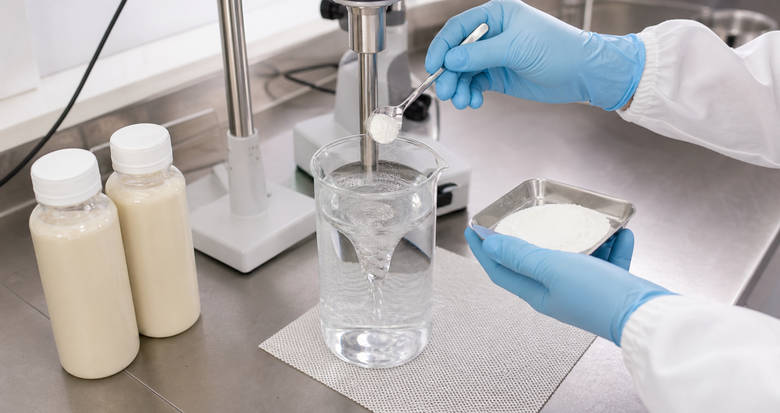
For every sample, record the actual powder weight, water temperature, mixer geometry, speed, addition time and hydration endpoint. Keep the preparation method identical across grades. If the plant uses dry blending, a slurry, an eductor or an inline high-shear mixer, the laboratory method should be selected as a reproducible model rather than assumed to be equivalent.
Measure a hydrated CMC solution only with a locked method. Concentration, dry or as-received basis, temperature, instrument geometry, speed and reading time all affect the result. The SINO-CMC guide to comparing 1% and 2% CMC viscosity results explains why one concentration cannot be converted to another with a universal factor.
Reproduce heat, homogenization and mineral stress
A cold bench sample can look uniform and still fail after pasteurization, sterilization, pumping or storage. Protein concentration, heat exposure, mechanical forces and formulation components such as salts can contribute to aggregation, precipitation, sedimentation or gelation in high-protein dairy systems. Plant proteins also change with heating and homogenization, and insoluble particles add a separate suspension problem.
Build a small process map with actual values instead of descriptions such as “high shear” or “standard heat”:
- temperature and duration of each hydration and mixing step;
- order and rate of protein, mineral, sugar, oil, emulsifier and hydrocolloid addition;
- homogenization pressure or equivalent shear condition, number of passes and product temperature;
- heating temperature, holding time and cooling rate;
- deaeration, fill temperature and package headspace;
- storage temperatures and planned evaluation days.
More pressure or more heat is not automatically better. Homogenization can reduce particle or droplet size, while excessive or poorly sequenced processing can promote new interactions or damage the desired viscosity profile. Compare pre-heat and post-heat samples from the same prepared batch so the thermal step is isolated from weighing and hydration variation.
Use a compact trial matrix with a real control
A practical first screen does not need dozens of uncontrolled samples. It needs a reference that can be reproduced and a sequence that identifies which variable changed the outcome.
| Trial | Variable changed | Question answered |
|---|---|---|
| Control | Current formula and process | Is the observed behavior repeatable? |
| A | Fully documented CMC prehydration | Was incomplete dispersion limiting performance? |
| B | One CMC grade at the same dry dosage | Does the molecular/viscosity profile change stability without changing dosage? |
| C | One controlled dosage step | Is there a useful response before mouthfeel becomes excessive? |
| D | One homogenization condition | Is particle or droplet size driving separation? |
| E | One heat or mineral condition | Does the instability appear only under commercial stress? |
| F | One defined stabilizer blend | Does a second mechanism require a complementary hydrocolloid or emulsifier? |
After the screening identifies a promising direction, confirm it with repeated batches and a narrower design. Do not combine a new CMC grade, higher dosage, different homogenization and changed heat treatment in one sample and then attribute the result to CMC.
Set acceptance criteria before looking at the bottles
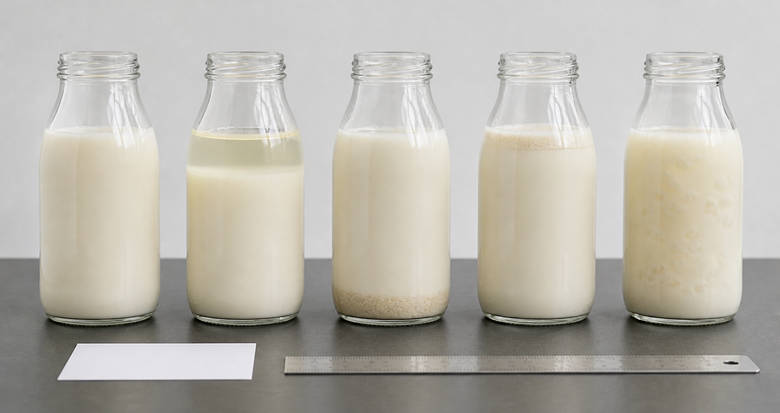
“Looks good” is not a durable release standard. Define the evaluation schedule and pass/fail limits before the trial is unblinded. A useful plan may include:
- pH before and after heat treatment;
- viscosity or flow behavior at a fixed temperature and method;
- serum, cream and sediment layer height;
- redispersibility after a defined inversion or shaking procedure;
- particle or droplet size where the laboratory can measure it reliably;
- appearance and texture immediately after processing and at planned storage ages;
- sensory checks for body, chalkiness, coating and flavor release;
- microbiological and chemical shelf-life tests under the manufacturer’s validated program.
Physical stability testing does not establish microbiological safety or regulatory compliance. Accelerated storage can compare formulations, but it should not be presented as a validated commercial shelf-life claim without an appropriate model and confirmation under the intended conditions.
Choose the next CMC sample from evidence
Once the formula and process are controlled, the supplier can make a more relevant sample recommendation. Provide the protein system, final pH, mineral load, total solids, desired flow and mouthfeel, heat treatment, homogenization and the exact test method behind any viscosity specification. Share photos and measurements from the control and the failed condition.
CMC viscosity grade, degree of substitution, substitution uniformity and particle form may affect handling and performance, but no single certificate value predicts a finished protein beverage. Compare the supplier specification with the delivered lot through the food-grade CMC COA review process, then bridge the selected lab sample through the documented CMC sample approval process.
Sodium carboxymethyl cellulose is identified by JECFA as sodium CMC/cellulose gum, INS 466. Buyers and beverage manufacturers must still confirm permitted use and level for the destination market and product category. A supplier’s technical recommendation does not replace the manufacturer’s formulation, safety or regulatory assessment.
Frequently asked questions
Can CMC prevent all sediment in a protein beverage?
No. CMC can change viscosity and suspension behavior, but sediment may consist of insoluble plant material, cocoa, mineral-protein aggregates or poorly dispersed powder. Identify the sediment and compare a controlled sample before increasing dosage.
Should dairy and plant-protein drinks use the same CMC grade?
Not by default. Their proteins, particles, oils, minerals, pH and processing histories differ. Use the same evaluation framework, but qualify each complete formulation independently.
Can a higher-viscosity CMC always improve stability?
No. Higher viscosity may slow settling, but it can also create excessive body or mask a protein or emulsion problem. Compare grades at equal dry dosage and judge physical stability together with sensory and processing requirements.
When should heat treatment be included in the trial?
As early as practical when the commercial product will be heated. A cold sample cannot demonstrate post-heat protein stability, final viscosity or storage behavior. Match the intended time, temperature, cooling and shear as closely as the laboratory can support.
Does CMC need to be combined with another stabilizer?
Sometimes. A formula may need separate support for protein protection, suspension, emulsion stability and mouthfeel. Test a defined blend only after the role of each component and the control process are clear.
What should be sent with a technical sample request?
Send the protein source and level, target pH, total solids, important minerals, current stabilizers, desired texture, CMC hydration method, homogenization, thermal process, storage conditions, defect photos and the measurements used to judge success.
Build a formulation decision, not a one-bottle demonstration
Effective use of CMC in protein beverages comes from connecting ingredient selection with the real protein, mineral, heat and shear system. Map the formula, define the failure mode, hydrate CMC reproducibly, preserve a control, introduce one change at a time and judge matched samples against predefined criteria. That process produces evidence suitable for scale-up and purchasing decisions.
If you are evaluating CMC for a dairy or plant-protein beverage, contact SINO-CMC with a non-confidential process summary and target properties. We can review the comparison method and suggest a relevant sample for your own laboratory and production validation. Final formulation, safety, shelf-life and regulatory decisions remain with the beverage manufacturer.
References
- FAO JECFA Monographs 11: Sodium Carboxymethyl Cellulose.
- Effect of Protein Content on Heat Stability of Reconstituted Milk Protein Concentrate under Controlled Shearing, Foods.
- Influence of Processing Conditions on a Millet Skim Milk Beverage, Foods.
- Stabilization of Directly Acidified Protein Drinks by Single and Mixed Hydrocolloids, Food Science & Nutrition.