
CMC Ice Cream Trials: How to Test Melt Resistance and Ice-Crystal Control
A CMC ice cream trial should separate melt resistance, ice-crystal control and eating quality instead of treating them as one result. A sample can melt slowly yet feel gummy, retain fine ice crystals yet become too hard to scoop, or perform well after freezing but fail during temperature fluctuations. The useful question is therefore not simply whether sodium carboxymethyl cellulose “works.” It is which CMC grade and level, alone or in a defined stabilizer system, gives the required balance in the actual ice cream formula and process.
Quick answer: Lock the base mix, CMC dispersion method, pasteurization, aging, freezer settings, draw temperature, overrun, hardening and storage. Compare matched batches that change one variable at a time. Measure mix flow, first-drip time, melt collected over time, shape retention, hardness or scoopability, sensory texture and evidence of ice-crystal growth after a documented temperature challenge. A slower melt is not automatically better; the winning condition must also meet processing, mouthfeel and cold-chain requirements.
This guide is written for frozen-dessert developers, quality teams and ingredient buyers. Existing SINO-CMC pages explain the general application of CMC in ice cream and provide broad food-product specification and dosage context. The purpose here is narrower: building a reproducible trial that produces evidence for formulation and purchasing decisions without copying a universal recipe.
Define the frozen dessert before choosing a stabilizer
Ice cream is a multiphase system. Ice crystals, air cells, fat droplets or fat agglomerates, proteins, sugars and the unfrozen serum phase all contribute to texture and meltdown. CMC can influence water mobility and continuous-phase viscosity, but its observed effect depends on the rest of that structure.
Before requesting a sample, record the formula and process at a level that protects confidential details while still defining the system:
- fat source and level, including whether the product is dairy, vegetable-fat, low-fat or non-dairy;
- protein source, milk solids-not-fat and any plant solids or fiber;
- total solids and the sweetener system, including sucrose, glucose syrup or other freezing-point-active solids;
- emulsifier and every other hydrocolloid, with exact use levels;
- CMC addition order, water temperature, mixer geometry, speed and hydration time;
- pasteurization, homogenization, aging, freezing and hardening conditions;
- target overrun, draw temperature, pack size and storage distribution profile;
- the defect to improve and the sensory properties that must not change.
Two mixes with the same CMC dosage can behave differently because their unfrozen water, serum solids, proteins, fat structure and air phase differ. Published ice-cream studies also use specific formulas and equipment. Their findings can identify variables worth controlling, but their exact results should not be presented as a production prescription for another product.
Separate the three questions: crystals, melting and texture
Ice-crystal control and melt resistance are related to the total structure, but they are not interchangeable measurements.
| Question | What to observe | What it does not prove alone |
|---|---|---|
| Does the product resist ice-crystal growth? | Microscopy where available, coarse or icy sensory texture, crystal-size distribution, and change after controlled storage or temperature cycling | That the product will melt slowly or survive every cold-chain excursion |
| Does the product have the intended meltdown? | Time to first drip, mass or volume collected at fixed intervals, retained shape and visual collapse | That the mouthfeel is smooth, clean and acceptable |
| Is texture acceptable? | Hardness, scoopability, gumminess, iciness, creaminess, coating and flavor release at a fixed serving temperature | That storage stability or processing performance is acceptable |
A formulation team should set pass/fail criteria for all three. Optimizing only first-drip time can reward a sample that holds its shape unnaturally or leaves a heavy coating. Optimizing only fresh smoothness can miss recrystallization during distribution.
Control CMC dispersion before judging performance
Dry CMC that hydrates around an unwetted core can form lumps and deliver less functional viscosity than the weighed amount suggests. Concentrated sugars, salts and proteins can also change the ease of dispersion. Use one documented preparation method for every trial condition.
A practical record includes the actual powder weight, dry-blend carrier if used, water or mix temperature, addition time, mixer type, speed, shear duration and hydration endpoint. If the factory uses an eductor, powder induction system or inline mixer, the laboratory method should be a reproducible model of that process rather than an undocumented hand addition.
Do not compare certificate viscosity values without the test method. Solution concentration, dry or as-received basis, temperature, instrument geometry, speed and reading time can materially change the result. The SINO-CMC guide to comparing 1% and 2% CMC viscosity explains why there is no universal conversion between methods.
Build a compact trial matrix
The first screen should identify direction, not create a large set of confounded samples. Keep enough base mix to make matched batches, and prepare the control more than once if process repeatability is not already known.
| Condition | Single intended change | Decision supported |
|---|---|---|
| Control | Current formula and current process | Is the baseline repeatable? |
| A | Documented CMC dispersion and full hydration | Was inconsistent preparation limiting performance? |
| B | One alternative CMC grade at equal dry dosage | Does the grade profile change flow, freezing or texture? |
| C | One controlled dosage step with the same grade | Is there a useful response before gumminess or process resistance appears? |
| D | One defined CMC-based stabilizer blend | Does the system need a complementary hydrocolloid or emulsifier function? |
| E | One controlled temperature challenge | Does the preferred condition retain quality under the planned stress model? |
Do not change CMC grade, dosage, emulsifier, sweetener and freezer setting in one sample and then attribute the result to CMC. After a promising condition is identified, repeat it in independent batches and narrow the comparison around the likely operating window.
Run the freezing and hardening steps as controlled operations
Mix properties are only the beginning. Freezer residence time, dasher speed, refrigeration load, draw temperature, overrun and the speed of hardening influence the structure delivered to storage. Record actual values rather than descriptions such as “normal freezing.”
- Prepare each mix from the same raw-material lots where practical.
- Use the same pasteurization, homogenization and cooling sequence.
- Age every condition for the same time and temperature.
- Freeze matched batch sizes with controlled equipment settings.
- Measure draw temperature and overrun instead of assuming they are equal.
- Fill identical containers at the same target weight and minimize delay before hardening.
- Harden and store samples in mapped positions so local freezer differences can be recognized.
A higher mix viscosity may change pumping, air incorporation or draw behavior. If overrun or draw temperature differs, the final products no longer represent a clean CMC comparison. Record the change and either correct the process or interpret the structural result with that limitation.
Use a repeatable ice cream meltdown test
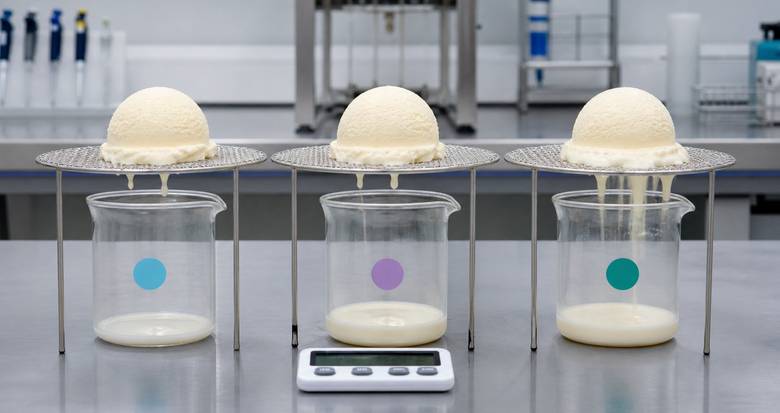
There is no single universal meltdown method for every product. Choose a method that can be repeated and that matches the decision being made. At minimum, standardize sample mass, geometry, starting core temperature, screen or support, collection vessel, test-room temperature, airflow and observation interval.
Useful records include:
- time to first visible drip;
- melt mass collected at fixed time intervals;
- percentage of the original sample melted over time;
- height or diameter loss and the pattern of structural collapse;
- appearance of the melt, including watery separation, foam or fat-rich residue;
- photos from the same position, distance and lighting.
Plotting cumulative melt against time is more informative than recording only one endpoint. A condition may delay the first drip but then collapse rapidly. Another may begin dripping earlier while retaining a more acceptable creamy melt and shape. The preferred curve depends on the product and serving context.
Challenge ice-crystal stability without inventing shelf life
Ice recrystallization is strongly affected by storage temperature and temperature fluctuation. Journal of Dairy Science studies have shown that formulation, sweetener, stabilizer and thermal history interact, and that cycling can accelerate crystal growth. This supports testing a documented cold-chain challenge; it does not support promising that one ingredient prevents all damage.
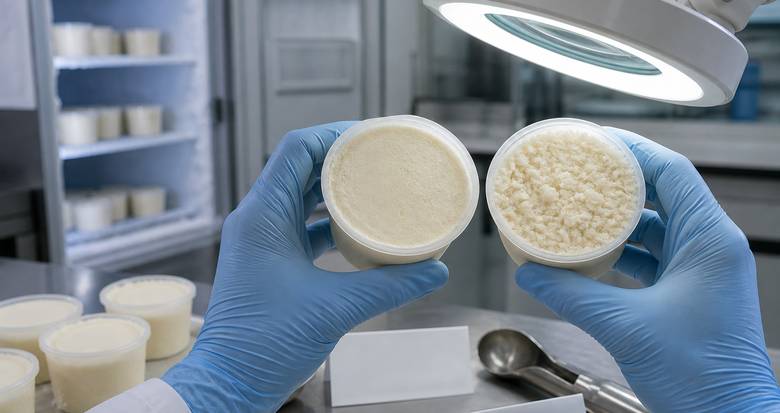
For a comparative challenge, document the storage set points, actual product temperatures, duration at each condition, number of cycles, package size and sample position. Keep an uncycled control from the same batch. Evaluate matched samples at defined ages using microscopy where the laboratory has a validated method, or use a standardized sensory and visual scale for coarseness, iciness and structural change.
Accelerated cycling is a screening tool. It may reveal relative sensitivity, but it does not by itself establish commercial shelf life, microbiological safety or performance in every distribution route. Confirm the selected formula under the intended packaging and real storage conditions.
Interpret trade-offs instead of chasing the slowest melt
Several result patterns deserve different actions:
- Slow melt, heavy or gummy mouthfeel: the structure may be overbuilt. Recheck dosage, grade, total stabilizer and serving temperature.
- Fine texture, rapid collapse: ice-crystal control may be acceptable while the fat, emulsifier, air-cell or total-solids structure needs attention.
- High mix viscosity, low or variable overrun: processing has become part of the problem. Review hydration and freezer operation before increasing dosage.
- Good fresh texture, coarse texture after cycling: hardening or temperature control may dominate, or the stabilizer system may need better thermal-shock tolerance.
- Good lab result, poor pilot result: mixing, heat transfer, shear, residence time, air incorporation or hardening rate may not have scaled proportionally.
CMC is often evaluated with other hydrocolloids, but blend behavior is formulation-specific. The existing SINO-CMC comparison of CMC, xanthan gum and guar gum provides general context. In a development program, specify the complete blend and test it against a control rather than claiming a universal synergy.
Translate the winning condition into a purchase specification
A finished ice cream result cannot be guaranteed by one certificate value. Once a condition is repeatable, connect it to incoming-material controls. Record the CMC grade, lot, dry dosage, solution-test method, degree of substitution specification, purity and any relevant microbiological or regulatory documentation. Confirm which values are release requirements and which are informational.
Review the supplier certificate through a structured food-grade CMC COA process, then bridge the selected sample through the documented sample-to-commercial-batch approval workflow. If the commercial line uses different mixing, aging, freezer capacity or hardening, plan an explicit scale-up check instead of assuming equivalence.
FAO/JECFA identifies sodium carboxymethyl cellulose as sodium CMC or cellulose gum, INS 466. That identity does not determine permitted use or maximum level in every destination market and frozen-dessert category. The manufacturer and importer should verify the applicable local regulation, labeling rule and finished-product standard.
Frequently asked questions
Does a slower melt always mean the CMC trial succeeded?
No. The sample must also meet mouthfeel, scoopability, overrun, processing and storage criteria. An excessively structured product can melt slowly and still be unacceptable.
Can melt resistance be used as a substitute for ice-crystal measurement?
No. Meltdown reflects the whole product structure, while recrystallization concerns changes in the ice phase. Use separate observations and interpret them together.
Should CMC be tested alone or in a stabilizer blend?
That depends on the formula and target. A useful screen may include CMC alone to understand its contribution and one fully defined blend to test complementary functions. Change only one planned factor at a time.
Can one CMC dosage be used for every ice cream formula?
No. Fat, protein, total solids, sweeteners, emulsifiers, other gums, overrun and process conditions change the response. Broad ranges are starting context, not a production specification.
How should temperature cycling be designed?
Use a documented, repeatable profile relevant to the expected cold chain, keep a constant-temperature control and record actual product temperatures. Treat the result as comparative evidence until real-time storage confirms it.
What information should accompany a CMC sample request?
Send a non-confidential summary of fat and protein sources, total solids, sweetener system, emulsifier and other gums, current CMC handling, pasteurization, aging, freezing, overrun, hardening, storage conditions, observed defects and the methods used to measure melt and texture.
Build evidence that can survive scale-up
The strongest CMC ice cream trial is not the one with the most samples. It is the one that holds the formula and process steady, separates melting from crystal and sensory outcomes, includes a real control, documents temperature history and repeats the preferred condition. That evidence gives formulators and buyers a defensible basis for selecting a grade and defining the next pilot or commercial run.
If you are evaluating CMC for ice cream or another frozen dessert, contact SINO-CMC with the non-confidential formulation class, process outline, target texture and current trial data. We can review the comparison method and suggest a relevant food-grade CMC sample for your own validation. Final formulation, shelf-life, safety and regulatory decisions remain with the manufacturer.
References
- FAO/JECFA: Sodium Carboxymethyl Cellulose specification record.
- Recrystallization in Ice Cream After Constant and Cycling Temperature Storage Conditions as Affected by Stabilizers, Journal of Dairy Science.
- Effect of Biopolymers on Structure and Ice Recrystallization in Dynamically Frozen Ice Cream Model Systems, Journal of Dairy Science.
- Effect of Sweetener, Stabilizer, and Storage Temperature on Ice Recrystallization in Ice Cream, Journal of Dairy Science.