
CMC in Bakery Products: A Water-Retention Trial Guide
A useful CMC bakery trial measures water retention without confusing it with softness, yield or shelf life. A bread can retain more mass after baking yet become dense. A softer crumb can result from formula or process changes that have little to do with retained water. A sample may perform well on the first day but lose its advantage during storage. The decision is therefore not whether sodium carboxymethyl cellulose “holds water” in general, but which grade and controlled use level delivers the required dough handling, baked yield and texture in the actual product and process.
Quick answer: Keep flour, water, yeast, salt, sugar, fat, emulsifiers, mixing, dough temperature, proofing, piece weight, oven profile, cooling, slicing, packaging and storage constant. Compare a repeatable control with a small number of CMC conditions that change one factor at a time. Record water addition, dough consistency, stickiness, proofing behavior, baked weight, bake loss, loaf volume, crumb moisture or water activity where relevant, and firmness at fixed storage ages. Select the condition that meets the complete specification—not simply the one with the highest water addition or softest fresh crumb.
This guide is for bakery developers, quality teams and ingredient buyers planning a reproducible comparison. Existing SINO-CMC pages describe general CMC uses in flour products and CMC in frozen dough and pastries. This article has a narrower intent: how to test water management, texture and process trade-offs before a bakery formulation or purchase specification is approved.
Define the bakery product and the real defect
“Bakery product” is not one test system. Pan bread, buns, cakes, tortillas, cookies, laminated pastries and frozen dough differ in flour strength, water level, fat and sugar, aeration, heat transfer and expected texture. A condition that helps one formula may be unsuitable for another.
Begin with a short product brief:
- product type, piece size and target finished weight;
- flour or starch system, protein level and any whole-grain, resistant-starch or gluten-free component;
- water, sugar, fat, egg, dairy solids, salt and yeast or chemical leavening system;
- emulsifiers, enzymes, modified starches and every other hydrocolloid;
- mixing equipment, dough endpoint, target dough temperature and rest time;
- forming, proofing, baking, cooling, slicing, packaging and storage conditions;
- the defect to improve: dry bite, excessive bake loss, rapid firming, stickiness, weak shape, poor volume or another defined problem;
- the attributes that must not deteriorate, such as machinability, volume, crust, flavor release or clean bite.
Turn a broad request such as “improve moisture” into a measurable question. For example: can the candidate condition reduce bake loss while keeping dough handling, finished volume and day-three crumb firmness within the approved limits? This wording prevents one attractive result from hiding an unacceptable trade-off.
Separate water retention, water activity and softness
These terms describe different things. Water retention is often inferred from formulation water, dough mass, baked mass and moisture change. Water activity describes how available water is for physical, chemical and microbial processes. Softness is a mechanical or sensory property influenced by moisture, crumb structure, starch changes, fat, emulsifiers, enzymes, packaging and storage temperature.
| Question | Useful measurement | What it does not prove alone |
|---|---|---|
| Did the process retain more mass through baking? | Scaled dough weight, cooled product weight and calculated bake loss | That the retained mass is distributed well or that the crumb will remain soft |
| Did crumb water change more slowly? | Validated moisture method at fixed locations and storage ages | Microbiological shelf life or sensory acceptance |
| Did water activity change? | Calibrated water-activity measurement at a controlled temperature | Total water content or mold-free life |
| Did texture remain acceptable? | Firmness/compression method plus blinded sensory evaluation | That the effect came only from CMC or only from water retention |
Do not make a shelf-life claim from moisture or firmness alone. Commercial shelf life also depends on hygiene, kill step, post-bake exposure, cooling, packaging barrier, preservatives where permitted, distribution and microbiological validation. A hydrocolloid trial can support a texture or water-management decision; it cannot replace the finished product’s safety and shelf-life program.
Lock the control before changing CMC
CMC is hygroscopic and forms a viscous colloidal solution in water. Its effect in dough depends on dispersion, hydration and competition for water with flour, starch, proteins, sugars, salts and other ingredients. A lumpy or partly hydrated addition can create false variability.
Document the powder weight on the chosen formula basis, whether it is preblended with dry ingredients, the addition order, water temperature, mixer type, speed, mixing time and dough endpoint. Keep the same protocol for every condition unless addition method is the single planned variable.
Certificate viscosity is not a direct prediction of dough behavior. It must be read together with solution concentration, dry or as-received basis, temperature, instrument, spindle or geometry, speed and reading time. The SINO-CMC guide to comparing 1% and 2% CMC viscosity results explains why values from unlike methods should not be converted with a universal factor.
Build a compact bakery trial matrix
Start with a screening design that answers one question per comparison. Prepare the control in duplicate when practical so ordinary mixing, proofing and oven variation can be seen before a small ingredient effect is accepted.
| Condition | Single intended change | Decision supported |
|---|---|---|
| Control | Current approved formula and process | Is the baseline repeatable? |
| A | One candidate CMC grade at a documented screening level | Does the candidate change water demand, handling or product structure? |
| B | Same grade at one adjacent controlled level | Is the response useful before excessive viscosity or gumminess appears? |
| C | One alternative CMC grade at the same dry basis | Does grade profile matter under the locked method? |
| D | Preferred CMC condition with one justified water adjustment | Can water be changed without losing machinability, volume or eating quality? |
| E | Repeat of the preferred condition on another day or raw-material lot | Is the effect robust enough for a pilot decision? |
Avoid changing CMC grade, CMC level, water, mixing time and emulsifier together. That sample may look better, but it cannot reveal which change mattered. Published bread studies use specific flours, hydrocolloid levels and processes; their results help identify variables and measurements, not a universal production recipe.
Measure dough handling before adding more water
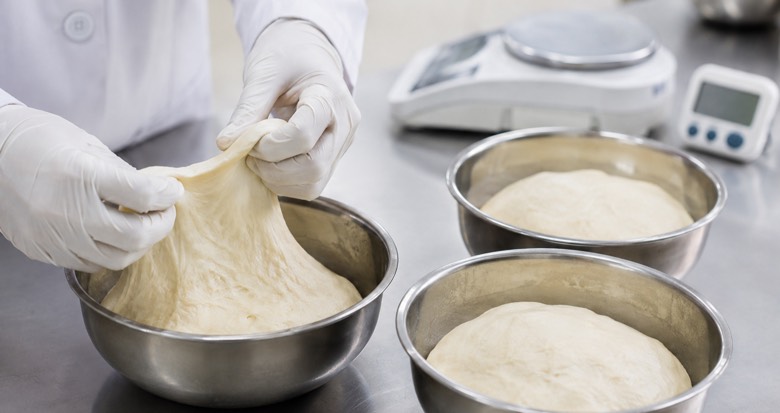
Additional formula water is not automatically usable water. The dough still has to mix, divide, round, sheet, mold, proof and transfer through the actual equipment. Evaluate water adjustments only after the control and CMC-only comparisons establish a direction.
Useful dough records include:
- actual dough temperature at the mixer discharge;
- mixing time or energy to the defined development endpoint;
- consistency, extensibility and recovery using the plant’s validated method;
- stickiness or residue on dividers, rollers, belts and hands under standardized conditions;
- piece-weight variation and ease of forming;
- proof time to a defined height or volume;
- spread, height, gas retention and signs of over- or under-proofing.
Research on modified celluloses in bread systems shows that hydrocolloids can change dough rheology and may require additional water, while frozen-dough studies report effects on fermentation and final volume that depend on hydrocolloid type and level. The practical implication is to measure both processing and the baked result. If the dough becomes difficult to machine or proof, the highest water addition is not the winning condition.
Calculate bake loss and yield on a consistent basis
Weigh pieces at the same points in the process. A simple comparison can use dough-piece mass before baking and product mass after a fixed cooling period. Calculate bake loss consistently as the mass lost during baking divided by the starting dough-piece mass, expressed as a percentage. Use the same balance, pan type, piece position, oven loading and cooling time.
Also record finished count, rejects, trimming or breakage and the mass actually suitable for sale. A lower bake-loss value is not commercially useful if the condition causes low volume, a wet line, collapse, slicing damage or unacceptable crust. Where multiple loaves or trays are produced, report the mean and range rather than selecting the best unit.
Oven temperature and humidity profiles can dominate the result. Record actual conditions and rotate positions only according to a preset plan. If the control varies widely across the oven, resolve that repeatability problem before attributing a small change to CMC.
Track crumb texture through storage
Fresh softness is only one time point. Cool, slice and package samples using the same schedule, materials, headspace and seal quality. Store them at documented conditions and test at predetermined ages relevant to the product. Do not repeatedly open one package and treat every slice as an independent storage sample.
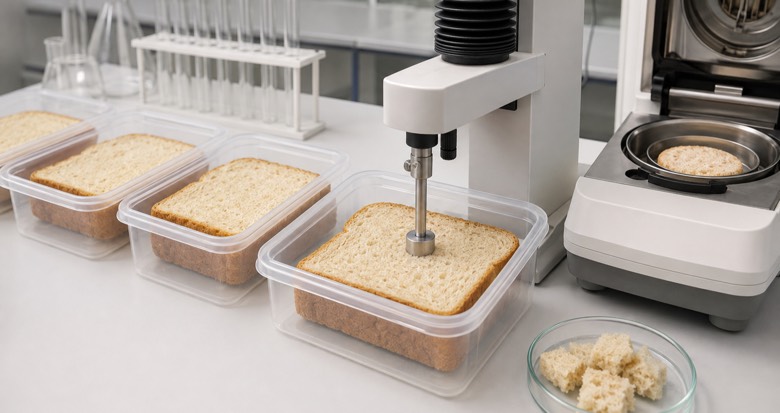
For instrumental firmness, standardize slice thickness, compression geometry, speed, strain, sample temperature and the position taken from the loaf. Pair the numbers with a blinded sensory review of softness, cohesiveness, gumminess, dryness, resilience, crust condition and flavor release. Record loaf volume and crumb-cell structure because a more open crumb can change compression results independently of water retention.
Studies of bread systems containing modified celluloses or CMC report formulation-specific changes in water loss, crumb firmness, volume or storage properties. These findings support measuring multiple attributes over time. They do not prove that every CMC grade will extend the shelf life of every bakery product.
Interpret common result patterns
- Lower bake loss, dense or gummy crumb: retained water may have been gained at the expense of structure or clean bite. Review CMC level, water adjustment, mixing and bake endpoint.
- Softer fresh crumb, rapid firming later: the condition improved the initial structure but did not control the storage mechanism that matters. Review the complete formula, packaging and starch-management strategy.
- Higher water addition, sticky machining: the water is not operationally useful at the current hydration and process settings.
- Good bench result, poor line result: mixer energy, powder dispersion, dough temperature, residence time, proofing or oven heat transfer may not have scaled proportionally.
- Good texture, reduced volume: assess fermentation, gas retention, proof endpoint and dough strength before choosing the condition.
- Variable results between days: investigate flour absorption, ingredient moisture, CMC basis, dosing accuracy and environmental conditions before widening the specification.
When another hydrocolloid or emulsifier is already present, evaluate the complete system. Wednesday’s planned CMC-versus-xanthan comparison will address gum selection as a separate search intent; this bakery article deliberately stays focused on a controlled product trial rather than declaring one hydrocolloid universally superior.
Bridge the trial to a purchasing specification
Once a preferred condition is repeated, connect the product result to incoming-material controls. Record the exact CMC grade and lot, dry or as-received dosing basis, moisture or loss-on-drying value where applicable, degree of substitution specification, purity, particle form, solution-viscosity method and relevant microbiological or regulatory documentation.
Review the lot documentation with a structured food-grade CMC COA process. Then use the sample-to-commercial-batch approval workflow to lock the formula, preparation method, acceptance measurements and change-control expectations. A commercial batch should not be accepted only because its product name matches the laboratory sample.
FAO/JECFA identifies sodium carboxymethyl cellulose as cellulose gum or sodium CMC, INS 466, and notes that the article of commerce can be specified further by viscosity. This identity does not determine permitted use or maximum level for every product and destination. The food manufacturer and importer must verify the applicable local additive standard, product category, labeling requirement and use condition.
Frequently asked questions
Does CMC always let a bakery add more water?
No. Water demand and usable water depend on flour, starch, protein, sugar, fat, other improvers and the process. Any water increase must be validated against machinability, proofing, volume, crumb, bake endpoint and storage quality.
Is lower bake loss enough to approve a CMC grade?
No. Approval should also include dough handling, finished dimensions, volume, crust, crumb structure, texture over time, sensory quality and repeatability. A heavier loaf can still fail the product specification.
Can crumb moisture predict bakery shelf life?
Not by itself. Shelf life may be limited by staling, mold, flavor change, oxidation, packaging or other factors. Use the finished product’s validated microbiological, sensory and packaging program.
How should two CMC grades be compared?
Use the same dry dosing basis, addition method, formula and process, and compare their certificates using the complete viscosity test method. Change only the grade in the direct comparison, then optimize water or level separately.
Should a bakery test CMC against xanthan gum?
Only if the formulation objective justifies that comparison. The two gums can produce different dough and texture responses. Use equal, clearly documented test logic rather than assuming equal viscosity or equal dosage means equal function.
What information should accompany a CMC bakery sample request?
Provide a non-confidential product and process outline, flour or starch system, current hydrocolloids and emulsifiers, water level, mixing and proofing conditions, baking profile, packaging, storage target, observed defect and the measurements that will decide acceptance.
Build evidence that can survive the production line
The strongest CMC bakery trial uses a stable control, changes one factor at a time, distinguishes retained mass from texture and safety, and repeats the preferred condition. It treats dough handling, bake loss, volume, crumb structure and storage texture as a connected decision rather than optimizing one number in isolation.
If you are evaluating CMC for bread, buns, cakes or another bakery system, contact SINO-CMC with a non-confidential formula class, process outline, current defect and acceptance method. We can review the trial design and suggest a relevant food-grade CMC sample for your own validation. Final formulation, shelf-life, safety, labeling and regulatory decisions remain with the manufacturer.
References
- FAO/JECFA: Sodium Carboxymethyl Cellulose specification record.
- Modified celluloses improve the proofing performance and quality of bread made with a high content of resistant starch.
- Effects of hydrophilic hydrocolloids on dough and bread performance of samples made from frozen doughs.
- Effect of hydrocolloids and emulsifiers on the shelf-life of composite cassava-maize-wheat bread after storage.
- The Effect of Carboxymethyl Cellulose Sodium on the Proofing Tolerance and Quality of Frozen Dough Steamed Bread.