
Ceramic Glaze CMC Trial: Rheology, Suspension and Firing Checks
A ceramic glaze CMC trial should prove more than whether a sample makes the glaze slurry thicker. It should show that the complete glaze can be prepared reproducibly, remain stable for the required holding time, pass through the intended application process, dry without avoidable handling damage, and deliver the required fired surface.
Quick answer: Freeze one glaze recipe, one water source, one body lot and one firing schedule. Compare the approved control with one identified CMC candidate at a time on a declared addition basis. Record hydration, solids, density, pH, temperature and shear history. Measure a relevant flow profile, settling or redispersibility, application weight, drying time and unfired adhesion. Then fire matched test pieces and inspect coverage, color, gloss, pinholes, crawling, cracks and other agreed defects. Approve the grade only against written process and fired-product limits.
This guide is for ceramic technologists, glaze formulators and technical buyers qualifying CMC for ceramic glaze slurry. SINOCMC already has a general ceramic grade CMC product page and an article on factors that influence CMC addition in glaze slurry. The article below owns a specific intent: how to design and interpret a controlled qualification trial. It does not set a universal formula, dosage, firing result or production guarantee.
Define the ceramic process and the decision
Start by identifying the actual application route: dipping, spraying, bell application, disc application, curtain coating, roller coating, screen printing, digital decoration support or another process. Record whether the target is wall tile, floor tile, tableware, sanitaryware or a technical ceramic. Note the body porosity, green or bisque-fired condition, target wet pickup, line speed, drying stage and firing cycle.
Write one decision statement before preparing samples. Examples include: replace the current CMC without increasing settling or drying time; reduce glaze-layer damage during handling; improve application uniformity while keeping pump load within the operating window; or qualify a second supply lot against the current control. Turn the statement into quantifiable acceptance conditions. “The slurry looks good” is not a release criterion.
Separate glaze-slurry and ceramic-body trials
CMC can be used in glaze systems and in ceramic bodies, but the two trials answer different questions. A glaze trial emphasizes flow, suspension, wet pickup, drying, adhesion and fired-surface quality. A body-binder trial emphasizes mixing, granulation or forming, green density, handling strength, drying and burnout. Do not combine the two applications into one approval result.
Research on low-temperature porcelain green bodies found that CMC amount, viscosity and degree of substitution affected green strength in that specific material system. This supports testing the complete body rather than transferring a glaze-slurry conclusion. If the purchasing project covers both uses, issue separate protocols and approval records.
Freeze the glaze recipe and comparison basis
Use the current approved glaze and CMC as the control. Keep frit and mineral lots where practical, solids, particle-size target, milling endpoint, deflocculant, clay or suspending agent, pigments, opacifier, water source and final density fixed. Measure water hardness or conductivity when it is known to vary. Electrolytes, soluble species and pH can change polymer and particle interactions, so a candidate should not be judged in a quietly adjusted formula.
Identify each CMC by supplier, grade, lot, physical form, moisture or loss on drying, purity basis, degree of substitution and certificate viscosity method. Compare on a declared basis – for example, as-supplied mass or active CMC solids. A viscosity result from a dilute CMC solution is not the glaze slurry’s application viscosity. The CMC viscosity comparison guide explains why concentration and method must travel with the number.
Use a trial matrix that changes one factor
When screening grades, hold the CMC addition basis constant. When optimizing level, hold the grade constant. Do not change CMC grade, level, glaze solids, deflocculant and milling endpoint in the same first-pass matrix. Prepare an independent repeat of the leading condition; dividing one slurry into two jars does not test preparation repeatability.
| Condition | What changes | What stays fixed | Decision supported |
|---|---|---|---|
| Control | Current approved CMC and level | Glaze, body, water, process and firing schedule | Establishes the production reference. |
| Candidate A | One identified CMC grade | CMC addition basis and every other ingredient | Shows the grade effect. |
| Candidate B | Second grade, or second level in a separate matrix | Solids, density, pH, temperature and shear history | Shows whether the response is systematic. |
| Repeat | Fresh batch of the leading condition | Target settings and acceptance methods | Checks preparation robustness. |
Select candidate levels from the approved formula, supplier discussion and plant constraints. Existing broad dosage pages are starting context, not production limits. Record actual weighed masses and calculate final solids after every water or additive adjustment.
Control hydration, milling and order of addition
Write a batch sheet before mixing. Include vessel geometry, batch mass, water source and temperature, mixer or mill type, speed, addition order, addition time, hydration time, milling endpoint and the stage at which CMC, deflocculant and soluble salts enter. If the plant uses a CMC solution or premix, reproduce its concentration, preparation sequence and age.
Look for dry pockets, gel particles, foam, air entrainment, wall build-up and delayed viscosity development. Screen a defined sample when agglomerates are a known risk and report the retained mass. A candidate that reaches the target only after impractical hydration or creates persistent gel particles may fail the process even if a conditioned beaker later looks acceptable.
Measure a flow profile, not one viscosity value
Glaze slurry experiences different shear conditions during storage, pumping, screening and application. Record the instrument, spindle or geometry, speed or shear rate, temperature, sample age, measurement sequence and whether results were taken on an increasing or decreasing ramp. If the factory uses a validated flow cup, keep it as an operational check, but do not treat one discharge time as a full rheological profile.
Compare agreed points such as low-shear structure, application-range viscosity, thixotropic recovery and drift over the planned holding period. A study of kaolin suspensions found that the effect of CMC depended on addition level, molecular weight and suspension-preparation procedure. Research on aqueous ceramic suspensions likewise shows that low amounts, degree of substitution and molecular mass can change viscosity, particle size and stability in the studied systems. The practical conclusion is to test the actual glaze, not to rank grades from raw-material viscosity alone.
Track settling, storage and redispersibility
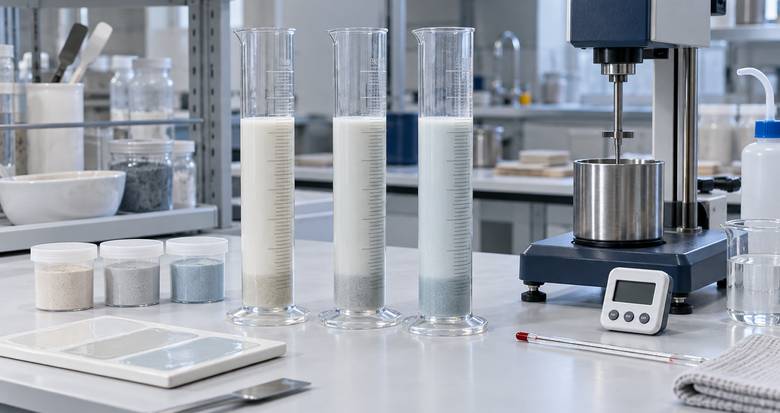
Fill identical, covered cylinders or jars to the same height and store them at a controlled temperature. At fixed times, record clear-layer height, sediment volume, interface shape, wall deposits and any odor or gas that could indicate contamination. Use the sediment’s actual holding time rather than an arbitrary overnight observation if the slurry normally remains in circulation longer.
Settling alone is not enough. Apply a defined manual inversion, stir or low-shear remix procedure and record the time or work needed to redisperse the sample. Hard sediment that will not return uniformly is different from soft, reversible settling. Recheck density, solids and viscosity after redispersion. Keep covered and open samples separate so evaporation is not mistaken for polymer response.
Apply the glaze to matched ceramic bodies
Use test pieces from the same body lot with controlled dimensions, moisture and surface condition. Randomize or blind sample order where practical. Apply each glaze with the same lab method and settings. Record body mass before application, wet pickup, dry glaze mass or calculated coat weight, number of passes, application time and environmental conditions.
Inspect flow, leveling, edge build, runs, skips, spray pattern, screen transfer or other method-specific behavior. If the application changes because the candidate requires more water or a different deflocculant setting, document that as a separate condition. Do not report it as a drop-in equivalent.
Measure drying and unfired handling
Record surface-dry time and the time to the next handling step under a defined temperature, humidity and air movement. Inspect for powdering, cracking, peeling, edge lift and glaze loss during a repeatable touch, brush, tape or handling procedure selected by the plant. Use the same interval after application for every sample.
Longer open time can improve leveling in one process but slow the line or increase damage risk in another. Strong unfired adhesion can be valuable, but an excessive binder response may change drying, organic burnout or defect formation. Approve the operating window rather than maximizing one property.
Fire matched pieces and inspect the complete surface
Fire control and candidate pieces together when possible, with recorded kiln position, loading, peak temperature, hold and cooling schedule. Include replicates across more than one location if kiln variation is meaningful. Do not attribute every fired difference to CMC before checking glaze thickness, body moisture, application uniformity and kiln position.
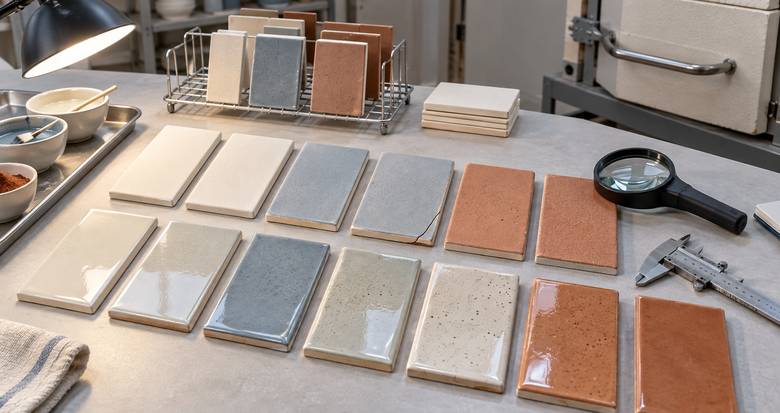
Before testing, define the visual and instrumental checks relevant to the product: coverage, color difference, gloss, surface roughness, pinholes, crawling, blisters, craters, cracks, edge defects, decoration clarity and body-glaze adhesion. Photograph under fixed lighting and retain representative pieces. If glaze fit, crazing or chemical resistance is part of release, use the factory’s applicable validated method rather than inventing a shortcut.
Diagnose common trial failures one variable at a time
- Viscosity rises during holding: check evaporation, temperature, delayed hydration, soluble salts, pH, microbial condition and shear history before changing grade.
- Acceptable viscosity but rapid settling: review particle-size distribution, density, low-shear structure, deflocculant balance and actual storage time.
- Hard sediment: verify milling, particle agglomeration, electrolyte changes and the defined redispersion procedure.
- Uneven application: inspect flow profile, screen residue, foam, density, body absorption, nozzle or applicator settings and wet pickup.
- Cracking or peeling during drying: compare layer thickness, drying rate, body moisture, adhesion, binder level and environmental conditions.
- Pinholes, crawling or color variation after firing: preserve samples and separate glaze preparation, contamination, application weight, drying, burnout and kiln effects before assigning the defect to CMC.
Change one suspected cause per follow-up and keep the approved control in the matrix. This discipline is slower than adjusting several settings together, but it produces evidence that can survive scale up and supplier review.
Bridge the selected CMC to production
A bench test cannot reproduce mill energy, tank circulation, filtration, line speed, dryer loading or kiln variation. Run the leading condition through a staged pilot or controlled production trial. Log make-down time, screen or filter pressure, slurry density and viscosity through time, tank deposits, application weight, dryer behavior, handling loss, reject rate and fired-surface checks.
Freeze the approved grade and lot criteria, addition basis, hydration procedure, glaze formula, water-quality range, milling endpoint, holding window, application settings, firing schedule and acceptance methods. Define which changes require requalification. The broader sample to commercial batch approval workflow explains how to preserve the evidence chain from the lab sample to purchasing.
What a technical buyer should send with an inquiry
Share the ceramic product type, glaze and body route, application method, batch and trial scale, solids and density, water-quality range, pH, milling and mixing equipment, holding time, current CMC grade, target flow method, drying conditions, firing cycle, current failure mode and release criteria. If the formula is confidential, provide ranges and the decision criteria rather than customer identities or proprietary details.
Ask the supplier for a clearly identified sample lot, certificate with test methods, physical form and particle-size information when relevant, moisture or loss on drying, purity basis, degree of substitution, viscosity method and hydration guidance. A useful sample is one that can be traced into a reproducible glaze trial.
Frequently asked questions
Can I approve ceramic grade CMC from certificate viscosity alone?
No. Certificate viscosity is a raw-material value under a stated solution method. Glaze performance also depends on solids, particles, soluble salts, water quality, pH, shear, body absorption, application and firing.
Should candidate CMC grades be compared at equal mass?
Use a declared and justified basis. Equal as-supplied mass is simple, but active solids may differ when moisture or purity differs. Record weighed mass and calculated active basis so the comparison can be reproduced.
Is the highest glaze viscosity the best result?
No. Excessive viscosity can hurt pumping, screening, application, leveling and drying. The useful condition balances suspension and adhesion with the process flow and fired-surface requirements.
How long should a settling test run?
Use the real holding and circulation window as the minimum decision context. Fixed readings at several times are more informative than one final photograph. Include redispersibility and post-redispersion viscosity.
Can fired test tiles replace a production trial?
No. Test tiles can screen surface and application responses, but they do not reproduce full-scale mixing, circulation, filtration, line speed, drying load, kiln loading or process variation.
Should ceramic body CMC use the same protocol?
No. A body trial needs its own forming, green density, handling strength, drying and burnout checks. Evidence from a glaze-slurry trial should not be transferred automatically to the body application.
Plan a decision-ready ceramic glaze CMC trial
SINOCMC can review a non-confidential trial brief and discuss a ceramic grade CMC sample for your own qualification. Include the glaze application, formula ranges, water quality, solids, flow method, holding time, drying and firing conditions, defect limits and current control grade. Contact SINOCMC with the brief; final approval should follow your factory’s controlled tests and commercial-batch evidence.
Technical sources
- Benchabane A, Bekkour K. Influence of deagglomeration and carboxymethyl cellulose binders on rheological behaviour of kaolin suspensions. Applied Clay Science. 2003;23:257-264. The study shows effects of CMC molecular weight, level and preparation procedure in its kaolin systems.
- Cerrutti BM, Zambon M, Megiatto JD Jr, Frollini E. Synthesis of carboxymethylcelluloses with different degrees of substitution and their performance as renewable stabilizing agents for aqueous ceramic suspensions. Industrial Crops and Products. 2017;108:730-740. Results apply to the studied alumina suspensions and are not universal glaze limits.
- Kume S, Nonaka H, Taniguchi H, Niijima S, Nishimura M. Strengthening of Low-Temperature Sintering Porcelain Green Body Using Carboxymethyl Cellulose. Journal of the Society of Materials Science, Japan. 2021;70:926-930. The work supports separate body-specific testing.
- Andreola F, Pozzi P, Romagnoli M. Rheology of ceramic glaze suspensions for single firing: study of the influence of additives. Boletin de la Sociedad Espanola de Ceramica y Vidrio. 1999;38(3). The study addresses concentrated glaze suspensions and additive-dependent rheology.
- Spray-drying research in the Journal of the European Ceramic Society. Optimization of the rheological properties of alumina slurries for ceramic processing applications, Part II. 2001;21:493-506. It illustrates why binder compatibility, slurry viscosity and green-body results must be assessed together in the studied process.