
Oil Drilling CMC Qualification Trial: Rheology, Salt Tolerance and Fluid Loss Checks
An oil drilling CMC trial should prove that a candidate controls filtration and supports the required drilling-fluid rheology after realistic mixing, salinity and aging—not merely that its certificate carries an oilfield label. Qualification must connect an identified sample lot to the buyer’s base fluid, preparation method, test equipment, acceptance limits and commercial-batch release plan.
Quick answer: Freeze one base-fluid recipe and one test method. Compare the approved control with one identified CMC candidate at the same declared addition basis. Prepare fresh-water and relevant salt-water systems, record hydration and rheology, measure filtration under the agreed procedure, age the fluids at a temperature and time justified by the operation, then repeat the critical measurements. Approve only when the laboratory result, repeat preparation and commercial-batch evidence all meet written limits.
This guide is for drilling-fluid laboratories, oilfield chemical distributors and technical buyers evaluating CMC for water-based drilling fluids. SINOCMC already publishes a broad oil drilling grade CMC and PAC product page, an introduction to CMC-LV and CMC-HV in API 13A, and general articles on oilfield functions. This article owns a narrower intent: how to build a controlled, decision-ready qualification trial. It does not reproduce a standards table, prescribe one mud formulation or claim that a laboratory result predicts every well.
Define the fluid system and the purchase decision
Start with the intended system, not the polymer name. Record the water source, salt type and concentration, clay or other solids, weighting material, pH-control agents, dispersants, lubricants, bridging materials and any other polymer. State whether the candidate is being evaluated primarily as a filtration-control additive, a viscosifier, or both. A CMC that is appropriate for one fresh-water fluid may not provide the same balance in a high-salinity or highly solids-loaded system.
Write the decision before mixing. Examples include qualifying a second source against an approved control, screening a lower-viscosity grade where fluid loss is the main need, screening a higher-viscosity grade where carrying capacity matters, or confirming a new lot against an existing specification. Convert that decision into numerical limits and observable failure criteria. “Good salt tolerance” is not a release specification.
Use the contractual standard and edition
API Specification 13A and ISO 13500 address drilling-fluid materials, including technical-grade low-viscosity and high-viscosity CMC. ISO 10414-1 addresses field testing of water-based drilling fluids. These documents serve different purposes: a raw-material classification or conformance test is not the same as a finished-fluid qualification in the buyer’s formulation.
Identify the standard, edition, corrigenda and any buyer-specific method on the purchase specification. Do not copy a limit from an old brochure or an unlicensed summary and assume that it governs the current contract. Where a supplier certificate reports viscosity or filtration, obtain the preparation, apparatus, speed, temperature, aging and calculation details needed to interpret the number.
Freeze the base fluid before comparing candidates
Use the current approved formulation as the control. Hold water chemistry, solids lots, ingredient order, mixing equipment, mixer speed, addition time, total shear, hydration time, temperature and final volume constant. If the field system uses brine, calcium-bearing water or another challenging phase, include that chemistry in the laboratory plan instead of approving from deionized water alone.
Identify each CMC by supplier, grade, lot, physical form, moisture or loss on drying, purity basis, degree of substitution and certificate test method. Compare on a declared basis—for example, as-supplied mass or corrected dry mass—and record the calculation. The CMC viscosity comparison guide explains why concentration, temperature, instrument geometry and speed must travel with every viscosity result.
Build a matrix that answers one question at a time
When screening grades, hold the CMC addition basis constant. When optimizing addition, hold the grade and lot constant. Include a fresh independent preparation of the leading condition; two aliquots taken from the same mixer do not test preparation repeatability.
| Condition | Purpose | Variables held fixed | Decision supported |
|---|---|---|---|
| Blank | Base fluid without the candidate where the protocol permits | Water, solids, mixing and test sequence | Shows the base-fluid response. |
| Control | Current approved CMC grade and lot | Addition basis and full formulation | Defines the operating reference. |
| Candidate | One identified CMC grade and lot | All non-CMC ingredients and procedures | Shows the candidate effect. |
| Saltwater | Relevant electrolyte condition | CMC identity, solids and test method | Checks performance in intended salinity. |
| Repeat | Fresh preparation of the leading condition | Target settings and acceptance methods | Checks make-down robustness. |
| Aged | Leading fluids after the specified aging history | Container, temperature, time and cooling method | Checks retained performance. |
A fresh-water, moderate-salinity and higher-salinity sequence can be useful when those conditions match the intended operation or contractual material test. It is not automatically the correct matrix for every fluid. Choose water chemistry from the real application and record ion source, concentration, preparation route and verification method.
Control dispersion and hydration
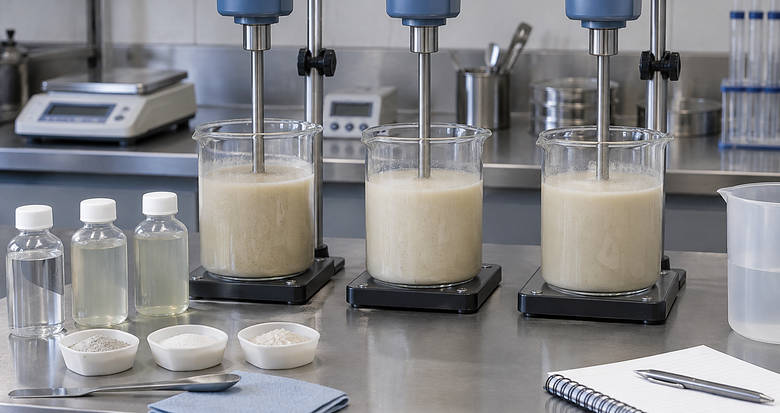
Write the preparation sheet before weighing. Include vessel geometry, batch size, water temperature, impeller type, mixer speed, powder addition rate, location of addition, total mixing time, rest period and final dilution. Record whether salts and solids were added before or after the CMC. Local high concentration, poor wetting or premature electrolyte contact can create gel particles and make a capable polymer look inconsistent.
Observe dusting, floating powder, fish eyes, wall deposits, foam and delayed viscosity. If the physical form is part of the purchase decision, compare it under the plant’s actual charging constraints. Do not silently increase shear or hydration time for one candidate. A product that meets the final number only after an impractical make-down step may still be a poor commercial fit.
Record rheology as a profile, not one number
Use the laboratory’s defined rotational-viscometer procedure and report the instrument, rotor-bob geometry, speeds, sample temperature and timing. Preserve the actual dial readings or instrument output before calculating any reported parameters. Depending on the governing method, the decision may consider high- and low-shear response, apparent or plastic viscosity, yield-related behavior and gel development.
Interpret these results against the operating objective. More viscosity is not automatically better. Excessive low-shear structure can complicate pumping or solids control, while insufficient response can reduce suspension and hole-cleaning support. CMC-LV and CMC-HV names describe material classes or commercial positioning; they do not replace a finished-fluid performance window.
Measure filtration with the full method attached
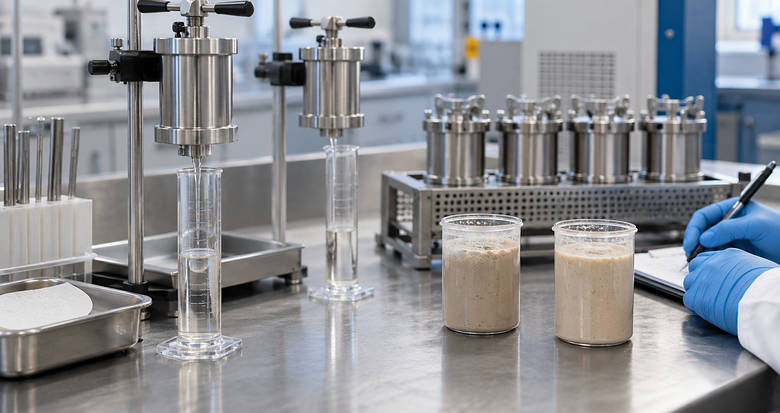
Record cell type, pressure differential, test temperature, medium, duration, starting volume, filtrate volume and any procedural deviations. Inspect the filter cake using a predefined description or measurement where the method allows. Keep observations such as spurt, cloudy filtrate, cracking, edge leakage or an irregular cake separate from the reported filtrate volume.
Use the same apparatus condition and consumables for control and candidate. Check seals and calibration before blaming the polymer for an anomalous result. A lower filtrate value in one fresh fluid is useful screening evidence, but it does not establish wellbore stability, formation compatibility or field economics by itself.
Apply aging that represents the decision
Select aging temperature, duration, motion and pressure capability from the intended operation, buyer procedure and safe equipment limits. Record the time to temperature, actual temperature history, cooling route and time between cooling and measurement. Never use equipment outside its rated temperature or pressure.
After aging, remix only as the method directs and repeat the critical rheology and filtration measurements. Compare absolute results and change from the fresh condition. Inspect separation, settling, gel structure, odor or color changes only as descriptive evidence; visual stability alone is not proof of chemical or thermal stability.
Challenge contaminants only when they matter
Calcium, magnesium, cement, drilled solids, brine composition and other additives can change a water-based fluid. Add a contaminant challenge only when it represents a foreseeable field condition or a buyer requirement. Define the contaminant identity, amount, addition point and conditioning before testing.
Do not combine salinity, solids loading, temperature and multiple chemical changes in the first screen. If a candidate fails a complex system, return to a structured sequence to determine whether the cause is hydration, electrolyte compatibility, solids interaction, another additive or the test method.
Diagnose common trial failures
- Lumps or delayed viscosity: check powder addition rate, order of addition, local concentration, water temperature, electrolyte timing and mixer energy.
- Fresh rheology passes but aged rheology drifts: verify aging history, evaporation or leakage, sample cooling, remix procedure, contamination and thermal demand.
- Filtration result varies between repeats: inspect cell seals, filter medium, timing, pressure stability, sample homogeneity and operator sequence.
- Saltwater result falls sharply: confirm salt identity and concentration, water preparation, hydration before salt exposure and the intended basis of comparison.
- High viscosity with poor filtration control: do not assume the test is contradictory; viscosity and filtration response are different decision dimensions.
- Certificate and laboratory disagree: compare methods, sample basis, conditioning, instrument settings and calculation before concluding that the lot is out of specification.
Change one suspected cause per follow-up and retain the approved control. This produces evidence that purchasing, the mud laboratory and operations can audit.
Separate material conformance from system performance
A supplier certificate can show that an identified lot was tested against stated raw-material properties. The buyer’s mud trial shows how that sample behaves in a defined system. Both matter, and neither should be presented as the other.
If API 13A or ISO 13500 conformance is contractual, state the applicable product category, edition, test methods, acceptance limits, certificate requirements and any independent verification. Do not infer certification from a website phrase, a generic oilfield grade name or a single in-house fluid test. The CMC certificate-verification guide provides a separate document and scope review.
Bridge the approved sample to a commercial batch
Preserve a retain sample and the complete record: supplier, grade, lot, container, sampling date, moisture basis, preparation sheet, raw instrument output, calculations, photos, deviations and sign-off. Define which material properties and finished-fluid checks will be repeated on the first commercial batch.
Commercial approval should specify grade identity, acceptable physical form, packaging, certificate fields, sampling plan, raw-material limits, make-down window, base-fluid formula, salinity range, fresh and aged test methods, release limits and rules for deviation or requalification. The sample to commercial batch approval workflow explains how to keep sample identity and decision evidence connected through scale up.
What a technical buyer should send with an inquiry
Share the water source and salinity range, fluid type, solids and other additives, intended CMC role, current control grade, preparation equipment, test standards and editions, fresh and aged temperature window, rheology and filtration limits, packaging needs and target volume. If the formulation is confidential, provide ranges and decision limits rather than customer names, well names or proprietary data.
Ask the supplier for an identified sample lot, certificate with test methods, physical form, moisture or loss on drying, purity basis, degree of substitution, viscosity method, preparation guidance and the exact material category being offered. Trace the same sample through the qualification record.
Frequently asked questions
Can oil drilling grade CMC be approved from its certificate?
No. A certificate supports lot identity and reported raw-material properties. Approval also requires the buyer’s defined fluid system, preparation, rheology, filtration, aging and repeatability checks.
Should CMC-LV and CMC-HV be compared at the same dosage?
An equal-addition screen can reveal grade effects, but it may not identify the best operating window. Keep grade screening and dosage optimization as separate matrices, and record whether the basis is as supplied or corrected dry mass.
Is fresh-water testing enough?
Only when fresh water represents the intended use and purchase specification. Include the relevant brine or contaminant condition when the operation or contract requires it.
Does a lower filtrate volume prove better field performance?
No. It is one controlled laboratory response. The decision must also consider rheology, cake observations, solids and additive compatibility, aging, operational limits and the buyer’s field-validation process.
Can one aging temperature qualify every well?
No. Aging conditions should be justified by the intended service, applicable procedure and safe equipment limits. Evidence from one condition should not be generalized to a more severe environment.
When should a lot be requalified?
Define triggers in the approval plan. Typical triggers can include an out-of-limit receiving test, material or process change, new supplier site, unexplained fluid drift, major formulation change or movement beyond the approved salinity and temperature window.
Plan a decision-ready oil drilling CMC trial
SINOCMC can review a non-confidential test brief and discuss an oil drilling grade CMC or PAC sample for your own qualification. Include the base-fluid composition, salinity, preparation, test standards, fresh and aged conditions, decision limits and sample-volume requirement. Contact SINOCMC with the brief; final approval should follow your laboratory’s controlled methods and commercial-batch evidence.
Technical sources
- American Petroleum Institute. API Standards. Obtain the licensed, contractually applicable edition of API Specification 13A and confirm current errata or addenda before using its material requirements.
- International Organization for Standardization. ISO 13500, Petroleum and natural gas industries — Drilling fluid materials — Specifications and tests. Use the edition named in the purchase contract.
- International Organization for Standardization. ISO 10414-1, Petroleum and natural gas industries — Field testing of drilling fluids — Part 1: Water-based fluids. This supports controlled fluid testing; it does not supply a universal supplier-approval limit.
- ASTM International. ASTM D1141, Standard Practice for the Preparation of Substitute Ocean Water. Use only when a defined substitute-ocean-water preparation is relevant to the laboratory program.