
Textile Sizing CMC Trial: Pickup, Hairiness and Weaving Checks
A textile sizing CMC trial should prove that the candidate protects warp yarn through weaving without creating an impractical size kitchen, brittle yarn, excessive deposits or difficult desizing. A beaker viscosity match is only the start. The decision should connect CMC preparation, size-box control, yarn pickup, hairiness, abrasion and tensile behavior to a controlled loom trial and downstream removal.
Quick answer: Freeze one yarn lot, one base size recipe and one sizing route. Compare the approved control with one identified CMC candidate at a time on a declared solids basis. Record solution preparation, temperature, viscosity method, pickup and moisture. Test hairiness, breaking force and elongation, an agreed abrasion response, loom breaks and deposits, then verify desizing on the actual fabric route. Approve only against written laboratory, weaving and downstream limits.
This guide is for textile mills, sizing technicians and technical buyers qualifying CMC for cotton warp sizing. SINOCMC already publishes broad introductions to how CMC works in textile sizing and the use of CMC in textile printing and dyeing. This article owns a specific intent: how to design a controlled warp-sizing qualification. It does not prescribe a universal dosage, claim a guaranteed loom result or transfer evidence from one yarn and machine to another.
Define the yarn, loom and approval decision
Start with the yarn system: fiber type and blend, count system and nominal count, twist, spinning route, package condition, warp density, weave construction and loom type. Record the current unsized-yarn strength, elongation, unevenness and hairiness where available. The same sizing recipe can behave differently on compact-spun cotton, open-end yarn, blends or filament-containing warps.
Write one Decision-making instruction before preparing the size. Examples include: qualify a second source without increasing warp stops; reduce hairiness while retaining elongation; replace part of an existing blend without changing desizing; or approve a new lot against the current control. Translate the statement into numerical or clearly observable limits. “Runs well” is not a reproducible release criterion.
Keep printing-paste and warp-sizing trials separate
CMC may be used in warp sizing, printing pastes and selected finishing systems, but these applications impose different shear, film, color, wash-off and compatibility requirements. A printing-paste trial emphasizes rheology, screen or jet transfer, edge definition, color yield and wash-off. A warp-sizing trial emphasizes yarn wetting, penetration, surface film, flexibility, abrasion protection, weaving and desizing.
Do not approve a textile grade CMC for warp sizing solely because it thickens a printing paste. Likewise, a successful warp trial does not establish suitability with a reactive-dye printing recipe. Use separate protocols, samples and release records.
Freeze the base recipe and comparison basis
Use the current approved size formulation as the control. Hold the yarn lot, water source, solids target, starch or PVA components, wax or lubricant, defoamer, preservative, mixing equipment and cooking sequence constant. Record water hardness or conductivity when it varies. Electrolytes, pH and other polymers can change CMC hydration and solution behavior.
Identify each CMC by supplier, grade, lot, physical form, moisture or loss on drying, purity basis, degree of substitution and certificate viscosity method. Compare on a declared basis, such as as-supplied mass or active CMC solids. The CMC viscosity-method guide explains why concentration, temperature, spindle and speed must travel with the number.
Use a matrix that changes one factor
When screening grades, hold the CMC addition basis constant. When optimizing addition level, hold the grade constant. Do not change CMC grade, starch ratio, lubricant, squeeze pressure and machine speed together in the first comparison. Prepare an independent repeat of the leading condition; two portions from the same size kettle do not test preparation repeatability.
| Condition | What changes | What stays fixed | Decision supported |
|---|---|---|---|
| Control | Current approved CMC and level | Yarn, recipe, preparation and sizing settings | Defines the operating reference. |
| Candidate A | One identified CMC grade | CMC solids basis and all other ingredients | Shows the grade effect. |
| Candidate B | A second grade, or a second level in a separate matrix | Water, temperature, shear and test methods | Shows whether the response is systematic. |
| Repeat | Fresh preparation of the leading condition | Target settings and acceptance methods | Checks make-down robustness. |
| Unsized | No size application where the protocol permits | Same yarn lot and conditioning | Shows the treatment response, not production approval. |
Select candidate levels from the current mill recipe, supplier discussion and equipment limits. Record every weighed mass and calculate final solids after water or additive correction. A supplier brochure is useful for screening; it is not a plant acceptance limit.
Control CMC hydration and size-kitchen preparation
Write the batch sheet before mixing. Include vessel geometry, batch mass, water quality and starting temperature, impeller type, speed, powder addition rate, order of addition, cooking or holding temperature, mixing time and final dilution. If CMC is combined with starch, PVA or another polymer, document when each component enters and whether the blend is prepared separately.
Inspect for dry pockets, gel particles, foam, wall buildup, incomplete dissolution and delayed viscosity. Screen a defined sample if retained agglomerates are a known risk and weigh or grade the residue. A candidate that reaches the target only after impractical mixing or creates persistent gel particles may fail before it reaches the slasher.
Measure solution condition at the point of use
Record solids, temperature, pH and a viscosity result using the mill’s defined method. Sample the make-down vessel and, when practical, the feed to the size box. Note the age of the solution and whether it was recirculated, reheated or diluted. One cold laboratory viscosity cannot represent a hot, sheared and aging production liquor.
Also record filtration or screen behavior, foam persistence and visible deposits. If the candidate changes pump load, flow stability or replenishment frequency, treat that as part of the qualification rather than adjusting the process silently.
Calculate size pickup instead of relying on bath viscosity
Determine size add-on or pickup using the mill’s validated mass or extraction approach and state the basis clearly. Condition samples consistently before weighing. Record squeeze pressure, yarn speed, bath temperature, immersion path, moisture at exit and drying conditions because they influence deposition and penetration.
Recent research on cotton warp sizing shows that wet-zone tension, squeeze pressure and machine speed can materially change size add-on, abrasion response, breaking behavior and hairiness in the studied system. That evidence supports controlling machine settings; it does not create universal target numbers for factory.
Test hairiness, strength, elongation and abrasion together
Condition unsized, control and candidate yarns under the same laboratory environment. Use the same instrument, specimen length, speed and number of replicates. ISO 2062 provides methods for single-end breaking force and elongation using a constant-rate-of-extension tester. Report both central tendency and variation; one best specimen is not representative.
For hairiness, record the instrument, sensing threshold, yarn length and speed. For abrasion, use a mill-validated yarn method or a clearly described simulation that correlates with the loom. A lower hairiness count is useful only if the yarn retains adequate elongation and the size film survives repeated contact. Excess pickup can increase stiffness or make a surface-rich film that abrades away without useful penetration.
Check adhesion, flexibility and shedding
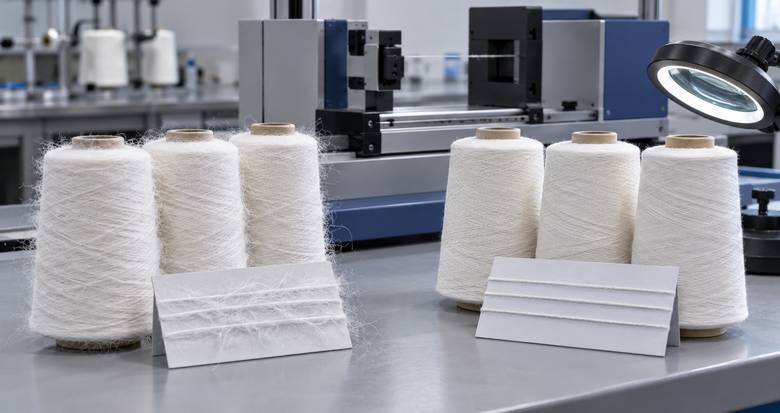
Inspect sized yarn under magnification for coverage, loose fibers, cracks, flakes and fused groups. If the mill uses a film test, prepare control and candidate films at the same solids, drying and conditioning history. Compare flexibility and break behavior, but do not treat a free film as a complete substitute for yarn adhesion and penetration.
Run a defined rub, flex or simulated-loom sequence and collect visible shed where practical. Record deposits on guides, heddles or reeds during the pilot. Low laboratory hairiness with high machine deposits is not a successful outcome.
Run a controlled pilot weaving trial
Take the leading conditions to a pilot beam or controlled production segment. Keep loom, style, warp length, speed window, humidity and operator instructions consistent. Randomize order where practical and identify each beam or section without revealing the supplier to the evaluator.
Record warp stops by cause, broken-end location, loom efficiency, startup adjustments, shedding clarity, static behavior, deposits and fabric defects. Normalize counts to a declared length or operating time. Separate mechanical stops unrelated to the sized yarn. Preserve yarn, size-liquor and fabric samples from the trial.
Verify desizing and downstream fabric quality
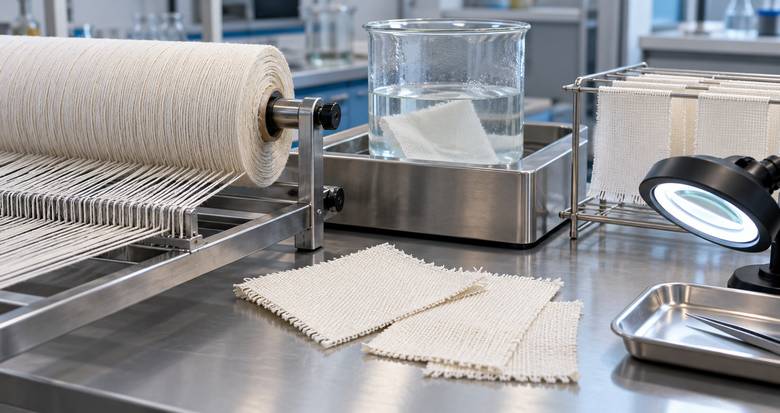
Use the actual desizing or preparation route planned for the fabric. Record liquor ratio, water quality, temperature, time, chemistry, mechanical action and wash sequence. Compare residual size using the plant’s validated method and inspect absorbency, handle, whiteness or dyeing uniformity where they matter.
Easy removal in hot water under one laboratory condition does not prove compatibility with every mill route. If the candidate reduces loom stops but requires extra washing, the purchasing decision must include water, energy, time, effluent load and downstream quality.
Diagnose trial failures one variable at a time
- Viscosity drifts during holding: check temperature, evaporation, delayed hydration, pH, water quality, contamination and shear history.
- Gel particles or screen residue: review powder addition rate, order of addition, local high concentration, mixing energy and blend compatibility.
- High pickup with brittle yarn: verify solids, squeeze pressure, moisture, drying severity, plasticizer or lubricant balance and film flexibility.
- Hairiness improves but abrasion does not: inspect penetration, surface-rich film, adhesion, drying and the relevance of the abrasion method.
- More warp stops: separate low elongation, uneven pickup, weak adhesion, deposits, static, loom settings and unrelated mechanical causes.
- Difficult desizing: verify recipe identity, thermal history, water quality, wash conditions, blend components and the residual-size method.
Change one suspected cause per follow-up and keep the approved control in the matrix. This discipline produces evidence that can be transferred to purchasing and production.
Bridge the selected CMC to a commercial batch
A lab kettle and pilot beam do not reproduce production storage, recirculation, beam width, drying load or loom variation. Scale up in stages. Log make-down time, liquor condition, pickup across the beam, moisture profile, yarn-test results, loom performance, deposits, fabric quality and desizing.
Freeze the approved grade and lot criteria, solids basis, preparation procedure, water-quality range, recipe, size-box window, squeeze and speed settings, conditioning and test methods. Define which deviations require review or requalification. The sample to commercial batch approval workflow provides the broader evidence chain, while the CMC certificate-verification guide helps purchasing confirm that the received lot matches the approved identity and scope.
What a technical buyer should send with an inquiry
Share the fiber and yarn type, count, spinning route, fabric construction, loom type and speed range, current size recipe ranges, water quality, make-down equipment, size-box temperature, target pickup, drying route, current problems, desizing method and release criteria. If the recipe is confidential, provide ranges and decision limits rather than customer names or proprietary details.
Ask the supplier for a clearly identified sample lot, certificate with test methods, physical form and particle-size information when relevant, moisture or loss on drying, purity basis, degree of substitution, viscosity method and preparation guidance. Trace that sample through the trial record.
Frequently asked questions
Can textile grade CMC be approved from solution viscosity alone?
No. Solution viscosity is one controlled raw-material property. Warp sizing also depends on preparation, blend compatibility, pickup, penetration, film behavior, yarn condition, machine settings, weaving and desizing.
Should candidate grades be compared at equal mass?
Use a public record. Equal as-supplied mass is simple, but active solids may differ with moisture or purity. Record both weighed mass and calculated solids so another team can reproduce the comparison.
Is the highest size add-on the best result?
No. More add-on may increase surface protection, but it can also increase stiffness, reduce elongation, raise deposits or complicate desizing. Approve the lowest robust operating window that meets the mill’s yarn, loom and fabric limits.
How many yarn specimens should be tested?
Follow the laboratory’s validated method or the applicable standard and use enough replicates to characterize variation. Record exclusions and do not select only the best-looking specimens.
Can a laboratory abrasion test replace a loom trial?
No. It is a screening tool. The loom introduces repeated tension, bending, yarn-to-yarn contact, guides, heddles, reeds, humidity and machine-specific settings that a single laboratory test cannot reproduce.
Should printing-paste performance be included in the same approval?
No. Printing has a different recipe, rheology, transfer, color and wash-off decision. Run a separate printing protocol if the same CMC is proposed for both applications.
Plan a decision-ready textile sizing CMC trial
SINOCMC can review a non-confidential trial brief and discuss a textile grade CMC sample for your own qualification. Include the yarn, base recipe, preparation, size-box settings, pickup target, yarn-test methods, loom conditions, desizing route and release limits. Contact SINOCMC with the brief; final approval should follow your mill’s controlled tests and commercial-batch evidence.
Technical sources
- Maatoug S, Abu Nab E. Analyzing the Influence of Sizing Machine Settings on the Performance of the Sized Cotton Warp Yarns Using Eco-Friendly Carboxymethyl Cellulose from Saudi Wheat Straw. Polymers. 2026;18(10):1262. The reported settings and optima apply to the studied system; this article uses the work only to support controlling machine variables and measuring multiple yarn responses.
- Maatoug S, Abu Nab E. Performance Evaluation of the Sizing of Cotton Warp Yarns Using Low-Cost Carboxymethyl Cellulose Derived from Saudi Wheat Straw. Polymers. 2026;18(2):226. The study compares size add-on, hairiness, abrasion, tensile response and desizing in its own cotton-yarn system.
- International Organization for Standardization. ISO 2062:2009, Textiles — Yarns from packages — Determination of single-end breaking force and elongation at break using constant rate of extension tester. The standard remains current after ISO review and defines controlled tensile-test methods rather than product acceptance limits.
- Li P, Guo M, Sun F, Gao W. An adhesive-aided ring spinning for improving cotton yarn quality with the aid of sodium carboxymethyl cellulose solution. Journal of Engineered Fibers and Fabrics. 2020;15. The work provides application-specific evidence that CMC treatment and process variables can affect cotton-yarn hairiness.
- Stana-Kleinschek K, Ribitsch V, Kreze T, Fras L. Rheological properties of printing pastes and their influence on quality-determining parameters in screen printing of cotton with reactive dyes using recycled polysaccharide thickeners. Carbohydrate Polymers. 2009;78(1):25-35. This separate printing study reinforces why printing-paste conclusions should not be transferred directly to warp-sizing approval.