
How CMC Works in Textile Sizing
In high-speed weaving, every warp break directly impacts your profit margins. While modern looms are impressive, the real key to consistent performance is often found in the sizing room. Unlike traditional starches, textile grade CMC is a high-performance film-former. It provides a protective coating that allows yarn to withstand the constant mechanical friction and tension of the loom.
1. Mastering Surface Friction
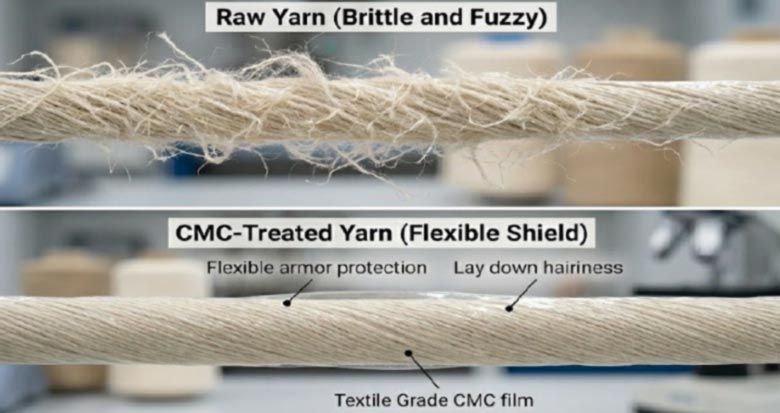
Textile Grade CMC acts as an effective surface smoothing agent. In the size box, CMC wets the yarn instantly, laying down these protruding fibers and bonding them flat against the yarn body. This transforms a fuzzy, high-friction surface into a smooth, rod-like profile. It significantly reduces the coefficient of friction, allowing the warp to glide through the loom without resistance.
Microscopic Visual Comparison: Raw Yarn VS CMC-Treated Yarn
2. Engineering Tension Survival
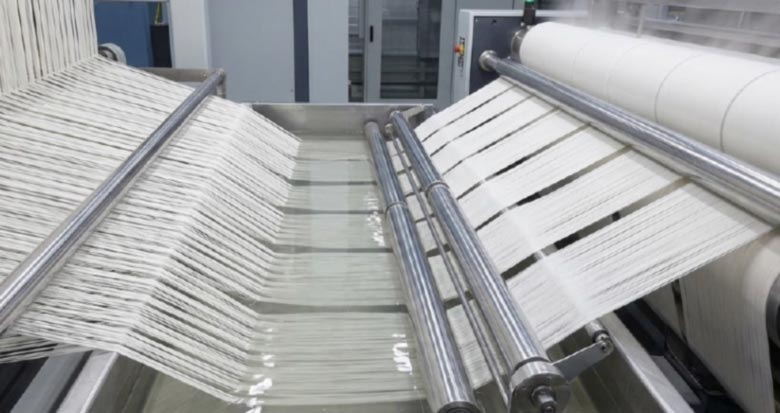
Unlike starch, our textile grades CMC are designed for film elongation and resilience. It forms a tough yet highly elastic film and stretches along with the yarn rather than snapping, absorbing energy and maintaining film integrity throughout the cycle. Mills that switch from pure starch to a CMC blend typically see a 10%–15% reduction in warp breakages, leading to much higher loom efficiency.
3. Ensuring Desizing Efficiency
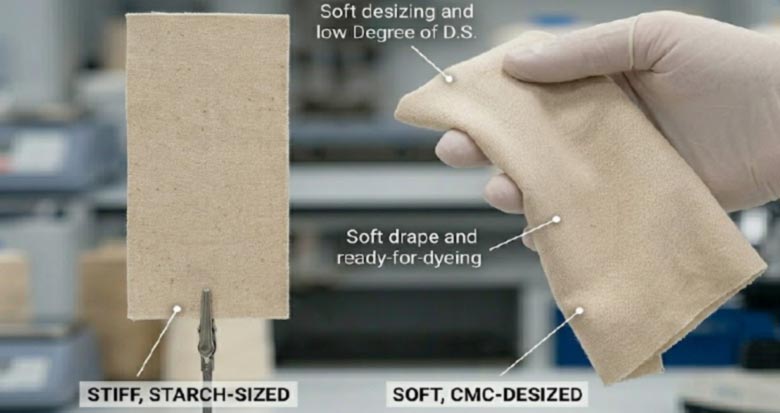
The ultimate goal of a sizing agent is to be easily removed after weaving. Residual size causes fabric stiffness (the “sandpaper” feel) and results in uneven dyeing. The key is the Degree of Substitution (D.S.). A higher D.S. means the CMC molecule has more water-loving sites. High-quality CMC rinses away effortlessly during desizing. This leaves the fabric in a soft, pristine state, perfectly prepared for uniform dyeing and finishing.
4. Maximizing Environmental Sustainability
In today’s global supply chain, chemical safety is essential. Unlike synthetic polyacrylates, CMC is naturally derived and biodegradable. This significantly reduces the COD/BOD load in your wastewater treatment plant.
5. Optimized Specifications for Weaving Success
| Yarn Type / Process | Recommended Viscosity (1% Soln.) | Target D.S. | Primary Operational Benefit |
| Fine Cotton (High Count) | 20 – 100 cps | 0.85 – 0.95 | Deep penetration for fine count stability & easy wash-off |
| Heavy Denim / Coarse Yarn | 500 – 1,000 cps | 0.70 – 0.90 | Maximum film strength & robust bonding for heavy weave |
| Polyester / Blends (Filament) | 100 – 300 cps | ≥0.90 | High elasticity & superior adhesion to synthetic surfaces |
| Yarn Dyeing/Printing Pre-treat | 50 – 200 cps | ≥1.0 | Ultra-pure; absolute zero dye interference or resisted spots |
At SINOCMC, we provide specialized grades designed to solve your specific weaving challenges. Contact our team today for any help!
SINOCMC Team