
Welding Electrode CMC Trial: Extrusion, Green Strength and Burn Checks
A welding electrode CMC sample should not be approved from a solution-viscosity number alone. In a covered-electrode plant, the candidate enters a mineral-rich wet mix, passes through a pressure-coating die, supports the coating while it is still fragile, and then experiences drying, baking, handling and welding. A change that looks acceptable in a beaker can still alter extrusion pressure, coating concentricity, green strength, cracking, moisture behavior or arc performance.
This guide gives welding-consumable buyers, distributors and electrode factories a controlled way to compare a CMC candidate with an approved control. It is not a universal formulation, dosage or welding-electrode specification. The electrode classification, flux system, plant equipment, baking program, safety controls and acceptance limits must come from the manufacturer’s approved documents and the applicable destination-market standard.
Why welding electrode CMC needs a process trial
CMC can contribute water binding, wet-mix cohesion, lubrication and green handling strength in some covered-electrode formulations. Those functions are interdependent. Increasing wet cohesion may help a coating remain intact after extrusion, but excessive water demand or an unsuitable rheology profile may increase pressure, reduce surface quality or complicate drying. A candidate therefore has to be judged inside the complete electrode process, not as an isolated powder.
SINOCMC’s earlier overview of CMC in welding electrodes describes the broad application. A second article covers binder and lubricant functions in welding rods. This guide addresses a different question: how should a factory qualify a new sample without confusing raw-material, process and finished-electrode evidence?
1. Freeze the electrode system before comparing CMC
Write a one-page trial protocol before mixing. Identify the covered-electrode classification, core-wire diameter and chemistry, flux-batch identity, silicate or other liquid binder, solids-to-liquid basis, target electrode diameter, die set, mixer, extrusion line, drying and baking program, conditioning period, storage environment and welding procedure. Use the same approved lots wherever practical. If another raw material or machine setting changes at the same time, the result cannot be attributed to CMC with confidence.
Define the comparison on a dry-matter basis. Record whether CMC addition is calculated as received or after correcting for moisture. Hold the total batch mass, liquid addition rule, mixing energy, mixing time, rest time and test temperature constant. If the candidate requires a different addition method, document that method as an experimental variable rather than quietly changing the process.
Before the plant trial, compare the control and candidate certificates and confirm identity, lot number, moisture or loss on drying, viscosity method, solution concentration, test temperature, pH where relevant and any buyer-controlled purity or particle-size requirements. The CMC viscosity-grade comparison guide explains why a result measured at 1% cannot be treated as interchangeable with a 2% result unless the method is normalized.
2. Prepare a small, decision-ready trial matrix
Begin with the approved control and one candidate at the same dry CMC addition. Include a repeat of the control or candidate so that normal batch variation is visible. Only after the equal-addition comparison should the factory consider an adjusted candidate level, and only when the formulation owner permits it. Changing both product and dosage in the first comparison hides the source of the effect.
| Batch | Purpose | CMC basis | Decision use |
|---|---|---|---|
| Control | Approved production reference | Current approved level | Defines normal process and electrode behavior |
| Candidate | Direct material comparison | Same dry addition as control | Shows whether the sample fits the existing process window |
| Repeat | Repeatability check | Same selected condition | Separates a stable effect from one-batch noise |
| Adjusted | Optional optimization | Written, approved adjustment | Used only after the direct comparison |
A laboratory or pilot batch should be large enough to pass through representative mixing and extrusion equipment. A cup-scale paste may screen hydration, but it cannot prove pressure-coating behavior, core-wire feeding, concentricity or production drying.
3. Control CMC make-down and wet-mix history
Use the plant’s approved addition route. Some systems add CMC as a dry blend into the flux powder; others pre-disperse or dissolve it in a liquid phase. Record water quality, temperature, addition rate, agitation, hydration time and sequence. If a pre-solution is used, follow a reproducible method and check for fisheyes or undispersed particles. The industrial CMC dissolution guide provides general make-down principles, but the welding-electrode formula and safety procedure remain decisive.
During wet mixing, record total liquid addition, mixer load, mixing time, power or torque trend if available, paste temperature, appearance and the time between discharge and extrusion. Do not add unrecorded water merely to make one batch easier to extrude. That correction may improve the momentary pressure while changing green strength, drying load and coating behavior.
Useful wet-mix observations include cohesion, plasticity, tack, smearing, cracking when the mass is folded, release from the mixer, and change during the normal waiting period. A simple factory penetration, squeeze-flow or extrusion-consistency method can support comparison when the fixture, sample mass, temperature and timing are fixed. The method does not need to be presented as an international standard; it needs to be repeatable and linked to plant decisions.
4. Measure extrusion, coating and line stability
Run the control first or alternate trial order when practical. Stabilize the line under the factory’s normal procedure before collecting data. Record die identity, core-wire speed, extrusion speed, head pressure or motor load, interruptions, die buildup, surface tearing, coating slip, exposed wire, start-up scrap and the amount of material required to reach steady operation.
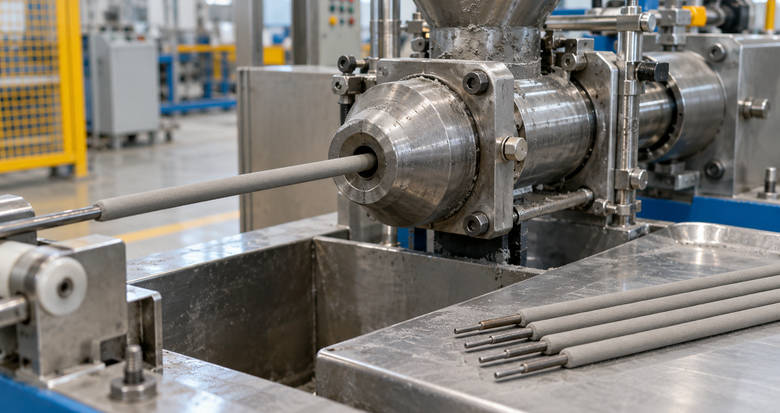
Measure coating diameter and concentricity at defined positions and sample counts. Also inspect straightness, surface smoothness, longitudinal cracks, rough patches, coating thickness variation and damage at the grip and arc ends. ISO 544:2024 addresses technical delivery conditions, dimensions, tolerances and markings for welding consumables; the factory should use the requirements that apply to its product and market rather than inventing a generic limit for this CMC trial.
Compare the whole operating window, not only the best five rods. A candidate that produces attractive samples after repeated water or pressure adjustments may be less robust than a control that runs steadily. Record planned and unplanned adjustments so that process cost and operator workload are part of the approval decision.
5. Check green strength and handling before drying
Freshly coated electrodes must survive transfer, straightening where applicable, rack loading and movement into the dryer without coating damage. Establish a fixed conditioning time after extrusion, because a rod tested immediately cannot be compared fairly with one tested after surface drying.
Use the factory’s approved handling checks: visual inspection after transfer, a controlled bend or deflection fixture, a defined-height handling or drop simulation, gentle twist where appropriate, and counting of chips, cracks or coating separation. Record the core-wire diameter, span, loading direction and conditioning time. “Good green strength” is not a sufficiently reproducible result by itself.
Green handling is an intermediate gate. Passing it does not prove final coating adhesion, moisture resistance, classification or welding performance. Conversely, an overly rigid wet coating may survive handling but crack during drying. Keep the gates separate.
6. Treat drying and baking as change-control stages
Use the established temperature ramp, air flow, loading pattern, residence time and cooling method for the electrode type. Do not create a universal drying schedule from a blog article. Covered-electrode families differ in formulation and moisture sensitivity, and product-specific instructions can override general guidance.
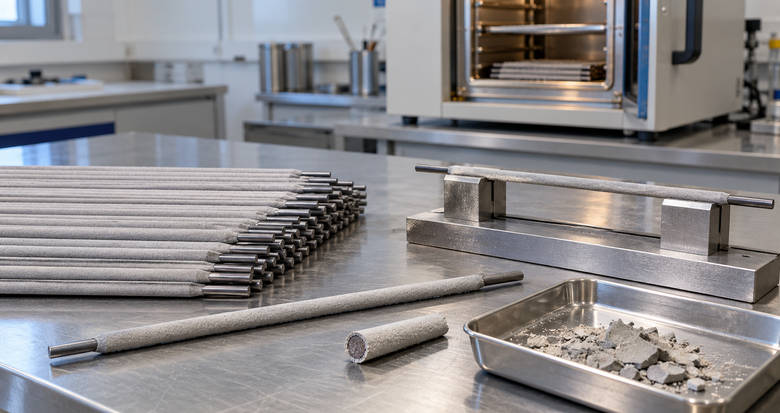
Weigh defined samples or racks before and after each validated stage when mass-loss tracking is part of the plant method. Inspect for blistering, longitudinal or end cracks, uneven color, warping, exposed core wire, coating flake-off and changes in diameter or concentricity. After cooling under controlled conditions, repeat the handling or adhesion check with the same fixture and sample count.
For low-hydrogen electrodes, moisture and diffusible-hydrogen controls are product-critical and cannot be inferred from CMC identity or a short bake trial. AWS A5.1/A5.1M:2025 includes moisture testing requirements for low-hydrogen electrode coverings, while ISO 3690:2018 specifies procedures for determining diffusible hydrogen in arc-weld metal. Use the applicable classification and buyer requirement.
7. Separate operability from weld-metal compliance
Only trained personnel should conduct welding trials under the site’s approved procedure, ventilation and personal-protective-equipment controls. OSHA notes that welding fume composition and exposure depend on the process, base metal, filler metal and work practices; see its guidance on controlling welding fumes and gases.
For an operability screen, fix the electrode diameter, conditioning, base metal, joint, welding position, current type, polarity, current range, travel technique and operator or automated setup. Compare arc initiation, restrike, arc stability, spatter, coating burn-off, stub loss, slag detachability, bead profile, undercut, visible porosity and fume behavior using a written scoring method. Random workshop welding cannot support a supplier change.
Classification evidence is a separate gate. ISO 2560:2020 covers classification of covered electrodes and deposited metal for manual metal arc welding of non-alloy and fine-grain steels. ISO 15792-1:2020 specifies preparation of all-weld-metal test pieces and specimens, and ISO 15792-3:2011 covers classification testing of positional capacity and root penetration in a fillet weld. Select the standard that matches the electrode and destination market.
A CMC sample can pass extrusion and still fail a required finished-electrode test. Approval should therefore connect raw-material evidence, process data, electrode dimensions, drying behavior, welding operability and required classification results without substituting one for another.
8. Scale up without losing traceability
After a successful pilot, repeat the selected condition using a new preparation and, where risk justifies it, a second CMC lot. Then run a controlled production-scale batch. Keep the approved formulation, but document scale-dependent differences in mixing time, liquid distribution, paste temperature, rest time, extrusion load, line speed, dryer loading and environmental exposure.
Define the commercial release package before ordering. It may include the agreed CMC specification and method, certificate fields, retained sample, lot traceability, change-notification requirement and the electrode factory’s incoming test. AWS A5.01M/A5.01:2019 (R2024) provides a framework for stating heat, lot, testing and certification requirements when procuring welding consumables. The broader CMC sample-to-commercial-batch approval workflow can help buyers organize supplier evidence and first-order controls.
Approval checklist for buyers and electrode factories
- The electrode classification, formula, raw-material lots, equipment and acceptance limits are written before the trial.
- Control and candidate CMC are compared on the same dry-addition and test-method basis.
- Water, mixing, rest time, extrusion settings and all operator adjustments are recorded.
- Extrusion load, steadiness, scrap, surface quality, diameter, straightness and concentricity are checked with adequate samples.
- Green handling, drying/baking defects and post-bake coating adhesion are separate gates.
- Welding operability uses a controlled procedure; required classification, moisture, hydrogen and mechanical tests remain independent requirements.
- A repeat pilot and production-scale confirmation demonstrate that the result is not a one-batch exception.
- The purchasing specification, certificate fields, lot traceability, retained sample and change-control expectations are agreed before commercial release.
Frequently asked questions
Can solution viscosity alone select welding electrode CMC?
No. Solution viscosity is useful only when concentration, basis, temperature, instrument and method are comparable. The electrode factory must also evaluate wet-mix behavior, extrusion, green handling, drying, coating quality and welding performance.
Should a candidate use the same dosage as the control?
Start with the same dry CMC addition to isolate the material change. An adjusted level can be evaluated later if the formulation owner approves it and the adjustment is recorded as a separate condition.
What does green strength mean in this trial?
It means the ability of the freshly coated electrode to withstand defined handling before drying without cracking, chipping or separating from the core wire. Because factories use different fixtures and transfer systems, the method and timing must be written.
Can a successful extrusion trial approve the sample?
No. Extrusion is one gate. The sample still needs post-extrusion handling, drying or baking, coating inspection, controlled welding and any classification or buyer-required testing.
Does CMC determine low-hydrogen performance?
No single ingredient proves low-hydrogen performance. Covering composition, manufacturing, drying, packaging, storage and handling all matter. Apply the relevant classification, moisture and diffusible-hydrogen methods to the finished electrode.
What should a buyer send when requesting a sample?
Send the electrode classification and diameter, current CMC test method and addition basis, flux-system constraints that can be disclosed, addition route, mixing and extrusion conditions, key defects, drying or baking regime, required standards, annual demand, packaging needs and the evidence required for commercial approval. Do not send customer-confidential formulas through an unsecured channel.
Build a sample plan before changing the commercial lot
A reliable welding electrode CMC decision is a documented bridge from raw material to finished consumable. When the control, process history and acceptance limits are fixed, the factory can see whether a candidate genuinely improves or preserves manufacturing robustness instead of reacting to a single attractive batch.
Contact SINOCMC with your CMC test method, electrode type, addition route and qualification plan. Our team can help organize a sample discussion around comparable data. Final formulation, safety, welding procedure, classification and release decisions remain with the electrode manufacturer and the applicable qualified personnel.
Technical sources
- AWS A5.1/A5.1M:2025 — Specification for Carbon Steel Electrodes for Shielded Metal Arc Welding.
- AWS A5.01M/A5.01:2019 (R2024) — Procurement of Filler Metals and Fluxes.
- ISO 544:2024 — Technical delivery conditions for filler materials and fluxes.
- ISO 2560:2020 — Classification of covered electrodes for non-alloy and fine-grain steels.
- ISO 15792-1:2020 — Preparation of all-weld-metal test pieces and specimens.
- ISO 15792-3:2011 — Positional-capacity and root-penetration classification testing.
- ISO 3690:2018 — Determination of hydrogen content in arc-weld metal.
- OSHA — Controlling Hazardous Fume and Gases during Welding.