
CMC in Pesticide Suspension Concentrates: Stability, Dilution and Sprayability Checks
A pesticide suspension concentrate (SC) is not approved by one viscosity number. The formulation must remain sufficiently uniform in the package, redisperse after standing, dilute into the intended water, pass the relevant sieve and foam checks, and move through the filling and application system defined by the formulator.
Carboxymethyl cellulose (CMC) can contribute viscosity and structure in some water based formulations, but it is not a universal suspension solution. Its effect depends on the CMC grade, concentration, hydration, water chemistry, active ingredient, particle system, surfactants, salts, pH, preservatives and other rheology modifiers. A candidate therefore needs to be tested in the complete formulation rather than selected from a supplier solution result alone.
This guide gives overseas pesticide formulators, chemical distributors and quality teams a controlled framework for evaluating CMC in pesticide suspension concentrates. It does not recommend a pesticide recipe, active ingredient, use rate or regulatory specification. The registered formulation, applicable authority, current label and approved laboratory methods always take priority.
1. Define the formulation and approval boundary
Start by confirming that the product is an aqueous suspension concentrate and not an emulsifiable concentrate, capsule suspension, suspo-emulsion, oil dispersion or soluble concentrate. FAO and WHO define an aqueous SC as a stable suspension of fine active-ingredient particles in an aqueous continuous phase, normally intended for dilution with water before use. A different formulation type can require different tests and acceptance logic.
Record the active ingredient identity and source, nominal loading, particle-size target, aqueous phase, surfactant and dispersant package, antifoam, preservative, density target, pH range, packaging system, intended dilution range and application equipment. Protect proprietary formula details under the buyer’s confidentiality procedure.
Define the decisive indicators before the trial. These may include concentrate homogeneity, pourability, rheology profile, sediment character, redispersion, water dispersibility, diluted suspensibility, wet-sieve residue, persistent foam, temperature stability, package compatibility, filling behavior and spray-system performance. Use only the tests required by the applicable registration, contract or validated internal method.
2. Separate the CMC question from the whole formulation
A suspension concentrate is a multi-component system. If the clay, surfactant, particle-size distribution, milling energy, pH or solids content changes with the CMC, the result cannot be assigned confidently to the polymer. During the first group of tests, change only one defined CMC variable while keeping the following constant:
- active ingredient source, batch and particle-size condition;
- water source, hardness or conductivity and temperature;
- all dispersants, wetting agents, clays, gums, antifoams and preservatives;
- solids, density and pH adjustment procedure;
- order and rate of addition;
- premix, milling and finishing equipment;
- mixing energy, time and batch size;
- hold time before sampling; and
- container, headspace and storage history.
The earlier SINOCMC overview of CMC in agriculture covers broad application context. This article owns the narrower factory qualification intent for aqueous pesticide SC systems.
3. Identify the CMC candidate and comparison basis
Record the commercial grade, supplier, production batch, physical form, moisture basis, viscosity test concentration, hydration procedure, test temperature, instrument, rotor number and speed. Two products both described as “high viscosity CMC” may behave differently if their molecular characteristics, substitution pattern, particle form or solution method differ.
The 2026 review of CMC solution and gel rheology describes how concentration, degree and pattern of substitution, molar-mass distribution, pH, temperature, salt, surfactants and colloids can affect response. That evidence supports a formulation-specific comparison; it does not create a universal pesticide grade.
Review the supplier documentation and retained sample, but do not treat a passing certificate as proof of SC performance. Align supplier comparisons using the controls in the CMC viscosity method guide. If a bag shows liner damage, moisture exposure or clumps, follow a controlled receiving and moisture-damage investigation before using it in a normal trial.
4. Standardize CMC dispersion and hydration
CMC powder can form hydrated shells around dry cores when it is added too quickly or the liquid is not stirred. In a formulation containing salts, surfactants and fine insoluble particles, sequence and local concentration can also change dispersion, apparent viscosity and batch-to-batch repeatability.
Choose one preparation route that represents the plant. Depending on the validated process, CMC may be pre-hydrated in a defined water portion or introduced through a controlled premix. Record water condition, powder addition time, impeller, speed, temperature, hydration time and the point at which other ingredients enter. Do not switch between pre-hydration and direct addition during the same grade comparison.
If the plant sequence is not documented, first establish a repeatable baseline using the principles in the industrial CMC mixing guide. A clear make-down record is more useful than compensating for poor dispersion by adding more polymer.
5. Use a matched screening matrix
Keep the first matrix small enough to interpret. The condition names below are examples, not recommended addition levels or pesticide specifications.
| Condition | CMC variable | Formula controls | Concentrate checks | Dilution checks |
|---|---|---|---|---|
| Control | Current approved formulation | Same active, water, additives and process | Homogeneity, rheology, sediment and pourability | Dispersion, suspensibility, sieve and foam reference |
| Candidate A | First CMC grade at the planned screen level | Unchanged from control | Same methods and elapsed-time points | Same dilution water and procedure |
| Candidate B | Second grade or one controlled level change | Unchanged from control | Same methods and elapsed-time points | Same dilution water and procedure |
| Repeat | Selected candidate in an independent batch | Reweighed, remade and resampled | Preparation sensitivity and repeatability | Repeatability across the required endpoints |
6. Check concentrate homogeneity before interpreting rheological property data
Confirm density or solids by the validated method and inspect for dry specks, agglomerates, entrained air, surface skin, floating material and non-uniform sampling. A viscosity result is not comparable if the candidate vessels contain different solids or were sampled after different agitation histories.
Measure rheology under defined temperature, sample age, geometry, speed program and pre-shear conditions. Many SC products and CMC systems are non-Newtonian, so one apparent-viscosity value may not describe low-shear suspension, pouring, pumping and high-shear processing at the same time. A useful profile may include low- and higher-shear behavior, recovery after shear and elapsed-time stability, if those measurements are part of the approved method.
A pesticide SC rheology study published in 2004 also treated physical stability as a rheological problem rather than a single viscosity target. Use such literature to design questions, not to copy acceptance limits into a different active-ingredient system.
7. Evaluate sediment character and redispersion
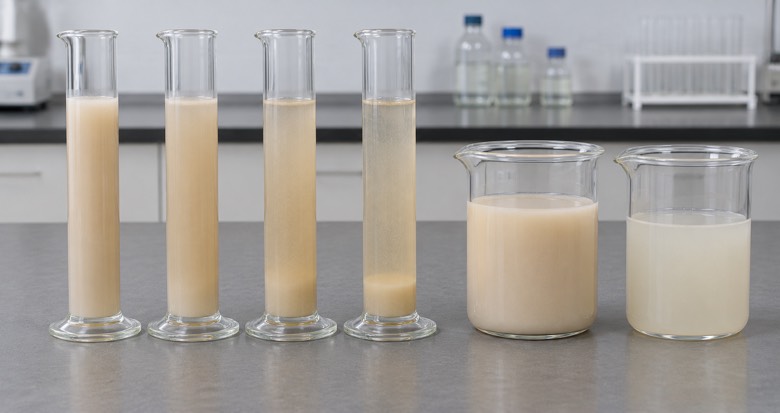
Store matched samples in identical containers at defined temperatures and times. Record the clear layer or cream layer, sediment volume, wall deposits and the force or number of standardized inversions needed to restore uniformity. A sample that separates slowly but forms a hard compact sediment may be less usable than one with modest, easily reversible separation.
Take top, middle and bottom samples only when the method requires it, and use a sampling tool that does not artificially remix the vessel. Compare active content or another approved marker where required. Visual appearance alone cannot prove uniform distribution.
Do not claim package shelf life from a short bench observation. The OECD storage-stability guidance distinguishes the evidence needed to verify that a plant-protection product remains unchanged over time and that package integrity is maintained. Follow the applicable regulatory study design and justify any accelerated condition before linking it to a labeled storage period.
8. Test dilution in representative water
The concentrate and the diluted spray suspension are different systems. Use the relevant field-use concentration range and representative water qualities required by the product program. Record temperature, hardness or conductivity, pH, order of addition, agitation, standing time and test cylinder geometry.
FAO and WHO SC guidance identifies water dispersibility, suspensibility, wet-sieve residue and persistent foam as important indicators of diluted-product sprayability. It also notes that viscosity is only one part of complex SC rheology. That is why a concentrate that looks stable in its package can still fail when diluted.
Observe initial dispersion, floating lumps, flocculation, settling, sediment recovery and foam. Perform the current CIPAC or other required method exactly as referenced by the buyer or registration. Method numbers and editions can change; do not substitute an informal cylinder test for a contractual method.
9. Check pourability, sieve residue and equipment compatibility
Package usability includes more than bulk stability. CIPAC MT 148 evaluates how much suspension concentrate remains after a standardized standing and pouring procedure, followed by rinsing. The method can support development and quality control when sampling and storage conditions are held identical.
Evaluate container emptying, residue location, rinsing, cap or induction-seal contact and any change after storage. Use the actual approved package materials. The CMC candidate should not be blamed for a residue problem until particle condition, package geometry, headspace and storage history are controlled.
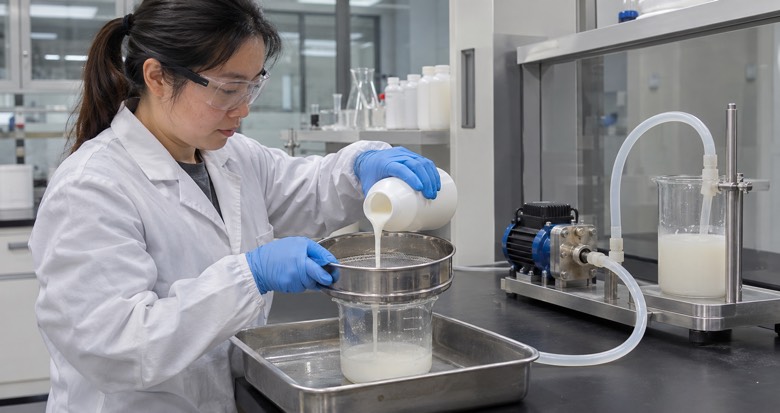
Wet-sieve and line checks should use the required mesh, dilution, agitation and timing. When appropriate, pass the diluted formulation through the representative strainer, pump, hose and nozzle under a safe contained procedure. Record pressure or flow changes, residue and cleanup. Do not conduct field spraying merely to screen a raw-material candidate.
10. Challenge storage without over-interpreting it
Build the storage program around the product’s regulatory and commercial requirements. Depending on the approved protocol, it may include ambient long-term storage, elevated-temperature storage, low-temperature exposure, temperature cycling, vibration or transport simulation. Every condition needs a defined container, orientation, sampling point and acceptance plan.
After each interval, inspect package integrity, appearance, odor only when safely permitted, density, pH, active content where required, rheology, sediment, redispersion, pourability, dilution, suspensibility, sieve residue and foam. Compare with time-zero data and the approved control.
Preservative performance, chemical degradation and packaging compatibility are specialist questions. CMC selection does not replace microbial, analytical, toxicological, ecotoxicological or registration evaluation. Any formulation change must be reviewed for its regulatory effect before commercial use.
11. Confirm filling, pilot scale and production repeatability
A bench sample can pass while the plant batch fails because powder feeding, wetting, milling, tank turnover, heat input, hold time or recirculation is different. Scale the selected candidate through a controlled pilot or production trial using the site’s qualified safety and containment procedures.
Track raw-material addition, hydration or premix preparation, mill condition, batch temperature, energy or time markers, foam control, recirculation, filtration, transfer, filling accuracy, line stops and restart behavior. Sample from defined locations and times rather than taking only one convenient vessel sample.
Compare the commercial batch with the retained laboratory candidate using the same critical methods. Follow the documented sample to commercial batch approval workflow so the buyer can link the approved sample to the delivered material.
12. Define supplier and change-control records
The approval file should identify the formulation revision, CMC grade and batch, supplier documents, retained samples, make-down instructions, water condition, processing record, storage conditions, methods, results, deviations, package type and responsible reviewers.
Agree which changes require notification and requalification. Examples may include the CMC manufacturing site, agreed specification, viscosity method, physical form, packaging, preservative system or another change defined by the buyer’s quality agreement. A matching product name alone is not sufficient change control.
For procurement, request the technical information needed to repeat the trial rather than asking only for “high viscosity CMC.” SINOCMC’s sodium carboxymethyl cellulose overview provides general product context; final suitability must be established in the buyer’s complete registered formulation.
Frequently asked questions
Is the highest-viscosity CMC the best choice for a pesticide SC?
No. A useful candidate must balance low-shear structure, redispersion, pouring, pumping, dilution and spray-system behavior. A high supplier solution-viscosity value does not predict all of those endpoints.
Can CMC replace every clay, gum or synthetic rheology modifier?
No. Different modifiers provide different suspension, recovery, compatibility and processing behavior. CMC may work alone or in a formulation-specific combination, but every complete system needs controlled testing.
Why did a stable concentrate fail after water dilution?
Dilution changes solids, surfactant balance, ionic environment and particle interactions. Water quality, order of addition, agitation and use concentration can expose flocculation, foam, sieve residue or rapid settling that was not visible in the package.
Can a short elevated-temperature test prove shelf life?
Not by itself. Use the accepted regulatory and company protocol, including package integrity and the required chemical and physical endpoints. Any relationship between accelerated and real-time storage must be justified for that product.
Should the supplier set the final acceptance limits?
The formulator or registrant should define limits from the registered composition, applicable specification, plant capability and validated performance. The CMC supplier can provide product data and sample support but should not invent pesticide-product limits.
What information should accompany a CMC sample request?
Share the aqueous formulation type, active-particle context, water condition, current rheology package, CMC make-down route, viscosity test method, pH and electrolyte range, process equipment, storage plan, package type, trial quantity and the failure mode under review. Protect confidential details under the applicable agreement.
Discuss a CMC sample for a pesticide suspension concentrate
When contacting SINOCMC, provide the available formulation context, current CMC or target behavior, complete viscosity method, water condition, trial batch size and the concentrate, dilution or handling problem being investigated. The team can review available product information and discuss a sample plan; final suitability and regulatory acceptability must be confirmed by the formulator in the complete product.
Send your pesticide suspension concentrate trial requirements to SINOCMC.
Technical sources
- FAO and WHO. Manual on Development and Use of FAO and WHO Specifications for Pesticides, aqueous suspension concentrate guidance. Open the manual.
- CIPAC. MT 148, Pourability of Suspension Concentrates. Open the method outline.
- OECD. Guidance Document for Storage Stability Testing of Plant Protection and Biocidal Products (2016). Open the guidance record.
- Tan, C. et al. “Research on the Rheological Properties of Pesticide Suspension Concentrate.” Journal of Zhejiang University Science A 5(12), 1604–1607 (2004). Open the paper record.
- Modi, J. J. “Evaluation of Water Soluble Polymers as Co-Suspending Agents for Flowable Pesticides.” ASTM STP (1986). Open the ASTM paper record.
- “Rheological Properties of Carboxymethyl Cellulose Solutions and Gels: An Overview.” Journal of Applied Polymer Science (2026). Open the review.
- U.S. EPA. National Pesticide Applicator Certification Core Manual, formulation overview. Open the manual.