
CMC in Battery Anode Slurries: Dispersion, Rheology and Coating Checks
In a water-based lithium-ion battery anode slurry, sodium carboxymethyl cellulose (CMC) is often discussed as if it were simply a binder or a viscosity builder. That description is incomplete. CMC can adsorb on graphite and conductive-carbon surfaces, change particle interactions, influence dispersion and contribute to the structure that determines how a slurry mixes, rests, pumps and coats. Its effect also depends on how much polymer remains free in the liquid phase.
For a battery-material buyer, this means that a supplier viscosity number cannot predict production performance by itself. A useful evaluation must connect the CMC identity and solution method to the complete slurry, the mixing sequence, the coating process and the finished electrode. This guide explains how to build that evidence chain without assuming that one grade, concentration or recipe is universal.
1. Start with the exact anode system
“Battery anode slurry” is not one formulation. A graphite system, a graphite–silicon blend and a high-silicon anode can place very different demands on dispersion, adhesion and mechanical integrity. Conductive-carbon type, particle surface area, solids loading, SBR latex, water quality, pH, mixing equipment and coating speed can all change the result.
Before comparing CMC samples, freeze the variables that define the intended use:
- active material type, supplier lot, particle-size distribution and surface treatment;
- conductive additive type and specific surface area;
- CMC and SBR roles, addition sequence and solids basis;
- water source, conductivity, temperature and pH-control practice;
- target slurry solids, density and coating mass;
- mixer geometry, vessel fill, speed, time and temperature history;
- storage or transfer time before coating;
- coater, gap, line speed, drying profile and copper-foil specification.
A sample that appears acceptable in a low-solids beaker may behave differently after high-solids kneading, long transfer, SBR addition or slot-die coating. Record the intended process first, then design the comparison around it.
2. Understand the multiple roles of CMC
Peer-reviewed work describes CMC in aqueous graphite slurries as a polymer whose role changes with adsorption, concentration and process history. At moderate levels it can help stabilize particles through steric and electrostatic effects. As free-polymer concentration rises, it can also increase continuous-phase viscosity and viscoelasticity. These effects are not interchangeable: a slurry can have the same apparent viscosity at one shear rate while having different dispersion, recovery or coating behavior.
CMC is also commonly used with SBR, but the two components do not perform identical jobs. CMC strongly affects the aqueous dispersion and slurry microstructure, while SBR contributes elastomeric binding after drying. Treating the pair as a single undifferentiated “binder percentage” can hide the cause of a process change.
For silicon-containing anodes, polymer–surface interactions and the electrode’s ability to tolerate volume change become even more important. Research on modified and cross-linked CMC systems shows why promising laboratory concepts must still be validated in the buyer’s own active material, loading, drying and cycling conditions. Such studies are technical evidence, not proof that an untested commercial CMC grade will deliver the same result.
3. Translate the supplier data sheet into testable hypotheses
Supplier documents are useful for identity and lot control, but they are not a substitute for slurry trials. Start with the sodium carboxymethyl cellulose product overview, then review the CMC certificate and supporting test methods before deciding what each number can and cannot tell you.
| Data item | Why it may matter | What still needs validation |
|---|---|---|
| Polymer identity and sodium form | Confirms the material family being compared | Compatibility with the complete anode system |
| Degree of substitution | Can affect charge density, solubility and adsorption behavior | Particle interaction, dispersion and coating response |
| Molecular-weight or viscosity grade | Provides a starting indicator of solution and slurry structure | Multi-shear rheology, recovery, aging and processability |
| Moisture and active-solids basis | Prevents an as-supplied mass comparison from shifting actual polymer solids | Dry-basis normalization in the trial and commercial batch |
| Purity, salts and insoluble matter | Supports incoming control and contamination review | Buyer-specific limits for water, equipment and electrochemical process |
| Particle form and bulk handling | Influences dusting, wetting and addition consistency | Actual make-down time, agglomeration and feeding repeatability |
Viscosity values are especially easy to misread. Concentration, temperature, hydration time, rotor number or geometry, speed and dry-versus-as-received basis must match before two results are comparable. The 1% versus 2% CMC viscosity guide explains why there is no reliable universal conversion.
4. Lock the CMC addition method
A fair trial begins before graphite enters the vessel. Poor wetting can leave fisheyes or partially hydrated material, while excessive local concentration can create lumps that later appear as unexplained slurry variability. Use one documented make-down method for all candidates.
- Normalize the CMC addition to the chosen solids basis.
- Record water quality, temperature and starting pH.
- Add the powder through a controlled vortex or validated feeding system.
- Keep addition rate, impeller geometry, speed and vessel fill constant.
- Define the hydration endpoint using time plus an observable criterion, not time alone.
- Check for undissolved specks, foam, temperature rise and wall buildup.
- Measure solution properties only after the same hold and temperature conditioning.
If the plant currently experiences slow hydration or lumps, first review the industrial CMC dissolution workflow. Changing the polymer grade and the preparation method at the same time makes the result difficult to interpret.
5. Treat mixing sequence and shear history as formulation variables
Recent studies show that identical raw materials and nominal compositions can produce different rheology when the preparation sequence changes. CMC may adsorb differently depending on whether it first contacts graphite, carbon black or the combined solid phase. The amount of free polymer left in the liquid also changes the slurry structure.
Build a mixing record that includes:
- CMC solution age and temperature before use;
- order and duration of active-material and conductive-carbon addition;
- high-solids kneading time, torque or power signal where available;
- dilution sequence and final solids adjustment;
- SBR addition point and shear exposure after latex addition;
- vacuum, deaeration and screen or filtration steps;
- final rest time before sampling and coating.
More shear is not automatically better. A 2026 study reported that severe high-solid-content kneading could degrade CMC’s dispersion function and destabilize graphite slurries under the studied conditions. That finding should be treated as a reason to test the buyer’s own process window, not as a universal ban on kneading.
6. Measure a rheology profile, not one viscosity point
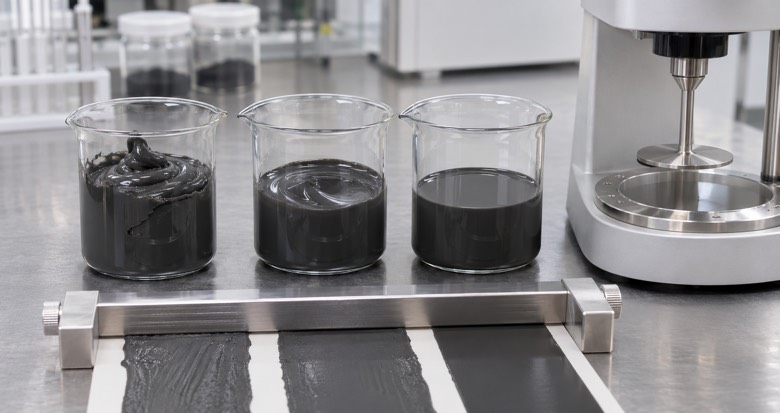
A production slurry experiences low shear during storage, higher shear in pumps and lines, and a different deformation history at the coating head. One rotor result cannot represent all of these conditions. The test plan should match the actual process and may include:
- flow curves across a defined low-to-high shear range;
- up-and-down ramps to assess time dependence and structural recovery;
- yield or low-shear structure indicators using a validated method;
- oscillatory tests where they are useful and reproducible;
- temperature sensitivity within the plant’s operating window;
- short and extended hold-time measurements;
- density, solids, pH, fineness or dispersion checks taken from the same sample.
Do not set acceptance limits from a research paper or supplier brochure. First connect each rheological endpoint to a plant failure mode: settling, poor transfer, air retention, edge instability, ribbing, streaks, excessive leveling, coat-weight variation or filter pressure. A number becomes useful only when it predicts a decision.
7. Include storage and transfer before coating
Slurry aging can change particle networks and apparent viscosity even when composition is unchanged. Take samples at defined times after mixing and after representative recirculation or transfer. Compare the top, middle and bottom of the vessel when stratification is a concern, but use a sampling method that does not create the difference being measured.
Record whether the slurry can be gently redispersed without introducing excessive air or requiring unplanned high shear. Watch for hard sediment, floating agglomerates, gel fragments, foam and screen residue. These observations often explain coating defects more directly than a single viscosity result.
8. Make coating quality a separate gate
A slurry can pass a beaker test and still fail on copper foil. Run matched drawdowns or pilot coating at the intended wet loading and speed. Inspect both the fresh film and the dried electrode.
Useful coating observations include:
- wet-film continuity, edge shape and leveling;
- streaks, pinholes, agglomerates, craters and air defects;
- coat-weight and thickness uniformity across and along the web;
- drying cracks, curl, migration or mottling;
- adhesion and cohesion under a buyer-approved method;
- response to calendaring, bending, slitting and dust generation;
- porosity, density and surface condition after the defined process.
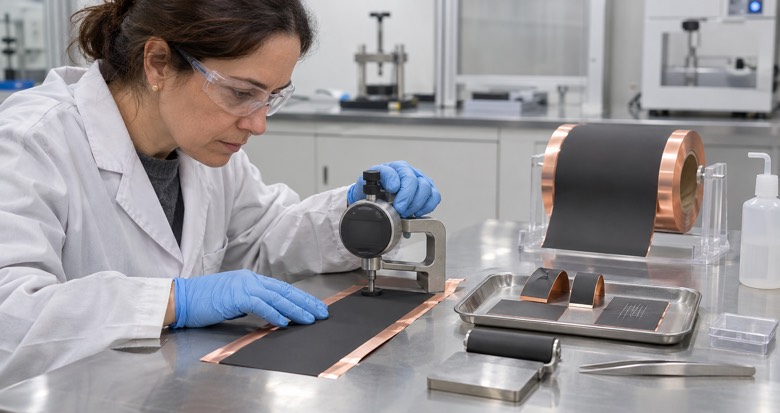
Mechanical checks must use the same substrate, surface preparation, drying and calendaring history. Otherwise a foil or process change can be mistaken for a CMC effect.
9. Keep electrochemical validation independent from process screening
Rheology and coating tests are necessary for manufacturability, but they do not prove cell performance. A buyer should define a separate electrochemical program using the relevant electrode design, counter or full-cell configuration, electrolyte, formation procedure, loading and test temperature.
Possible endpoints include initial efficiency, capacity retention, impedance, rate response and swelling or integrity observations. The exact program belongs to the cell developer. Laboratory results from graphite, silicon or a modified CMC binder in published literature should not be transferred directly to a different formulation or commercial-scale line.
10. Design the sample-to-commercial-batch bridge
Once a candidate passes the laboratory screen, define which variables must remain fixed and which can move within an approved range. The CMC sample approval process should connect the evaluation sample, retained reference, commercial COA and incoming test method.
A useful approval package can include:
- supplier and manufacturing-site identity;
- grade, lot and production-date traceability;
- agreed specification plus actual COA values;
- the exact viscosity and moisture methods used;
- trial formulation and dry-basis calculation;
- mixing, storage, coating, drying and calendaring records;
- rheology, dispersion, coating and electrode results;
- retained samples and change-notification expectations;
- release, deviation and requalification rules.
For the first commercial delivery, keep logistics and material protection in scope. The CMC receiving and moisture-damage guide explains how to document packaging condition, quarantine suspect bags and avoid turning transport evidence into an unsupported quality conclusion.
11. Common mistakes in battery-slurry CMC evaluation
- Choosing only by solution viscosity: this ignores adsorption, free polymer, particle interactions and shear history.
- Comparing unmatched dry solids: moisture differences can shift the actual polymer addition.
- Changing mixing and material together: the trial cannot isolate the cause.
- Using one shear point: storage, pumping and coating occupy different deformation regimes.
- Skipping aging: a fresh slurry result may not represent the coater feed.
- Passing rheology without coating: manufacturability must be shown on foil.
- Claiming electrochemical success from a process test: cell validation is an independent gate.
- Copying a literature recipe: published conditions are evidence about a specific system, not a universal formulation.
12. Questions to send a CMC supplier
- Which CMC identity, sodium form, viscosity method and concentration basis are stated?
- What degree-of-substitution, moisture, purity and insoluble-matter controls are available?
- How is lot-to-lot viscosity measured and normalized?
- What particle form and packaging are supplied?
- Can representative samples and the matching specification and COA be provided?
- What change-notification and traceability practices apply?
- Which claims are supported by measured data, and which require the buyer’s own anode validation?
The aim is not to find a universal “battery-grade” label. It is to obtain a controlled, traceable CMC candidate that can be tested against a defined slurry and electrode process.
Frequently asked questions
Is CMC the only binder in a water-based graphite anode?
Not necessarily. Commercial and research graphite anodes commonly use CMC with SBR. CMC strongly influences dispersion and slurry rheology, while SBR contributes elastomeric binding in the dried electrode. The appropriate system must be validated for the specific active materials and process.
Can a higher-viscosity CMC always improve coating stability?
No. Higher solution viscosity can increase slurry structure, but excessive free polymer or an unsuitable molecular-weight/process combination may impair dispersion, transfer, leveling or electrochemical performance. Compare complete rheology and coating behavior, not only one solution number.
Does degree of substitution determine battery performance?
Degree of substitution can influence charge density, solubility and surface interaction, but it does not determine performance alone. Molecular weight, distribution, purity, concentration, particle surfaces, water chemistry and preparation history also matter.
Should CMC be added before or after graphite and carbon black?
There is no universal sequence. Research shows that sequence can change adsorption, dispersion and rheology. Compare realistic sequences under controlled energy input and choose the one that gives repeatable slurry, coating and electrode results.
Can a laboratory drawdown approve a commercial batch?
A drawdown is a useful intermediate gate, but it does not reproduce every mixing, transfer, slot-die, drying, calendaring and cell condition. Approval should include pilot or production-representative evidence and a defined incoming-release plan.
Build a buyer-specific CMC evaluation plan
If you are evaluating CMC for a water-based graphite or graphite–silicon anode slurry, share the active-material system, conductive additive, target solids, CMC/SBR concept, water condition, mixer and mixing sequence, rheology method, hold time, coating process, drying profile, current defect and trial quantity. Contact SINOCMC to discuss a sample and documentation plan. Final suitability must be confirmed in your own electrode-manufacturing and electrochemical validation program.
Technical sources
- The role of carboxymethyl cellulose on the rheology of anode slurries in lithium-ion batteries, Current Opinion in Colloid & Interface Science, 2024.
- Role of carboxymethyl cellulose binder and its effect on the preparation process of anode slurries for Li-ion batteries, Colloids and Surfaces A, 2023.
- The effect of binders on the rheological properties and the microstructure formation of lithium-ion battery anode slurries, Journal of Power Sources, 2015.
- Interplay of Adsorbed and Free Polymer Governs Microstructure and Processability of Battery Slurries, ACS Nano, 2026.
- High-solid-content kneading degrades carboxymethyl cellulose as a dispersant and destabilises graphite anode slurries, Journal of Colloid and Interface Science, 2026.
- Chemical staining for fundamental studies and optimization of binders in Li-ion battery negative electrodes, Nature Communications, 2026.
- Poly(acrylic acid sodium)-grafted carboxymethyl cellulose as a binder for silicon anodes, Scientific Reports, 2016.