
With the textile industry increasingly demanding environmentally friendly and efficient processing, Sodium Carboxymethyl Cellulose (CMC), a functional cellulose derivative, is playing a growing role.
Q1: What is CMC?
A1: CMC is a water-soluble cellulose derivative obtained by chemically modifying natural cellulose. It features excellent thickening, film-forming, dispersing, and lubricating properties, making it widely used in textile printing, coating, and finishing processes.
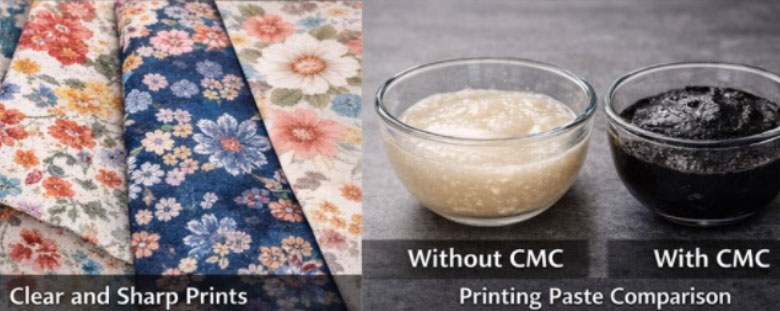
Q2: What roles does CMC play in textile printing and dyeing?
A2: In printing and dyeing, CMC is mainly used for:
- Thickening Agent: Increases the viscosity of printing paste, ensuring uniform distribution of dyes or pigments.
- Pigment Fixation: Helps bind pigments to fibers more effectively, improving color fastness.
- Print Clarity: Enhances edge definition and prevents bleeding.
Q3: How does CMC improve textile finishing processes?
A3: CMC is also used in finishing processes to enhance fabric quality:
- Softening and Lubrication: Improves fabric handle and reduces fiber friction during processing.
- Anti-redeposition: Prevents dirt or dye from reattaching to fabrics during washing.
- Coating and Sizing: Acts as a binder in coatings and improves warp yarn strength during weaving.

Q4: What are the typical specifications of textile grade CMC?
| Application | Suggested Viscosity Range | Key Focus |
| Warp sizing | 2000 – 3000 mPa·s | Film strength & adhesion |
| Textile printing | 1500 – 2500 mPa·s | Print sharpness |
| Fabric finishing | 1000 – 2000 mPa·s | Smooth hand feel |
| Yarn coating | 2500 – 4000 mPa·s | Wear resistance |
Conclusion
CMC is a versatile additive that plays a key role in modern textile printing, dyeing, and finishing. Its ability to improve viscosity, print quality, fabric handle, and environmental sustainability makes it an essential material for the textile industry.
SINOCMC Team