
CMC in Water-Based Foundry Coatings: Suspension, Application and Drying Checks
A water-based foundry coating can appear uniform after mixing and still fail in use through rapid settling, difficult remixing, uneven pickup, runs, poor coverage, slow drying, cracking or weak adhesion to the mould or core. When carboxymethyl cellulose (CMC) is part of the rheology and binder system, the purchasing question is not simply whether it increases viscosity. The real decision is whether a defined CMC candidate helps the complete coating remain stable, apply at a controlled film weight and survive the drying and casting process.
This guide gives foundries, refractory-coating formulators and industrial distributors a controlled way to evaluate CMC in water-based foundry coatings. It is limited to water-based systems and does not evaluate alcohol-based foundry coatings. It does not replace a foundry’s established formulation, safety controls or casting qualification. Instead, it connects raw-material identity, slurry preparation, rheology, application, drying and production evidence so that a sample can be judged without relying on one viscosity value.
Quick answer: Compare the new CMC against the approved coating with the same refractory package, carrier, solids, water quality, mixing history, density, substrate, application method, wet film target and drying conditions. Record suspension and remixing, apparent viscosity at defined shear conditions, recovery after shear, brush/dip/spray behavior, coating pickup, dry film integrity and the relevant casting result. A candidate should not be commercially approved until a production batch reproduces the laboratory result.
What CMC can—and cannot—control in a water-based foundry coating
Foundry coatings are multi-component suspensions. Refractory particles, carrier liquid, binders, suspending agents, wetting agents, defoamers and other additives interact. In a water based system, CMC may contribute to viscosity, suspension, water retention and dry film cohesion. Those effects can influence how readily solids settle, how the coating responds to brushing or pumping, and how the wet layer remains on a mould or core before drying.
CMC does not determine casting quality by itself. Refractory type and particle-size distribution, solids content, density, substrate condition, application thickness, drying, metal temperature, pouring practice and mould design can all affect the result. A higher viscosity is not automatically better: excessive low-shear structure can make remixing, pumping or leveling difficult, while insufficient structure can allow settling, drainage or penetration.
The existing SINOCMC overview of CMC in casting coatings describes the general functions. This article owns a different intent: a documented buyer and factory trial for comparing one CMC candidate with the approved system.
1. Define the coating system and end-use gate
Begin with the actual process. Record whether the coating is water based or alcohol based, the refractory package, binder system, mould or core material, substrate preparation and the intended application method. This workflow concentrates on water based coatings; results should not be transferred automatically to an alcohol based system.
Describe how the coating is applied—by brushing, dipping, flow coating, spraying or another established method—and how excess material drains. Record the target area, geometry, number of coats, drying method and the casting surface or defect risk that the coating is intended to manage.
Define the acceptance gates before testing. A useful plan covers container stability, remixing, application behavior, wet and dry film control, mould/core compatibility, drying time and the relevant casting inspection. Do not approve a CMC candidate only because the slurry remains visually suspended.
2. Freeze the reference formula and process
Change only the CMC variable during the first screen. Keep the following constant:
- refractory powder source, particle-size distribution and batch;
- carrier water, total water addition and temperature;
- other binders, clays, dispersants, wetting agents, defoamers and preservatives;
- target solids, density and pH;
- order and rate of addition;
- vessel geometry, impeller, speed, time and batch size;
- hold time and agitation before sampling; and
- substrate, application method, wet film target and drying conditions.
If solids, water or another suspending agent changes at the same time, an improvement cannot be assigned confidently to CMC. The same discipline used in a sample to commercial batch approval workflow applies here: keep an approved reference, document each variable and retain representative samples.
3. Identify the CMC sample and its test basis
Record the commercial grade, manufacturer, batch, physical form, agreed viscosity method and the application-relevant specification items. Do not compare two samples simply because both are described as “high viscosity.” The solution concentration, hydration procedure, temperature, instrument, spindle or geometry and rotational speed must be aligned.
Check the bag and powder before the trial. Moisture ingress, damaged liners, clumps or foreign material can change dosing and dispersion. Suspect material should follow a controlled CMC receiving and moisture-damage investigation rather than entering a normal formulation comparison.
Review the supplier COA against the agreed specification, but do not treat a passing COA as proof of coating performance. Incoming documentation and application qualification are separate approval gates.
4. Standardize CMC dispersion and hydration
CMC can form hydrated shells around dry cores when powder is added too quickly or the liquid surface is poorly renewed. In a high-solids refractory slurry, addition sequence and mixing energy can also change agglomeration, apparent viscosity and the time required to reach a stable condition.
Select one preparation route that matches the plant. Depending on the established formula, this may involve pre-hydrating CMC in a defined portion of water or introducing it through a controlled dry blend. Record water temperature, powder addition time, mixer speed, hydration time and the point at which refractory solids and other additives enter.
The plant’s proven sequence takes priority over a generic recipe. If the current process is not documented, first create a repeatable baseline using the principles in the CMC mixing and lump-prevention guide. Do not change powder form or mixing sequence during the same comparison.
5. Use a matched trial matrix
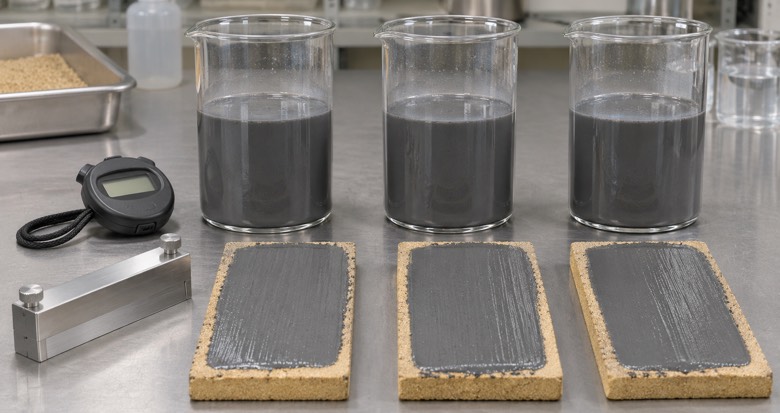
A small matrix is easier to interpret than a large formulation experiment. The rows below are condition labels, not recommended addition levels.
| Condition | CMC variable | Formula controls | Slurry checks | Process checks |
|---|---|---|---|---|
| Control | Current approved coating | Same solids, water, additives and density | Dispersion, rheology, settling and remixing | Pickup, film, drying and casting reference |
| Candidate A | First CMC grade at the planned screen level | Unchanged from control | Same methods and elapsed-time points | Same substrate and application conditions |
| Candidate B | Second grade or one controlled level change | Unchanged from control | Same methods and elapsed-time points | Same substrate and application conditions |
| Repeat | Selected candidate in an independent batch | Reweighed and remade | Repeatability and preparation sensitivity | Result spread and failure consistency |
6. Check density, solids and dispersion before rheology
Rheology data cannot be interpreted properly if the candidate batches have different solids or density. Measure the parameters required by the plant method after the same mixing and hold history. Check for dry specks, refractory agglomerates, foam and visible non-uniformity before taking a viscosity reading.
Particle-size distribution and powder-to-liquid ratio strongly influence foundry-coating flow and applied layer. A 2024 lost-foam study showed that changing powder-to-liquid ratio affected viscosity, shear-thinning behavior, coating weight and surface morphology in its tested system. That result supports controlling the ratio; it does not define a universal ratio for other water-based foundry coatings.
If a grind or dispersion gauge is part of the established plant method, use it consistently. Do not attribute poor dispersion automatically to CMC until powder addition, mixer energy, refractory condition and foaming have been checked.
7. Measure suspension and rheology as a profile
Record settling at defined times and temperatures in identical containers. Note the clear layer, sediment character and the effort needed to return the sample to a homogeneous condition. A coating that settles slowly but forms a hard, difficult-to-remix bed may be less useful than one with slight, easily reversible separation.
A flow cup can be useful for routine plant control when the method is already correlated to performance, but many water-based foundry coatings are shear-thinning or thixotropic. ASTM D1200 states that a Ford cup is intended for Newtonian or near-Newtonian liquids and directs non-Newtonian materials to rotational methods such as ASTM D2196. ASTM D2196 uses multiple speeds and recovery comparisons to characterize apparent viscosity, shear thinning and thixotropy.
Use the method required by the buyer or plant and record temperature, sample age and pre-shear history. The article on comparing CMC viscosity methods explains why concentration and test conditions must be aligned for supplier-grade comparisons.
8. Reproduce the real application step
Apply the control and candidates to mould or core coupons made from the actual substrate system. Match surface condition, temperature and application method. Measure or otherwise control wet pickup, drain time, number of passes and the interval before drying.
Observe brush drag and marks, dip drainage, spray pattern, flow, leveling, edge buildup, penetration and sag. The right response depends on the process: easy flow is not helpful if the coating drains from a vertical surface, while strong anti-sag behavior is not helpful if brush marks cannot level.
Coating thickness must be controlled because it affects drying, insulation and casting dimensions. Research on die coatings has reported that variation in the amount applied can contribute to dimensional variation, while refractory particle size and coating condition influence surface appearance and erosion resistance. Keep thickness and application history separate from the CMC identity in the trial record.
9. Follow drying and dry-film integrity
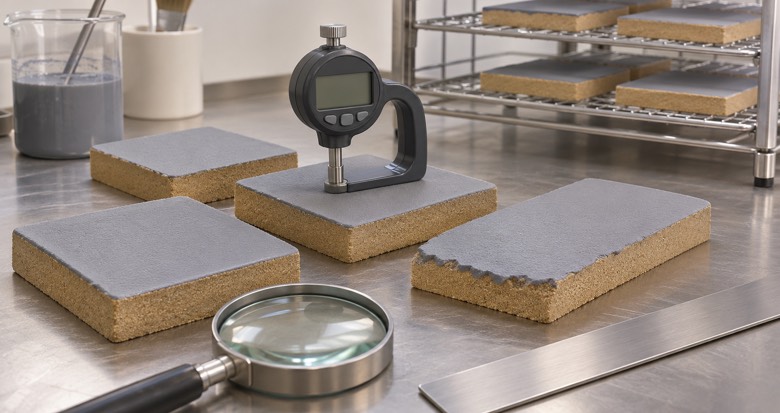
Record the drying environment, air movement, substrate temperature, coating thickness and the definition of “dry.” Visual surface dryness alone may not prove that the layer or underlying mould/core is ready for the next process.
Inspect for cracking, powdering, blistering, curling, edge lift, abrasion loss and poor adhesion to the substrate. Drying of particle-filled films involves liquid loss, particle consolidation and stress development; binder and rheology changes can therefore affect more than the stopwatch time. A World Foundry Congress study of one water based quick-drying coating separately measured suspension, drying, gas evolution, wear loss and high-temperature crack resistance, illustrating why no single test should stand in for the whole film evaluation.
Do not copy another study’s formulation or pass limits into a commercial specification. Use the foundry’s validated conditions and acceptance criteria.
10. Validate the coating in the controlled casting process
Laboratory slurry and coupon checks screen candidates; they do not establish casting suitability. Run the selected candidate in a controlled production or pilot casting with the same mould/core system, metal, geometry, pouring practice and inspection plan used for the approved control.
Evaluate only the relevant outcomes—for example coating transfer, erosion, burn-on, penetration, veining, surface finish, dimensional effect or cleaning effort—and record other process deviations. CMC should not be credited with an improvement unless the comparison controls the variables that could produce the same change.
Foundry trials involve heat, dust, chemicals and molten metal. Follow the facility’s qualified procedures, PPE, ventilation and hazard controls. This article is a raw-material evaluation framework, not an operating instruction for pouring or handling molten metal.
11. Confirm scale up and commercial lot control
Before purchase approval, confirm powder feeding, dust control, hydration time, vessel turnover, pump and filter response, agitation during use, transfer to the application station, cleaning and repeatability across the working shift. Compare the production batch with the retained laboratory candidate using the same critical methods.
The approval record should include the coating formula revision, CMC grade and batch, incoming documents, make-down instructions, process conditions, density/solids, rheology method, settling and remixing observations, application method, film target, drying conditions, coupon results, casting results, retained samples and responsible approval.
Agree which supplier or manufacturing changes require notification and requalification. A commercial name alone is not enough change control if the agreed CMC specification, physical form or test method changes.
Frequently asked questions
Is the highest-viscosity CMC the best choice for a water-based foundry coating?
No. The useful candidate must balance suspension, remixing, pumping or brushing, leveling, wet film control, drying and dry-film integrity. A high solution-viscosity number does not predict all of those properties.
Can I compare candidates with a flow cup only?
A flow cup may be useful for a validated plant control, but it is limited for shear-thinning or thixotropic materials. Use the established foundry method and add rotational measurements or recovery checks when they are necessary to explain application behavior.
How long should a settling test run?
Use time points that represent the coating’s real storage, transport and in-use hold periods. A short bench observation cannot establish package shelf life. Record both the amount of separation and the effort required to remix the sample.
Does better suspension guarantee fewer casting defects?
No. Suspension is one raw-material and slurry gate. Application thickness, drying, refractory selection, mould/core condition, pouring practice and casting design also affect results. Casting validation remains necessary.
Should water based and alcohol based coatings use the same CMC trial?
No. Carrier chemistry, binder compatibility, drying and safety controls differ. This workflow is written for water based systems. An alcohol based coating needs its own validated materials and procedures.
What information should I send with a CMC sample request?
Share the coating carrier, refractory system, solids and density, other binders or suspending agents, current make-down method, viscosity test conditions, application equipment, mould/core substrate, working-time target, drying method, trial quantity and the problem you need to solve. Protect confidential formula details according to your agreement.
Discuss a CMC sample for a water-based foundry coating trial
When contacting SINOCMC, provide the available formulation context, current CMC or target behavior, complete viscosity method, powder-handling preference, trial batch size and the slurry, application or film problem under review. The team can review the available product information and discuss a sample plan; final suitability must be confirmed in your own coating and casting process.
Send your water-based foundry coating trial requirements to SINOCMC.
Technical sources
- Liu, B., Liu, W. and Song, L. “Research on Water-Based Quick-drying Coatings for Foundry and the Film-Forming Mechanism.” 75th World Foundry Congress (2024). Open the conference paper.
- “Optimizing Powder-to-Liquid Ratios in Lost Foam Casting Coatings: Impacts on Viscosity, Shear Thinning Behavior, Coating Weight, and Surface Morphology.” Coatings 14(9), 1089 (2024). Open the peer-reviewed paper.
- “Experimental Evaluation of Ceramic Coatings for Die Protection in Low-Pressure Die-Casting Process.” Coatings 14(5), 643 (2024). Open the peer-reviewed paper.
- Poulsen, J. B. Drying of Water Based Foundry Coatings: Innovative Test, Process Design and Optimization Methods. Technical University of Denmark. DTU research record.
- ASTM International. D2196, Standard Test Methods for Rheological Properties of Non-Newtonian Materials by Rotational Viscometer. ASTM standard record.
- ASTM International. D1200, Standard Test Method for Viscosity by Ford Viscosity Cup. ASTM standard record.