
CMC in Grease-Resistant Paper: Barrier, Crease and Cobb Checks
A CMC grease resistant paper project should not be approved from a solution viscosity or one attractive oil-drop photograph. The buyer needs evidence that the complete coating system can be made consistently, applied at the intended coat weight, dried without defects, converted without opening barrier pathways, and tested against the real package use.
Quick answer: freeze the base paper, coating formula, CMC addition basis, application method, coat weight and drying conditions. Compare the current control with one CMC candidate at a time. Measure coating make-down and rheology, coat-weight uniformity, a grease-resistance method suited to the barrier mechanism, water absorptiveness where relevant, and performance after creasing, folding and converting. Finish with a package-relevant challenge using the intended fat or oil, temperature, contact time and geometry. Approve only against written limits and representative production evidence.
This guide is for paper mills, converters, coating formulators, distributors and technical buyers. It is deliberately narrower than SINOCMC’s overview of CMC in coated-paper production and the existing paper coating CMC qualification guide. Those pages cover general coating-color rheology, water retention and runnability. This article owns barrier design, grease and water test selection, crease damage, converting and end-use release.
Define the barrier job before selecting a CMC candidate
“Oil-resistant paper” is not a complete specification. Record the package form, base-paper grade and basis weight, coated side, food or non-food use, expected fat or oil, water content, temperature, contact time, pressure, folds, seams, printed areas and storage conditions. A dry snack wrapper, pet-food bag, bakery liner and takeaway tray can expose the sheet to very different combinations of grease, water, heat and flexing.
Separate claims that are often mixed together: surface repellency, resistance to grease breakthrough, water absorptiveness, water-vapor transmission, oxygen barrier, air resistance, seal integrity and package leakage. Passing one does not prove the others. If the intended use is food contact, define the destination market and the complete material construction before the trial. A performance result does not establish regulatory suitability, migration compliance or a “PFAS-free” claim.
The U.S. FDA states that PFAS-containing grease-proofing agents are no longer sold for use on food-contact paper and paperboard in the U.S. market, and the related authorizations were made ineffective after abandonment. That market fact increases interest in alternative barrier systems, but it does not make every cellulose-based formulation automatically compliant or equivalent.
Position CMC correctly inside the coating system
CMC can contribute film formation, solution structure, water retention, pigment or fiber dispersion and coating integrity. It may help a formulation cover pores and reduce defects. The result still depends on the base paper, CMC grade, coat weight, drying, other polymers or particles, plasticizers, crosslinking where permitted, and the final surface structure.
Recent USDA Forest Products Laboratory research compared CMC and cellulose-nanomaterial coatings on two copy papers under defined laboratory conditions. The authors found that CMC could aid coating and reduce defects, while the barrier result depended on material combination, processing and coat weight; creasing remained a challenge. Other published research has used CMC in multilayer systems with chitosan, nanocellulose, modified PVA, silica or other components. These studies demonstrate possible design routes, not a transferable commercial recipe or a guarantee for a SINOCMC sample.
Start with a written role for CMC. Is it the primary film former, a co-binder, a rheology modifier, a defect-control aid or part of a multilayer? The role determines which raw-material attributes, process controls and failure modes matter. The paper grade CMC product page provides general product context; the intended formulation and regulatory documentation still require application-specific confirmation.
Freeze the comparison basis and trial matrix
Use the approved production or pilot formula as the control. Keep the base-paper lot where practical, coating solids, pigments or fibers, binders, additives, water quality, pH, temperature, mixing sequence, screening, defoaming, application method and drying profile fixed. Record every deliberate adjustment. Quietly adding water until two coatings reach the same cup viscosity destroys the comparison.
Identify the CMC by supplier, grade, lot, physical form, moisture or loss on drying, purity basis, degree of substitution and exact certificate viscosity method. A one-percent result cannot be converted reliably into a two-percent value without material-specific evidence; use the CMC viscosity-method comparison to normalize certificate data before choosing candidates.
| Condition | Purpose | What stays fixed | Decision use |
|---|---|---|---|
| Control | Establish current process and barrier variation | Approved formula and operating window | Reference for all candidates |
| Candidate | Reveal grade effect at an equal declared basis | CMC mass or active-solids basis; same formula and process | Screen compatibility and defects |
| Optimized | Test a documented practical adjustment | One variable at a time, with revised solids and coat weight recorded | Define an operating window, not a rescue result |
| Repeat | Check batch and day reproducibility | Independent make-down and sampling plan | Confirm the selected condition before scale up |
Do not combine the equal-addition screen with the coat-weight optimization. First learn whether the candidate changes make-down, rheology, coverage or defects. Then optimize one selected condition with every change declared.
Control hydration, coating rheology and application
Write the batch sheet before mixing. Record vessel geometry, batch size, water source, temperature, agitator and impeller, speed or tip-speed basis, powder-addition rate, addition order, hydration time and the point at which salts, pigments, other polymers or crosslinkers enter. Check for fisheyes, gel particles, foam, wall build-up and incomplete dissolution. Use a filter or screen only if the normal process uses one, and report retained material rather than discarding it silently.
Measure the coating at a fixed temperature and age. One low-shear viscosity can be useful for make-down and pumping, but it does not describe high-shear application, leveling or recovery. Record the instrument, geometry or spindle, speed or shear rate, sequence and sample history. The target is a coatable operating window with controlled defects, not the highest viscosity.
Apply the control and candidates with the intended laboratory, pilot or production method. Measure wet pickup, dry coat weight and cross-sheet uniformity. Record dryer temperature, residence time, air conditions and final moisture. A smooth-looking sheet can contain pinholes, thin edges or local penetration paths that dominate grease failure.
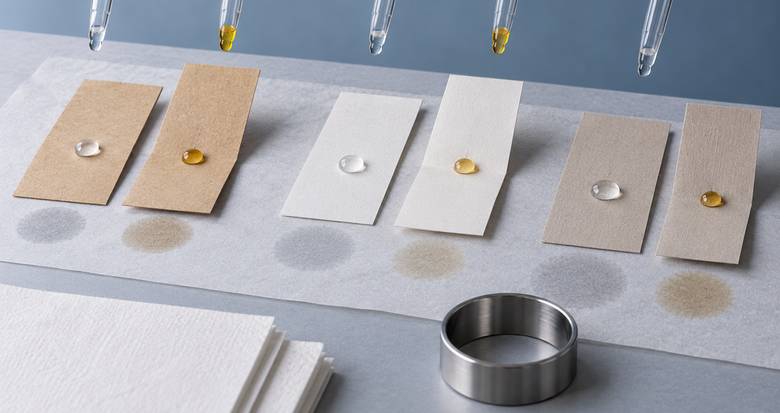
Choose grease tests that match the failure mechanism
The familiar TAPPI T 559 kit test reports the highest numbered test liquid that does not cause the defined surface failure. TAPPI also states that the method was designed primarily for fluorochemical surface treatments and that its use for film-like barriers or nonfluorochemical agents must be evaluated. A high kit number should therefore not be treated as universal proof of package performance.
ISO 16532-1 uses the time for a simulated fat material to break through paper or board and allows comparison of creased and uncreased specimens. This can reveal a different failure mode from short surface repellency. TAPPI T 454, intended for voids in glassine and greaseproof papers, is another example of a method with a narrower paper-type scope. Select the method with the buyer’s laboratory and end-use requirement; do not mix results from different procedures into one acceptance number.
For every result, record the standard and edition, conditioning, coated side, specimen count, coat weight, paper orientation, flat or creased state, reagent, contact time, failure definition, average and spread. Include blank base paper and the current control. When results cluster near the limit, add replicates and investigate defect location instead of averaging away a real weak spot.
Keep grease, water, vapor and oxygen evidence separate
CMC is hydrophilic. A dense CMC-containing film can slow oil, air or oxygen under some conditions, yet humidity, liquid water and drying history can change structure. If water exposure matters, measure it separately. ISO 535:2023 defines the Cobb method for water absorptiveness of paper and board within its stated scope. A Cobb result is not the same as water-vapor transmission or hot-water hold.
Specify which face is tested and whether edges are sealed. For a multilayer structure, test the complete construction and any relevant intermediate layer. If oxygen or water-vapor barrier is a requirement, use the buyer’s applicable transmission method at declared temperature and relative humidity. Do not transfer a dry-laboratory oxygen result to a humid food package without evidence.
Test creases, folds, seals and converted packages
Converting can turn a passing sheet into a leaking package. Score and fold specimens in the machine and cross directions using the intended radius, rule, pressure and sequence. Retest grease breakthrough across the crease and at corners. Inspect cracking, whitening, delamination, pinholes and exposed fibers. ISO 5626 measures folding endurance of paper under defined repeated folding, but package creasing is a different geometry; use it only when its scope supports the decision and retain a package-specific check.
Run printing, gluing or heat sealing where they are part of the construction. Confirm that inks, varnishes, adhesives and seal temperatures do not disturb the barrier or contaminate the test area. Measure seal strength and leakage with the buyer’s method. For trays, wraps or bags, include corners, seams, cut edges and closures rather than testing only an untouched center panel.
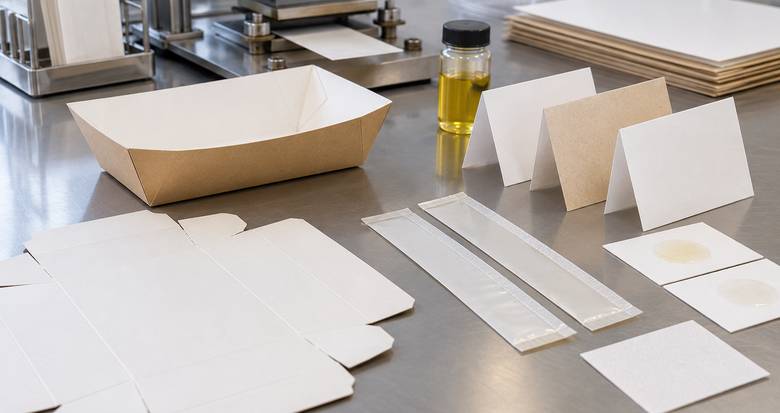
Use a realistic end-use challenge without overclaiming
Define the challenge from the package: oil or food simulant, temperature, contact duration, fill mass, headspace, stacking pressure and orientation. Include the most demanding credible combination, not an invented abuse condition. Observe staining, breakthrough, wicking, leakage, softening, odor transfer, delamination and seal failure. Use enough packages and production positions to capture variation.
Performance approval and food-contact compliance are separate gates. The buyer must confirm the complete construction, substances, intended conditions of use, migration or extraction requirements, declarations and labeling for each destination market. Do not describe a generated laboratory image, a raw-material certificate or a supplier article as evidence of legal approval.
Connect the selected formulation to production release
Repeat the selected condition with an independent coating make-down and a representative base-paper lot. Move to pilot or production only with predefined limits for make-down, coating viscosity profile, solids, coat weight, moisture, visible defects, grease test, water test where relevant, crease performance and converted-package challenge. Sample across the reel or sheet width and at planned time intervals.
The approval record should identify the CMC grade and lot, formula version, base paper, coating and drying conditions, test methods, raw data, acceptance limits and approvers. Define incoming checks and requalification triggers. A change in CMC source or grade, base paper, coat weight, another binder, dryer profile, converting geometry, package use or destination-market requirement may justify new evidence. The sample to commercial batch approval workflow explains how to bridge a laboratory sample to routine supply.
Diagnose common barrier-trial conflicts
- Flat sheet passes but the crease fails: examine coat flexibility, coat weight, base-paper compression, score geometry, moisture and layer adhesion.
- Kit rating looks good but oil breaks through during storage: the short surface test may not represent permeability, defects, temperature or contact time. Add a method tied to the real failure.
- Grease resistance improves but Cobb worsens: separate the two mechanisms and review the full hydrophilic/hydrophobic layer design, drying and exposed edges.
- Lab drawdowns pass but production varies: check cross-sheet coat weight, filtration, foam, streaks, dryer profile, base-paper porosity and sampling location.
- Average passes but isolated packages leak: map failures to corners, seams, pinholes, score intersections and reel position; a local defect cannot be released by the mean.
What a technical buyer should send with an inquiry
Share the base-paper type and basis weight, package format, food or non-food use, destination market, barrier claims, challenge oil or product, contact temperature and time, current coating composition ranges, solids, application method, target coat weight, dryer profile, printing and converting steps, current CMC grade, current failure mode, test methods and acceptance limits. Non-confidential control data are more useful than a request for the “best viscosity.”
Frequently asked questions
Can CMC alone guarantee grease resistance?
No. CMC can support film formation, rheology and defect control, but barrier performance depends on the complete coating, base paper, coat weight, drying, humidity, converting and end use.
Is the TAPPI kit test enough to approve a nonfluorinated coating?
Not automatically. TAPPI notes that T 559 was designed primarily for fluorochemical surface treatments and that applicability to film-like or nonfluorochemical barriers must be evaluated. Pair the method with permeability and package-use evidence when needed.
Should candidates be matched at equal viscosity?
Begin at an equal declared CMC addition basis to reveal grade effects. If the operating window requires viscosity adjustment, run a second documented optimization. Do not hide water, solids or coat-weight changes.
Why test both creased and uncreased paper?
A fold can crack or thin the coating and open a pathway that is absent in a flat specimen. ISO 16532-1 explicitly accommodates creased and uncreased testing; the converted package still needs its own checks.
Does a low Cobb value prove oil resistance?
No. Cobb measures water absorptiveness within the method’s scope. Grease repellency, breakthrough time, water-vapor transmission and seal leakage are separate properties.
Does a paper grade CMC certificate prove food-contact compliance?
No. The buyer must evaluate the exact raw material and complete package construction against the destination market, intended food, temperature, time and applicable compliance route.
Plan a decision-ready CMC barrier-paper trial
SINOCMC can review a non-confidential trial brief and discuss a CMC sample for the buyer’s own paper-coating evaluation. Include the base paper, full coating system, application and drying conditions, barrier methods, converting steps, compliance requirements, current control and failure mode. Contact SINOCMC with the brief; final approval should follow the buyer’s controlled laboratory, pilot, production and regulatory evidence.
Technical sources
- TAPPI. T 559 cm-22, Grease resistance test for paper and paperboard. TAPPI describes the kit-test principle and cautions that applicability to film-like and nonfluorochemical barriers requires evaluation.
- ISO. ISO 16532-1:2008, Paper and board — Determination of grease resistance — Part 1: Permeability test. The standard includes creased and uncreased specimens and determines breakthrough time for a simulated fat material.
- ISO. ISO 535:2023, Paper and board — Determination of water absorptiveness — Cobb method.
- ISO. ISO 5626:1993, Paper — Determination of folding endurance. Confirm method scope before using it for a converted-package decision.
- Sabo R, et al. Grease, Oxygen, and Air Barrier Properties of Cellulose-Coated Copy Paper. Polysaccharides. 2024;5:783–806. The study compares CMC and cellulose-nanomaterial coatings under its own materials and processing conditions.
- Shi H, et al. A facile method to prepare cellulose fiber-based food packaging papers with improved mechanical strength, enhanced barrier, and antibacterial properties. Food Bioscience. 2022;48:101729. The study evaluates a specific chitosan/CMC multilayer system.
- U.S. Food and Drug Administration. Authorized Uses of PFAS in Food Contact Applications. The page explains the U.S. market phase-out and abandoned authorizations for PFAS grease-proofing agents; it does not authorize an alternative coating.