
CMC Shelf Life and Retest Dates: A Buyer’s Storage and Release Guide
A printed date on a CMC bag or certificate can look like a simple release decision: use the material before the date, or reject it after the date. In practice, the decision is more disciplined. Buyers need to distinguish a supplier-supported shelf life from a retest or re-evaluation date, then confirm that the lot remained in its intended package and storage conditions.
For sodium carboxymethyl cellulose (CMC), age alone does not prove that a batch is suitable or unsuitable. Packaging integrity, moisture exposure, storage history, sampling and the test method all affect the evidence. This guide gives distributors, factories and quality teams a practical framework for receiving aging inventory, reviewing transferred stock and deciding whether a controlled requalification is justified.
1. Separate shelf life, expiration date and retest date
These terms are often used interchangeably in purchasing conversations, but they do not mean the same thing.
- Shelf life is the period supported by the supplier or responsible organization during which material is expected to meet the applicable specification when it remains in the defined, normally unopened package under the stated storage conditions.
- Expiration or use-by date is a limit after which the material should not be used under the governing quality system unless that system explicitly allows a scientifically justified alternative.
- Retest or re-evaluation date is a date after which the lot must be examined again against an approved specification before a new use decision is made.
The exact legal and quality-system meaning depends on the market and intended application. Pharmaceutical guidance provides useful definitions, but a food, detergent, paper, mining or construction buyer should not automatically apply an active-pharmaceutical-ingredient rule to industrial CMC. The buyer must follow the supplier documents, contractual specification and regulations that actually govern the finished product.
The ICH Q7 questions and answers published by the U.S. FDA make an important boundary explicit: API retest and expiry definitions do not strictly apply to raw materials, and a raw-material supplier may use the terms differently. That is why the first task is document clarification, not assumption.
2. Do not assume one universal CMC shelf life
There is no responsible universal shelf-life number for every CMC grade, package and destination. A defensible date must be connected to the manufacturer’s stability knowledge, the product specification, the packaging system and defined storage conditions.
Variables that can change the risk include:
- grade, degree of substitution, molecular-weight or viscosity range and purity profile;
- powder, granular or other particle form;
- paper bag, woven bag, polyethylene liner, drum or other barrier system;
- whether the package is factory sealed, opened, resealed or partially used;
- temperature, humidity, condensation, water ingress and proximity to heat or sunlight;
- pallet condition, floor and wall clearance, stacking damage and pest exposure;
- the end-use risk, such as food, pharmaceutical, battery, detergent or general industrial processing.
The International Pharmaceutical Excipients Council’s Excipient Stability Guide describes stability programs as the basis for recommended storage conditions and shelf-life claims, including re-evaluation, expiration and use-by dates. Its public summary also ties the expectation to an unopened container stored as recommended. This is a valuable best-practice principle even when the buyer’s CMC is not a pharmaceutical excipient.
3. Build the document chain before opening a bag
Begin with traceability. A date without a clearly identified lot, grade and manufacturer is weak evidence. Review the purchase specification, supplier technical data, label, certificate of analysis (COA), safety data sheet where relevant, shipment record and any storage instruction that accompanied the material.
The CMC certificate verification guide explains how to match the document issuer, lot identity, methods and actual results. For a shelf-life review, add these questions:
- Is the printed date an expiration date, a retest date or only a manufacturing date?
- Which document defines the storage condition and package on which the date depends?
- Does the date apply to the original unopened package only?
- Is there a supplier procedure for re-evaluation or date extension?
- Would the supplier issue a revised document, or must the buyer make and own the disposition?
- Was the lot repacked, transferred between warehouses or relabeled?
Do not alter a supplier COA or label to create a new date. If the buyer performs a requalification, record it as a buyer-side quality decision with its own sample, methods, results, approver and defined period of use.
4. Verify the package and storage history
A laboratory result is only one part of the decision. A sample taken from an intact, dry package with traceable storage history represents a different risk from a sample taken from a stained, punctured or repeatedly opened bag.
At minimum, inspect and record:
- outer bag, liner, seam and closure condition;
- water marks, dampness, caking, tears, punctures or contamination;
- pallet and stretch-wrap condition;
- warehouse temperature and humidity records where available;
- any excursion, flood, condensation or container-sweating event;
- whether bags were stored off the floor and away from walls and incompatible materials;
- inventory movements, partial use and resealing history.
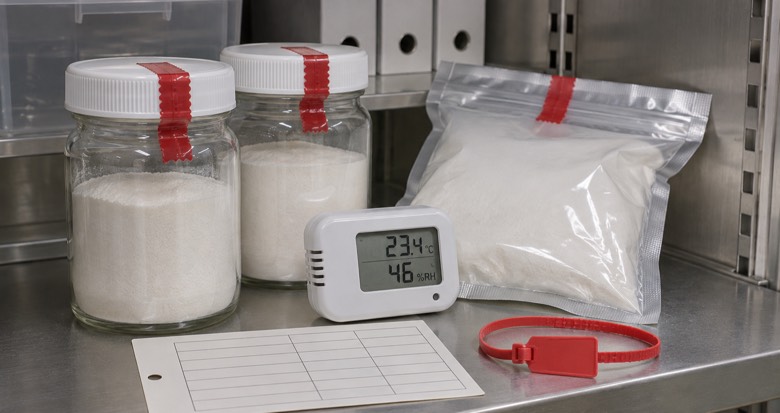
CMC powder interacts with environmental moisture. A peer-reviewed study on pharmaceutical excipients found that moisture content influenced powder flow, including CMC. A recent physical-properties review also summarizes the strong humidity-dependent moisture uptake of commercial sodium CMC powders. These sources support moisture control as a risk variable; they do not define a universal rejection limit for every commercial grade.
If damage or water exposure is suspected, quarantine the affected units and follow the evidence steps in the CMC moisture-damage receiving and storage guide. A normal-looking sample from one bag does not automatically clear other damaged bags.
5. Decide whether requalification is appropriate
Requalification is not automatic permission to use old stock. It is a controlled option only when the applicable quality system allows it and the evidence is sufficient. The decision should consider the end-use risk, supplier position, package history, available stability knowledge, sampling representativeness and whether the laboratory can reproduce the contractual methods.
Requalification is usually difficult to justify when:
- lot identity or original manufacturer cannot be confirmed;
- the package is open, wet, contaminated or materially damaged;
- storage records are missing after a known excursion;
- the supplier has assigned a firm expiration or use-by limit and does not support extension;
- the buyer lacks a current specification or validated test methods;
- the intended application has a higher safety or regulatory risk than the original approval;
- the remaining quantity is too small to justify representative sampling and full testing.
When the evidence is strong enough to consider testing, quality personnel should approve the written protocol before sampling. Purchasing urgency should not define the test scope.
6. Use a risk-based CMC retest plan
The retest panel should come from the applicable purchase specification and intended use. Do not select only the easiest test or copy a generic internet checklist. The table below shows common evidence categories and the questions they answer; it is not a universal specification.
| Check | Why it matters | Decision boundary |
|---|---|---|
| Identity | Confirms the sampled material is the intended CMC grade or compendial identity | Use the approved identity method; appearance or label review alone may be insufficient |
| Appearance | Screens for discoloration, foreign matter, caking and package-related change | Record observations; do not use appearance as proof of chemical or functional conformity |
| Moisture | Detects water uptake that may alter as-supplied mass, handling and test interpretation | Match the specified loss-on-drying or water method and basis |
| Viscosity | Checks a key functional property and possible storage-related change | Match concentration, dry basis, hydration, temperature, instrument, rotor, speed and endpoint |
| pH | Supports grade consistency and may reveal an abnormal sample or preparation issue | Use the specified solution concentration and conditioning |
| Purity | Confirms required compositional limits for the intended grade | Choose the contractual or compendial panel; do not infer purity from viscosity |
| Microbiology | May be critical for food, pharmaceutical or other sensitive uses | Apply only the relevant approved limits and sampling controls |
| Application | Confirms that laboratory conformity still translates into process performance | Run a controlled buyer-side trial when the functional risk justifies it |
For viscosity, method mismatch can create a false pass or false failure. Concentration, temperature, hydration time, instrument, rotor number, speed and dry-versus-as-received basis must be aligned. Review the CMC 1% and 2% viscosity comparison guide before comparing a supplier COA with an internal result.
7. Make sampling representative and traceable
An aging lot can become less uniform when some bags have been opened, moved or exposed differently. Define the lot boundary and package population before choosing samples. Segregate visibly damaged units rather than blending their evidence into an average.
The sampling record should identify the lot, package numbers, sampler, date, location, sampling tool, sample amount, container, seal and chain of custody. Protect the sample from ambient moisture during and after collection. If composite sampling is allowed, preserve individual samples long enough to investigate an unexpected result.
A retained sample is useful only when its package protection and history reasonably represent the commercial lot. A jar kept in a laboratory cabinet may not reproduce the humidity, closure or handling of a warehouse bag.
8. Compare with the original release evidence
A pass against the current specification is necessary, but trend information can make the decision stronger. Compare the retest result with the original COA, initial receiving result and retained-sample history using the same method where possible.

Large changes within the acceptance range may still require investigation. For example, a moisture increase can change the dry CMC actually added when a recipe is dosed on an as-supplied mass basis. A viscosity shift may be real, or it may reflect unmatched preparation and measurement. The food grade CMC COA review shows how to interpret a result without confusing the number with proof of application performance.
Do not average an out-of-specification result with a passing repeat to manufacture a pass. Follow the laboratory’s deviation and investigation procedure, including review of sampling, preparation, instrument suitability and data integrity.
9. Record a clear disposition and period of use
A requalification record should end with an explicit disposition: release, conditional release, further investigation, downgrade to an approved lower-risk use, return or disposal. “Lab passed” is not a complete decision.
If the lot is released, define:
- the quantity and packages covered;
- the approved end use and any restrictions;
- the new review date or limited period of use;
- storage and resealing requirements;
- whether application confirmation is required before full consumption;
- the approver and documents that support the decision.
Requalification should not create an endless cycle of new dates. Each extension consumes evidence and should be supported by the governing quality system, stability knowledge and actual lot history. Where a supplier position is required, obtain it in writing.
10. Prevent the same issue in future inventory
The lowest-cost solution is usually inventory control, not repeated rescue testing. Align order quantity with consumption, lead time and the supplier-supported date. Use first-expire-first-out where appropriate, keep packages sealed until needed, record partial bags and maintain dry storage.
During purchasing, confirm date expectations before the order is placed. The custom CMC packaging and lead-time guide helps buyers connect packaging, quantity and production timing. For a new grade or supplier, include date language in the sample to commercial batch approval workflow so the trial sample and commercial delivery are evaluated on a comparable basis.
11. Questions to ask the CMC supplier
- What shelf life, retest period or use-by date is assigned to this exact grade and package?
- Which storage conditions and package state support that date?
- Is the date based on manufacturing date, release date or another defined point?
- Does the date apply only to unopened original packaging?
- Which specification and methods should be used for re-evaluation?
- Can the supplier review a specific lot’s COA, storage history and packaging evidence?
- What change-notification, traceability and retained-sample practices apply?
- Will the supplier issue a written recommendation, and what decisions remain the buyer’s responsibility?
Frequently asked questions
How long is the shelf life of sodium CMC?
There is no single responsible number for every sodium CMC grade and package. Use the date and storage conditions assigned by the responsible supplier for the exact material. Confirm whether the date means shelf life, expiration, use-by or re-evaluation.
Can CMC be used after its retest date?
A retest date normally means the material requires approved re-examination before use; it is not automatic permission and not automatically the same as an expiration date. The buyer must follow the applicable quality system, supplier documentation, specification and intended-use requirements.
Is passing viscosity enough to release old CMC?
No. Identity, packaging, storage history, moisture, applicable purity or microbiological requirements and intended-use performance may also matter. Viscosity itself is meaningful only when the specified preparation and measurement method is matched.
Can an opened bag keep the same shelf life as an unopened bag?
Do not assume so. Opening changes the package barrier and introduces handling, moisture and contamination risks. Follow the supplier’s instructions and the buyer’s resealing, partial-container and use-period procedure.
Does caking always mean the CMC has failed?
Caking is a warning that requires investigation, not a complete chemical conclusion by itself. Quarantine affected packages, document the condition and assess moisture, contamination, sampling and functional risk under an approved procedure.
Can a distributor extend the manufacturer’s date?
A distributor should not simply overwrite the manufacturer’s date. Any buyer- or distributor-side requalification needs a defined quality-system basis, representative sampling, approved methods, documented results, a responsible approver and clear ownership of the new disposition.
Build a defensible CMC inventory decision
If you are reviewing aging or transferred CMC inventory, share the grade, lot, original package, manufacturing and printed dates, supplier documents, storage records, package condition, intended application, current specification, available test methods, remaining quantity and decision deadline. Contact SINOCMC to discuss the documentation and sample plan for a supplier-side review. Final release, regulatory and application suitability remain the buyer’s responsibility.
Technical sources
- IPEC Excipient Stability Guide for Pharmaceutical Excipients, Version 2, IPEC Federation, 2022.
- ICH Q1A(R2): Stability Testing of New Drug Substances and Products, International Council for Harmonisation.
- Q7 Good Manufacturing Practice Guidance for Active Pharmaceutical Ingredients: Questions and Answers, U.S. Food and Drug Administration.
- Q7A Good Manufacturing Practice Guidance for Active Pharmaceutical Ingredients, U.S. Food and Drug Administration.
- The Effect of Moisture on the Flowability of Pharmaceutical Excipients, AAPS PharmSciTech, 2013.
- Physical Properties of Carboxymethyl Cellulose (I): Solubility, Conformation and Supramolecular Aggregation, Polymer Reviews, 2026.