
Xanthan Gum Specification: A Buyer’s COA and 200-Mesh Check Guide
A xanthan gum offer can look complete because it lists viscosity, pH, moisture, ash, particle size and microbiological limits. Yet a buyer can still approve the wrong material if the document does not identify the grade, destination-market requirements, test methods, units, specification revision and lot-specific results. The phrase “200 mesh” is a good example: it is not a complete particle-size requirement unless the percentage passing and the sieve method are also defined.
This guide helps food-additive distributors, procurement teams and factory quality units review a xanthan gum specification, supplier data sheet and certificate of analysis (COA) before sample or commercial approval. It does not certify a supplier or replace the buyer’s regulatory, laboratory or application review.
Quick answer: separate four questions. First, does the material meet the current legal and identity requirements for the destination market and intended food use? Second, does the agreed purchase specification define the commercial grade and every acceptance method? Third, does the COA report traceable results for the actual lot? Fourth, does that lot perform in the buyer’s real formulation and process? A “food grade,” viscosity or 200-mesh statement cannot answer all four.
Start with four different documents—not one overloaded certificate
Buyers often use “specification” to describe several documents that serve different purposes. Keeping them separate prevents a typical value, regulatory statement or safety sheet from being mistaken for a lot-release result.
| Document | What it should establish | What it does not prove by itself |
|---|---|---|
| Regulatory statement | Identity, applicable market framework, intended-use boundary and cited revision | That every contract item or application requirement is satisfied |
| Purchase specification | Agreed limits, units, methods, grade, packaging and change-control requirements | That the shipped lot actually passed |
| TDS / product data sheet | Typical product description, grade positioning and handling information | Lot-specific conformity or legal acceptance in every country |
| Lot COA | Identity of the tested lot and its reported results against the agreed specification | Performance in the buyer’s formulation or authenticity of unrelated certificates |
An SDS has another purpose: hazard communication and safe handling. It should not be used as a substitute for the product specification or COA. Likewise, a laboratory accreditation certificate can support confidence in a defined testing scope, but it does not mean that every method or every lot result is covered. The supplier certificate verification workflow explains how to check issuer, holder, site, product, scope and validity instead of relying on a logo.
Build the specification from the intended market and use
There is no single global xanthan gum specification that automatically fits every destination, food category and customer contract. The current FAO/JECFA monograph, United States requirements and European Union specifications share important identity and purity concepts, but their wording, methods and limits are not identical. Food-use permissions can also depend on the food category and conditions of use.
For example, the United States rule in 21 CFR 172.695 describes xanthan gum identity, recovery process, viable-cell condition, residual isopropyl alcohol, a defined viscosity procedure and identification tests. The EU amended its E 415 definition and purity criteria through Commission Regulation (EU) 2026/196. Codex GSFA lists xanthan gum as INS 415 and provides use provisions by food category. A buyer should therefore name the destination market, end product and applicable document revision rather than write only “food grade.”
The public SINOCMC food grade xanthan gum 200-mesh data sheet is a useful example of a commercial grade description. Because it is an older public document, it should not be copied into a new purchase contract without confirming the current product revision, destination-market requirements and lot COA. A current quotation and approval package should resolve any difference between a legacy data sheet and the buyer’s current specification.
Review identity before comparing performance numbers
Start with the product name, grade code, manufacturer or responsible supplier, manufacturing site where relevant, CAS number, INS/E number for food use and lot number. Confirm that the product and site named on supporting certificates match the material being offered. A certificate for a company group, trading office or different site should not be assumed to cover the shipped lot.
Food-grade identity is more than a trade name. JECFA describes xanthan gum as a high-molecular-weight polysaccharide produced by pure-culture fermentation of a carbohydrate with Xanthomonas campestris, recovered with ethanol or isopropanol, dried and milled. The current EU definition adds its own organism and residual-enzyme conditions. The buyer’s approval record should cite the applicable identity source instead of using a marketing description alone.
Read a 200-mesh claim as a test statement
“200 mesh xanthan gum” is commonly used as a grade label, but mesh count alone does not tell the buyer how much material passed, which test sieve was used or how the test was run. The SINOCMC example data sheet states two separate limits: 100% through 80 mesh and not less than 92% through 200 mesh. That is materially different from saying “100% through 200 mesh.”
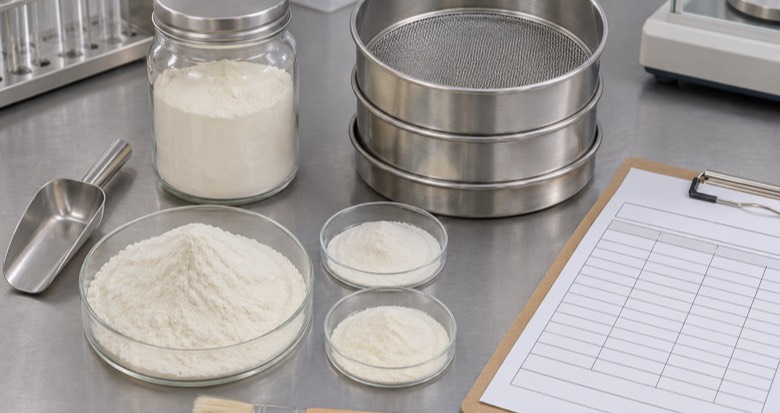
Before accepting a mesh statement, ask for:
- the percentage passing each named sieve, not only the grade label;
- the sieve designation or nominal aperture and the referenced sieve standard;
- the sample mass and whether the sample is tested as received or after conditioning;
- the sieving equipment, duration, intensity and any permitted brushing or air-jet step;
- the calculation and rounding rule; and
- method precision or an agreed repeat check near the acceptance limit.
ASTM E11 and ISO 3310-1 define technical requirements for woven-wire test sieves, while ISO 2591-1 describes factors affecting test sieving and reporting. Referencing the sieve hardware standard is useful, but the purchase specification still needs the product test procedure. Two laboratories can use a nominally similar sieve and obtain different results if sample conditioning, loading, time or handling differs.
Finer powder is not automatically the better grade. Particle size can affect dispersion, dust, lumping tendency, feeding and hydration, but those effects also depend on addition order, agitation, other dry ingredients and the liquid phase. Do not use a 200-mesh result as a substitute for an application trial.
Normalize the viscosity method before comparing COAs
A xanthan gum viscosity value is meaningful only with the complete method. At minimum, record the polymer concentration, salt concentration and identity, water quality, basis of addition, dispersion procedure, hydration time, test temperature, instrument model, rotor or spindle/geometry, speed, measurement time and reporting unit.
One official method illustrates the point. The US regulation specifies a 1% xanthan gum solution containing 1% potassium chloride, stirred for two hours and measured at 75°F using a Brookfield LVF or equivalent with a No. 3 spindle at 60 rpm; it also specifies a temperature-ratio check. A commercial grade may use a tighter viscosity range, but the reported number cannot be compared fairly if its preparation or measurement conditions differ.

Also separate viscosity from the shear ratio or other rheological descriptors. A single-point result does not describe the full flow curve, recovery after shear or behavior in the customer’s formulation. If the buyer needs pourability, suspension or texture evidence, define those application endpoints separately. The CMC versus xanthan gum bench-trial guide owns the material-comparison intent, while the CMC–xanthan blend-ratio guide covers formulation optimization. This article does not replace either trial.
Check each COA line for result, unit and method
A COA that reports only “Pass” can be difficult to trend or investigate. Where appropriate, the buyer should receive the actual result, unit, specification limit and method reference. Qualitative identity or absence tests may legitimately be reported as conforming, positive, negative or absent, but the wording should match the defined method.
Use the following review order:
- Traceability: product name, grade, lot or batch, manufacturing date where applicable, COA issue date and authorized issuer.
- Specification revision: the COA should map to the same approved limits and methods as the purchase order.
- Identity and appearance: confirm the defined identity test and descriptive boundary; appearance alone is not identity.
- Physical and chemical results: viscosity, pH, loss on drying or moisture, ash, pyruvic acid, nitrogen and other agreed items with units and methods.
- Particle size: percentage passing each agreed sieve, not “200 mesh” by itself.
- Contaminants and microbiology: limits appropriate to the current destination-market and customer specification, with sampling and methods defined.
- Supporting statements: allergen, GMO, irradiation, animal-origin, halal, kosher or other requested information should be current, scoped and separately verified where relevant.
The buyer should also define how out-of-specification, atypical or corrected results are handled. A revised COA should preserve the audit trail rather than silently replacing the earlier document. If an external laboratory report is used, confirm sample identity, lot, test scope, method and report authenticity. ISO/IEC 17025 provides a framework for laboratory competence, impartiality and consistent operation, but accreditation status must be checked against the specific laboratory and scope.
Use a buyer matrix to close specification gaps
| Item | Specification must state | COA must identify | Buyer verification |
|---|---|---|---|
| Viscosity | Range, unit and complete preparation/measurement method | Lot result, unit and method reference | Method-matched check and application trial |
| Particle size | Percent passing, sieve designation/standard and procedure | Result for each agreed sieve | Repeat near-limit result; dispersion and handling check |
| Purity / contaminants | Current destination-market and contract limits with methods | Lot result, unit and applicable qualifier | Risk-based identity or confirmatory testing |
| Microbiology | Organisms/counts, sampling quantity, limits and methods | Lot-specific count or absence result | Risk-based verification and trend review |
| Documents | Required declarations, certificate scope and revision | Lot and issuer linkage where applicable | Issuer/source validation and expiry tracking |
Approve the grade, then bridge the first commercial lot
Document review is only the first gate. After the buyer aligns the specification and methods, test a representative sample in the intended process. Freeze the formulation, addition order, hydration conditions, other ingredients, equipment, hold times and application endpoints. Record both laboratory data and practical observations.
When the sample passes, do not assume every future shipment is automatically approved. The first commercial lot should be compared with the approved sample using the agreed incoming checks and the critical application test. Retain traceable samples and define which supplier, site, raw-material, process, method, specification or packaging changes require notification and requalification. The sample-to-commercial-batch approval process provides the broader scale-up workflow.
A disciplined supplier file normally contains the approved specification revision, current TDS and SDS, COA template, relevant regulatory statements, verified certificates, sample/lot identity, test-method references, trial report, first-commercial-lot bridge, change-control agreement and routine release record. For a deeper certificate-to-result review, use the COA interpretation guide as a documentation checklist while keeping the xanthan-specific methods and limits in this article.
Frequently asked questions
Does “200 mesh xanthan gum” mean that all powder passes a 200-mesh sieve?
No. It is often a commercial grade label. The actual specification must state the percentage passing each sieve. The SINOCMC example states 100% through 80 mesh and at least 92% through 200 mesh; it should not be rewritten as 100% through 200 mesh.
Is a finer xanthan gum always easier to use?
No. Finer material may change dispersion and hydration behavior, but it can also change dusting, feeding and lumping risk. The result depends on the formula, addition method and mixing system. Confirm suitability in the buyer’s process.
Can a COA alone prove that xanthan gum is food grade?
No. The COA should show lot results against the agreed specification, but food-grade approval also requires correct identity, current destination-market review, intended-use assessment, traceable supporting documents and buyer acceptance.
Why can two xanthan gum viscosity results differ?
Concentration, salt, water quality, dispersion, hydration time, temperature, instrument, rotor or spindle, speed and read time can all change the result. Compare values only after the method is normalized.
Should the same xanthan gum specification be used for the United States and the EU?
Not automatically. The relevant legal texts, current revisions, food categories and customer requirements must be checked for each destination. A supplier data sheet is not a universal regulatory opinion.
Does meeting the specification guarantee performance in a sauce, beverage or other food?
No. The specification controls agreed raw-material attributes. Finished-product performance also depends on formula, process, shear, temperature, pH, salts, other hydrocolloids and storage. Use a controlled application trial.
Prepare a xanthan gum specification review
When contacting SINOCMC, share the destination market, food application, required grade, current specification, viscosity method, particle-size requirement, microbiological and contaminant limits, requested declarations, annual or trial quantity, packaging and approval timeline. If “200 mesh” is required, state the percentage passing and test method rather than only the grade name.
The team can review the available product information and discuss a sample plan. Final regulatory acceptance, specification approval and application suitability remain the buyer’s responsibility. Send your xanthan gum specification and trial requirements to SINOCMC.
Authoritative references
- FAO/WHO Joint Expert Committee on Food Additives. Xanthan gum specification monograph record, including the 2016 monograph.
- United States Government Publishing Office. 21 CFR 172.695 — Xanthan gum.
- European Union. Commission Regulation (EU) 2026/196, amending the E 415 definition and specifications.
- Codex Alimentarius. General Standard for Food Additives, CXS 192-1995.
- ASTM International. ASTM E11-24 — Woven Wire Test Sieve Cloth and Test Sieves.
- International Organization for Standardization. ISO 2591-1:1988 — Test sieving methods and ISO 3310-1:2016 — Test sieves of metal wire cloth.
- International Organization for Standardization. ISO/IEC 17025:2017 — Competence of testing and calibration laboratories.