
In the modern ceramic manufacturing process, achieving the perfect balance of strength, smoothness, and precision is a constant challenge. Sodium Carboxymethyl Cellulose (CMC), a versatile polymer derived from natural cellulose, has emerged as an indispensable additive in this field. Often referred to as “industrial monosodium glutamate,” CMC plays a multi-functional role as a binder, thickener, and rheology modifier, significantly enhancing the quality of ceramic products from the body to the glaze.

What is Ceramic Grade CMC?
Ceramic grade CMC is a high-purity water-soluble polymer that dissolves to form a stable, transparent colloidal solution. In the ceramic industry, it is specifically valued for its excellent water retention, film-forming properties, and high adhesion. It is widely used in ceramic bodies, glaze slurries, and flower paper (decal) production.
Core Applications of CMC in Ceramics
1. In Ceramic Bodies (Greenware)
In the production of ceramic tiles and sanitary ware, CMC is added to the body formulation as an efficient binder and plasticizer.
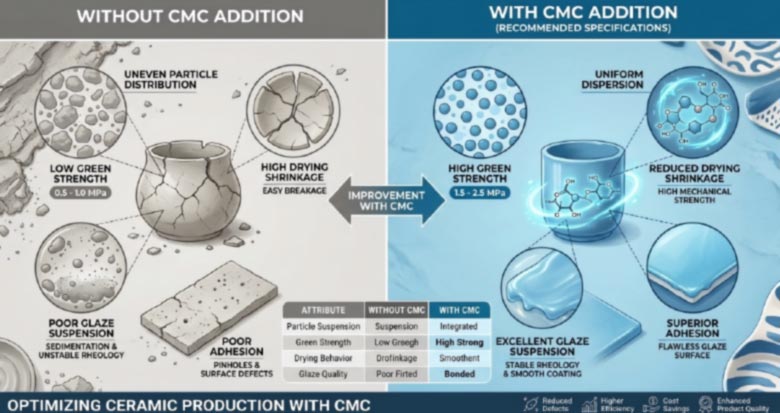
Enhanced Green Strength: CMC significantly improves the mechanical strength of the green body (unfired ceramic), reducing the risk of breakage during handling and transportation.
Improved Plasticity: It increases the plasticity of the clay, making it easier to mold into complex shapes and preventing cracking during the drying process.
Water Retention: CMC helps control the evaporation rate of water, ensuring uniform drying and preventing structural defects.
2. In Glaze Slurry
The glaze is what gives ceramics their aesthetic appeal and surface protection. CMC is a critical component in maintaining the stability of glaze suspensions.
Rheology Control: It acts as a thickener, providing the glaze slurry with the ideal viscosity for various application methods, such as dipping, spraying, or pouring.
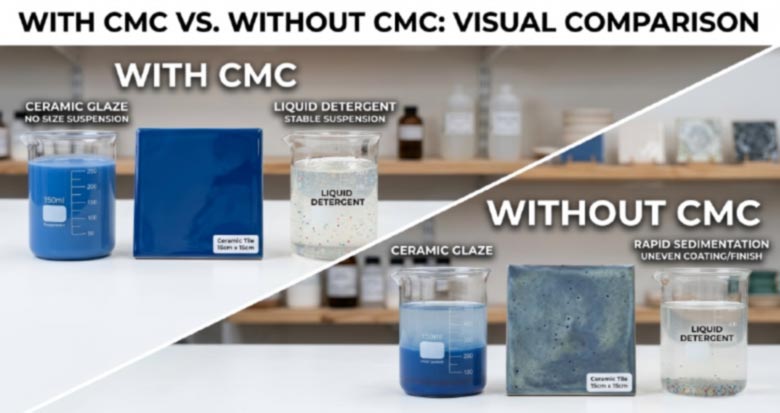
Preventing Sedimentation: By forming a stable network in the slurry, CMC prevents heavy glaze particles from settling at the bottom, ensuring a uniform coating.
Surface Smoothness: CMC helps the glaze flow evenly over the ceramic surface, eliminating pinholes and orange peel effects, resulting in a flawless finish after firing.
Recommended Specification and Dosage of CMC in Ceramic Industry
| Application Category | Recommended CMC Grade | Viscosity (mPa.s, 2% Sol.) | Degree of Substitution (D.S) | Recommended Dosage (%) | Key Function |
| Ceramic Body | Low to Medium Viscosity | 20 – 500 | 0.5 – 0.7 | 0.05%-0.20% | Enhances green strength and reduces breakage during handling. |
| Glaze Slurry | High Viscosity | 1,000-4,000 | 0.85-0.95 | 0.10%-0.30% | Improves glaze suspension, prevents sedimentation, and ensures smooth coating. |
| Printing Glaze | High Viscosity / High Purity | 4,000-6,000 | 0.90 – 1.2 | 0.20%-0.50% | Provides excellent rheology and water retention for sharp printing patterns. |
Conclusion
As the ceramic industry moves towards more automated and high-precision manufacturing, the demand for high-quality chemical additives like CMC continues to grow. By optimizing the physical properties of ceramic materials, CMC not only improves production efficiency but also elevates the artistic and functional value of the final products.
For more information on our ceramic grade CMC or to request a sample, please feel free to contact the SINOCMC Team. We are dedicated to providing the best chemical solutions for your industry needs.
SINOCMC Team