
In the competitive world of coating manufacturing, the difference between a premium product and a mediocre one lies in its rheology. While many factors contribute to a paint’s quality, Painting Grade CMC (SODIUM Carboxymethyl Cellulose) serves as the essential backbone that dictates how a coating behaves from the moment it’s canned to the second it dries on a wall.
While issues like pigment settling and dripping are common headaches in the industry, the true value of Painting Grade CMC is found in its active role during the application process.

1. Achieving Perfect Suspension Stability
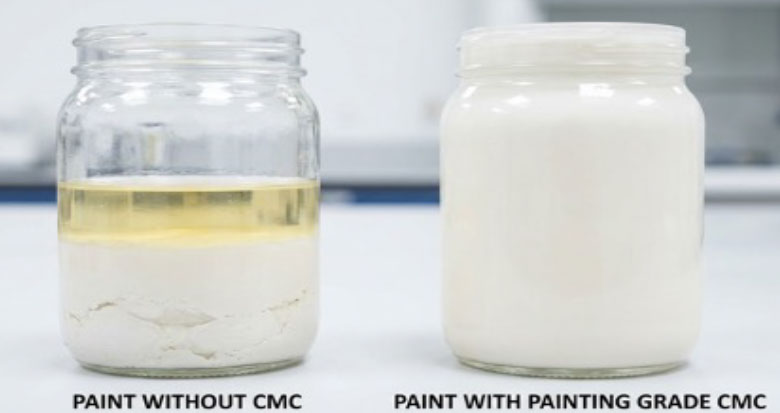
The primary role of Painting Grade CMC is to create a sophisticated molecular “web” that holds pigments and extenders in a state of permanent suspension. Without CMC, gravity inevitably wins, pulling heavy solids to the bottom and leaving a watery layer at the top.
CMC ensures that every brushstroke delivers the exact pigment-to-binder ratio intended by the chemist, eliminating the need for exhaustive re-stirring before use.
2. Precision Shear-Thinning for Effortless Application
A high-quality paint must be a “shape-shifter.” It needs to be thick in the can, thin while being brushed or sprayed, and thick again the moment it touches the wall. Painting Grade CMC provides this pseudoplastic behavior.
Under the high shear of a roller or spray nozzle, the CMC molecules align, allowing the paint to flow like water for maximum coverage. The moment the pressure is released, the molecular structure rebuilds instantly, providing the “body” needed to stay in place.

3. Film Leveling and Smooth Finishes
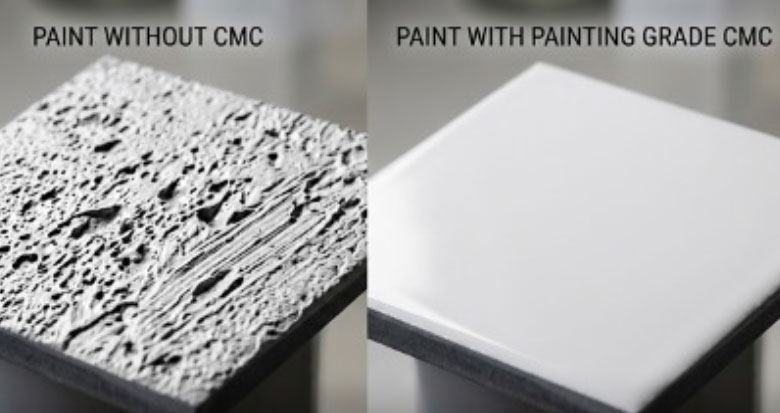
The “sandpaper” texture or visible brush marks often found in low-grade paints are usually the result of poor leveling. CMC controls the water retention of the coating, slowing down the drying process just enough to allow the paint to “level out” before it sets. This results in a mirror-smooth finish that feels as good as it looks.
4. Technical Specifications for Painting Grade CMC
To achieve these results, selecting the correct degree of substitution (D.S.) and viscosity is vital:
| Application Type | Recommended Viscosity (2% Soln.) | Primary Benefit |
| High-Gloss Latex | 500 – 1,500 cps | Excellent flow and leveling |
| Matte Wall Paint | 2,000 – 4,000 cps | High-build thickness and sag resistance |
| Texture/Stone Paint | 5,000 – 10,000 cps | Suspends heavy aggregates and sand |
| Water-based Primer | 200 – 800 cps | Deep penetration and uniform sealing |
| High-Gloss Latex | 500 – 1,500 cps | Excellent flow and leveling |
4. Summary
Painting Grade CMC is the hidden engine behind a high-performing coating. By optimizing suspension, controlling flow, and ensuring a smooth finish, it transforms a simple liquid into a professional-grade tool. At SINOCMC, we provide specialized grades designed to integrate seamlessly with your systems. If you have any demand for painting grade CMC, please feel free to contact us.
SINOCMC Team