
CMC in Liquid Detergent: A Compatibility and Soil-Redeposition Trial
A useful CMC trial in liquid detergent must separate three questions: does the powder hydrate reproducibly, does it remain compatible with the surfactant and electrolyte system, and does it improve fabric performance under a controlled wash? A beaker that looks thicker on day one answers none of those questions by itself. The trial needs a formula control, documented process conditions, storage checks and a soil-redeposition comparison on the intended textile.
Quick answer: Prepare a control and a small CMC ladder in the complete detergent base. Keep water, surfactants, builders, electrolyte, pH, fragrance, batch size and mixing history constant. Record dispersion and hydration, then measure viscosity at defined temperature and shear conditions, appearance, phase stability and pourability after fixed holds. For laundry products, run matched cotton swatches with a controlled soil load and compare reflectance or color change after washing. Advance a grade only when formulation stability, processing and fabric results all meet predefined limits.
This guide is for formulators, technical buyers and quality teams designing a liquid detergent CMC trial. It does not repeat the broad function overview in What can CMC do in liquid detergent. Instead, it turns the ingredient claim into a practical compatibility and anti-redeposition test plan.
Define the job before selecting a CMC grade
CMC can be considered for more than one role in a liquid detergent: helping suspend dispersed soil, reducing soil redeposition on cellulosic fabrics, adjusting flow, or supporting physical stability. Those roles do not automatically rise and fall together. A grade that gives a large viscosity increase may be inconvenient to disperse, sensitive to the formula’s ionic environment or unnecessary for the fabric-performance target. A low-viscosity grade may contribute little to bottle appearance yet still deserve testing for anti-redeposition performance.
Start with one primary objective and a short list of guardrails. For example:
- Primary objective: reduce gray-soil redeposition on cotton under the intended wash conditions;
- Formula guardrails: no haze, precipitation, phase split or unacceptable fragrance change;
- Process guardrails: complete addition without persistent fisheyes, excessive air or impractical mixing time;
- Use guardrails: pourability, dosing and rinsing remain acceptable across the specified temperature range; and
- Commercial guardrails: the approved grade, test method and lot acceptance plan can be transferred through scale up.
If the project is a hard-surface cleaner or dishwashing liquid rather than a laundry detergent, replace the fabric test with the actual application task. Do not claim anti-redeposition on cotton from a bottle-stability study.
Map the complete formula and ionic environment
CMC is an anionic, water-soluble cellulose derivative. Its solution behavior depends on molecular mass, concentration, degree and uniformity of substitution, temperature, pH, ionic strength and the surrounding ingredients. Published solution studies show that salts and surfactants can change CMC conformation and viscosity; studies with cationic surfactants also demonstrate strong, concentration-dependent polymer–surfactant interactions. These findings are reasons to test the real formula, not predictions of one universal outcome.
Document the detergent base before adding CMC:
- surfactant identities, charge types and active-matter basis;
- builder, chelant, hydrotrope and solvent levels;
- sodium chloride, sulfate or other electrolyte additions;
- pH target and neutralization sequence;
- water hardness or deionized-water specification;
- enzymes, preservatives, optical brighteners, dyes and fragrance; and
- final solids, density, fill temperature and package.
Cationic ingredients deserve particular attention because they can interact strongly with anionic CMC. Even within anionic or nonionic surfactant systems, salt level, hydrotrope balance and processing can change the observed viscosity and clarity. Use compatibility screening rather than assuming that two ingredients are compatible because each is water soluble.
Lock sample identity and the measurement basis
Record the CMC manufacturer, grade, lot, powder or granular form, purity basis, moisture or loss on drying, degree of substitution, certificate viscosity method and any supplier preparation instructions. “Detergent grade CMC” is not a sufficient sample identity. Two materials carrying that description can differ in polymer architecture, viscosity response, dissolution rate and non-CMC content.
Certificate viscosity should be used as a lot-control result under its stated method, not as a direct forecast of the finished detergent. Concentration, solution basis, water quality, temperature, instrument geometry, spindle, speed and hydration endpoint all affect the number. See our guide to comparing 1% and 2% CMC viscosity results before comparing supplier data.
Decide whether the trial addition is calculated on supplied powder or dry CMC solids. Whichever basis is chosen, use it consistently and report it. When purity or moisture differs materially between grades, a nominal equal-weight comparison may not be an equal-polymer comparison.
Build a compact control and dosage matrix
The first screen should be large enough to show a useful response without creating an unmanageable number of batches. Keep the base formula and process constant while changing only CMC grade or level. Do not copy a dosage range from a general article into production; select the ladder from the supplier’s guidance, the current formula and the project’s performance target.
| Condition | CMC variable | Purpose | Required observations |
|---|---|---|---|
| Control | No added trial CMC, or the current approved grade | Confirms the current formula and defect are repeatable. | Process, rheology, storage and fabric baseline. |
| Low | Low trial level | Tests whether a small addition changes compatibility or redeposition. | Same measurements and wash load as the control. |
| Mid | Middle trial level | Maps the response without assuming linearity. | Same measurements and wash load as the control. |
| High | High trial level within the approved study range | Identifies benefit, plateau or processing penalty. | Same measurements and wash load as the control. |
| Repeat | Independent preparation of the leading condition | Checks whether the result survives normal preparation variation. | Full critical measurement set. |
For a grade comparison, keep active CMC basis fixed first. For a dosage comparison, use one grade. Changing grade, dosage, salt, fragrance and mixing sequence together may produce an attractive sample, but it will not reveal which factor caused the result.

Control dispersion, hydration and order of addition
CMC powder can form surface-wetted lumps when it meets water too quickly. A lumped sample may appear weak at first and then change during storage as the remaining polymer hydrates. That is a process defect, not reliable evidence that the grade has low viscosity or poor compatibility.
Choose a preparation route the plant can reproduce. Depending on the formula and supplier guidance, CMC may be dispersed into a suitable water phase before high electrolyte loading, added as a controlled dry blend, or introduced through a validated premix. Record vessel geometry, batch mass, starting temperature, impeller type and diameter, speed, addition rate, addition point, mixing time, rest time and final temperature. General handling context is available in How to Use Sodium CMC, but the tested grade’s supplier instructions should govern the trial.
Keep the order of surfactant neutralization, salt adjustment, CMC addition, fragrance and minor ingredients fixed. Electrolyte added before complete polymer hydration may produce a different result from the same electrolyte added later. Treat order of addition as a separate factor only after the first grade or dosage screen is understood.
Measure compatibility over time, temperature and shear
Day-one appearance is only the first checkpoint. Create a measurement schedule before the trial begins. A practical screen may include immediately after deaeration, 24 hours, one week and application-relevant accelerated or low-temperature holds. Shelf-life approval requires a validated program; a short screen should not be presented as proof of commercial shelf life.
At each defined point, record:
- appearance, color, haze, particles, air and odor;
- top, middle and bottom uniformity or evidence of a compact layer;
- pH, density and other release measures relevant to the formula;
- apparent viscosity at documented temperature, spindle or geometry and speed;
- a second shear condition, flow curve or recovery test when dispensing and suspension both matter;
- pour time, pumpability or dosing behavior; and
- whether gentle inversion restores uniformity or leaves irreversible separation.
CMC solutions often show non-Newtonian, shear-dependent flow. Research on CMC concentration and molecular mass confirms that grade and level can change the flow response. Therefore, “viscosity” without method and temperature is not a complete detergent specification. A formula can pass at one spindle speed yet feel stringy, dose poorly or lose structure after pumping.
Run a matched anti-soil-redeposition test
For laundry detergents, the functional question is whether CMC helps keep removed soil from returning to the textile under the intended wash. Classic radiotracer research linked the anti-redeposition action of sodium CMC to adsorption on fabrics and soil particles, with performance depending on the textile. That supports a cautious conclusion: cotton results should not be assumed to transfer unchanged to polyester, blends or every soil type.
Design the wash comparison around the market use case:
- Condition and identify matched textile swatches from the same lot.
- Measure initial reflectance or color coordinates with the same instrument and geometry.
- Prepare the control and CMC detergents at equal active-detergent dose.
- Fix water hardness, liquor ratio, temperature, agitation, wash time and rinse.
- Add a reproducible soil or soil-loaded fabric source without contaminating conditions unequally.
- Wash randomized swatches with adequate replication.
- Dry and condition every swatch by the same procedure before final measurement.
- Compare change from each swatch’s starting value and report variation, not only the average.
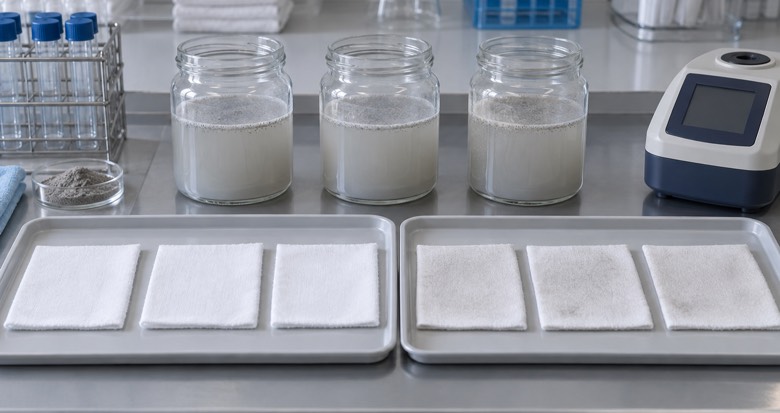
Include an unsoiled reference where helpful, and keep the soil load inside the method’s useful range. If the control is too clean, the trial cannot reveal improvement; if the load overwhelms every condition, it cannot identify a useful difference. For formal claims or customer specifications, use the applicable validated industry or customer method rather than inventing a protocol from this article.
Investigate failures with one-variable follow-ups
A failed sample does not always mean the polymer is unsuitable. Use the failure pattern to choose the next controlled test:
- Fisheyes or delayed viscosity: examine addition rate, powder dispersion, hydration time and early electrolyte exposure.
- Immediate haze or precipitate: review ionic surfactants, cationic ingredients, pH and local concentration during addition.
- Viscosity loss after salt: run a small electrolyte ladder at fixed CMC and surfactant levels.
- Stable bottle but weak cotton result: verify grade identity, active basis, textile, soil load and wash method before increasing dosage.
- Good cotton result but poor pouring: screen a different viscosity grade or lower dosage rather than relaxing a critical package-use limit.
- High replicate variation: audit sampling, mixing, temperature control, air removal and instrument procedure.
Do not repair each symptom by changing several ingredients at once. A short factorial or sequential design can be useful later, but the first diagnostic should make cause and effect visible.
Set decision rules before seeing the result
Write the pass, optimize and reject rules before the team sees the samples. Otherwise, a visually appealing beaker can receive more weight than fabric performance or process risk.
- Advance: hydration is reproducible, the formula meets critical stability and use limits, and the wash result improves against the control with acceptable variation.
- Optimize: a useful signal exists, but dosage, grade or order of addition needs a narrow follow-up.
- Equivalent: all limits pass but no repeatable technical or economic advantage is shown.
- Reject: the condition misses a critical compatibility, processing, fabric, safety or regulatory limit.
- Investigate: incomplete hydration, inconsistent repeats or measurement uncertainty prevents a decision.
Compare cost in use among conditions that meet the same specification. The lowest price per kilogram can be misleading if a grade requires more material, longer mixing, added hydrotrope or a narrower electrolyte window.
Bridge the selected condition to commercial scale
Repeat the leading condition in an independent laboratory preparation, then bridge it to pilot or plant equipment. Larger vessels change powder wetting, local concentration, circulation time, shear and air removal. Preserve the critical sequence and record any equipment-driven change. Do not treat a laboratory overhead mixer and a production recirculation loop as equivalent without evidence.
Freeze the approved grade and its purchasing controls: supplier, product name, viscosity method, degree of substitution or other relevant specification, purity basis, moisture, particle form, packaging, storage and certificate requirements. The sample to commercial batch approval workflow shows how to connect the trial sample to the first production lot without losing identity or method control.
Use the detergent grade CMC product page for general product context, but request and approve the specification for the actual grade under evaluation. Final formula safety, preservative efficacy, package compatibility, environmental claims, labeling and market compliance remain the finished-product manufacturer’s responsibility.
Frequently asked questions
What is the best CMC dosage for liquid laundry detergent?
There is no universal best dosage. It depends on the CMC grade, polymer basis, surfactant and electrolyte system, target textile, wash conditions, required rheology and plant process. Use a controlled ladder inside the supplier- and project-approved range.
Should CMC be selected by the highest certificate viscosity?
No. Certificate viscosity is useful only under its stated method. The finished detergent must also pass hydration, compatibility, flow, storage, dosing and fabric-performance criteria.
Can CMC be added after salt adjustment?
Possibly, but equivalence should not be assumed. Early electrolyte exposure can change hydration and viscosity. Compare controlled sequences using the actual formula and supplier guidance.
Does a clear, stable detergent prove anti-redeposition performance?
No. Bottle stability and fabric performance are different endpoints. A laundry claim needs a matched wash test on the intended textile and soil system.
Can cotton results be applied to polyester?
Not automatically. CMC interaction and soil redeposition depend on the textile and wash system. Test the actual fiber composition or make the claim specific to the validated substrate.
How should two CMC grades be compared fairly?
Lock the base formula, active-polymer calculation, batch process, hydration endpoint, measurement methods and wash conditions. Compare one grade variable at a time and repeat the leading condition independently.
Turn a detergent claim into a controlled approval package
A defensible liquid detergent CMC trial links raw-material identity, controlled hydration, surfactant and salt compatibility, method-defined rheology, timed storage observations and a matched fabric test. The outcome is not “CMC works” or “CMC fails.” It is a defined grade, level and process window supported by evidence for one formula and use case.
If you are planning a non-confidential detergent trial, contact SINOCMC with the product type, surfactant system, pH and electrolyte range, current thickener or anti-redeposition system, target textile, wash method, process outline and trial scale. We can help identify a detergent-grade CMC sample for your own formulation validation. Final formula, performance claims, safety and regulatory decisions remain with the manufacturer.
References
- Mechanism for the anti-redeposition action of sodium carboxymethyl cellulose with cotton. I. Radiotracer studies.
- Structure and solution properties of sodium carboxymethyl cellulose.
- Comparison between the interfacial and bulk rheology of sodium carboxymethyl cellulose in the presence of cationic and nonionic surfactants.
- Rheological study of sodium carboxymethyl cellulose: Effect of concentration and molecular weight.