
Mining Flotation CMC Trial: Selectivity, Water Chemistry and Scale Up Checks
A mining flotation CMC trial should prove selective depression in the buyer’s ore, water and reagent scheme—not simply show that a CMC solution is viscous. The useful result is a repeatable grade–recovery trade-off tied to an identified sample lot, controlled conditioning and an acceptance plan that can survive plant scale up.
Quick answer: Freeze the ore blend, grind, water chemistry, pulp density, pH, reagent sequence, conditioning time, air rate and froth collection. Compare an approved control with identified CMC candidates at matched addition bases. Track valuable-mineral recovery, gangue recovery, concentrate grade, mass pull, water recovery and froth behavior together. Repeat the leading condition with a fresh ore split, then challenge realistic process water before a supervised plant trial.
This guide is for mineral-processing laboratories, concentrators, distributors and technical buyers qualifying CMC as a flotation depressant. SINOCMC already publishes a broad mining grade CMC product page and an overview of the application of CMC in mining flotation. This article owns a narrower intent: how to design decision-ready laboratory and scale up evidence. It does not prescribe a universal dosage or claim that one result transfers between ores.
Define the separation problem before selecting a CMC
Start with mineralogy and the circuit objective. Identify the valuable minerals, the gangue phase that must be depressed, the liberation size, oxidation state, clay content and the streams in which the reagent will be used. Talc-rich sulfide ore, magnesite–quartz separation and another ore body can respond differently even when each trial uses a material called CMC.
Write the purchasing decision in measurable terms. Are you qualifying a second source against an approved depressant, screening a different CMC chemistry, reducing gangue recovery while protecting valuable-mineral recovery, or improving robustness in recycled water? Define the acceptable concentrate grade, recovery floor, mass-pull range, downstream penalty limits and operational constraints before looking at candidate labels.
Freeze the ore and the baseline flowsheet
Prepare one representative composite large enough for the complete matrix, repeats and retained samples. Record the source intervals or process streams, blending method, moisture basis, storage history, head assay and mineralogical information available. Homogenize and split with an appropriate sampling method. A candidate should not receive an easier ore split than the control.
Hold crushing and grinding procedure, target size distribution, pulp density, water source, pH modifier, collector, frother, activator, other depressants, reagent addition order, conditioning energy and time constant. Record cell volume, impeller speed, air flow, froth depth, scrape schedule and collection intervals. If the current plant practice varies, choose a documented baseline first; uncontrolled variability cannot demonstrate supplier equivalence.
Identify each CMC beyond a trade name
Record supplier, grade, lot, physical form, moisture or loss on drying, active or purity basis, viscosity method, degree of substitution and any other agreed characterization. Compare additions on a declared basis—such as as-supplied mass or corrected dry mass—and keep that basis consistent across the matrix.
CMC structure and solution conditions can influence adsorption. Research on talc and chalcopyrite systems has shown that degree and distribution of substitution, ionic strength and divalent cations can alter adsorption and flotation response. That evidence supports testing the actual ore and process water; it does not justify copying another study’s dosage into a purchase specification.
Prepare the CMC solution reproducibly
Define stock concentration, water chemistry, vessel geometry, mixer type, powder addition rate, mixing time, hydration time, temperature and maximum holding time. Record lumps, fish eyes, foam, wall deposits or visible undissolved material. Make stock solutions gravimetrically where practical and label every vessel with grade, lot, concentration, preparation time and operator.
Use the same preparation route for control and candidates unless the trial is explicitly testing make-down requirements. Do not silently give one candidate longer hydration or higher shear. If a practical difference in preparation is essential, run it as a separate factor and judge whether the plant can reproduce it.
Build a staged CMC flotation matrix
Start with a compact screen, then expand only the leading conditions. A blank without polymer can establish the ore’s natural response when safe and relevant. The approved control anchors the decision. Candidate screening should use enough levels to reveal the direction of the grade–recovery response without turning the first experiment into an unmanageable full-factorial study.
| Condition | Purpose | What remains fixed | Decision supported |
|---|---|---|---|
| Blank | Baseline without CMC where the procedure permits | Ore, grind, water and all other reagents | Shows natural gangue and valuable-mineral response. |
| Control | Approved depressant grade and operating addition | Complete flotation procedure | Defines the current benchmark. |
| Candidate A | First identified CMC lot at matched addition | Non-CMC variables | Tests supplier or grade equivalence. |
| Candidate B | Second chemistry or grade at matched addition | Non-CMC variables | Compares selectivity, not label claims. |
| Dose Series | Two or more levels for the leading grade | Grade, lot and full flowsheet | Maps the grade–recovery trade-off. |
| Repeat | Fresh ore split and new reagent preparation | Target settings and acceptance methods | Checks preparation and test repeatability. |
| Plant Water | Leading conditions in representative process water | Ore and reagent scheme | Checks water-chemistry robustness. |
Randomize test order where drift in ore, temperature or equipment condition could bias the result. Include procedural blanks and duplicate or repeat tests according to the laboratory’s quality plan. A duplicate assay from one flotation product does not replace an independently prepared flotation repeat.
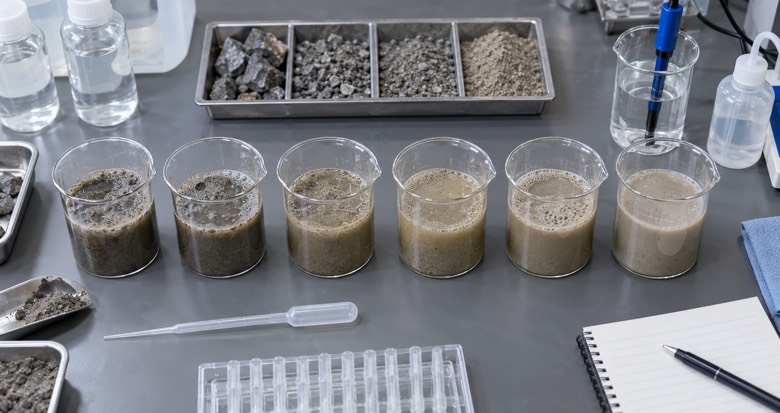
Control conditioning sequence and contact time
Reagent order can change surface interactions. Document when pH modifiers, dispersants, activators, CMC, collectors and frothers enter the pulp, along with the conditioning time after each addition. Use the same impeller speed, pulp level and temperature for every condition. Time collection from the same event, not from an approximate visual cue.
If the plant adds CMC at a different solids concentration or in a separate conditioning stage, include that sequence in the confirmation phase. A laboratory shortcut can rank candidates incorrectly when adsorption, mixing or competitive reagent interactions differ at plant conditions.
Measure selectivity, not froth appearance alone
Dry, weigh and assay the relevant concentrate and tailings products using the laboratory’s validated methods. Calculate mass pull, valuable-mineral recovery, gangue or penalty-element recovery and concentrate grade with a documented mass balance. Report closure and investigate results that fall outside the laboratory’s accepted range.
Plot grade against recovery for the control and candidates. A lower gangue recovery is useful only if valuable-mineral recovery remains within the decision window. Likewise, higher concentrate grade can result from lower mass pull rather than truly improved selectivity. Review both axes and the material balance before choosing a winner.
Record froth and water recovery as supporting evidence
Record froth height, texture, mobility, bubble character, mineral loading, collapse behavior and any persistent entrainment using predefined descriptions or images. Measure water recovery when it is part of the laboratory method. Excess water and fine-particle entrainment can raise gangue in the concentrate even when surface depression appears promising.
Keep these observations subordinate to mass-balanced metallurgical results. A visually clean froth does not prove selectivity, and a stable froth is not automatically desirable. The acceptable behavior depends on the circuit, collection method and downstream handling.
Challenge realistic water chemistry
Record conductivity or total dissolved solids, pH, hardness and the ions known to matter in the circuit. Use representative plant water, a controlled synthetic water or both. Calcium, magnesium and ionic strength can change CMC conformation and adsorption; recycled water can also carry residual reagents and dissolved species not represented by tap or deionized water.
Do not change water, pH, CMC grade and dosage in one step. Confirm the leading CMC condition in the baseline water, then compare a defined water challenge. If performance changes, investigate the responsible variable before rewriting the supplier specification.
Check ore variability before scale up
A single composite cannot represent every production period. After the primary screen, test the selected candidate and control against the ore domains most likely to change the decision: different talc or clay levels, oxidation, hardness, head grade, liberation or fines content. Use a small, risk-based variability program rather than treating every historical sample as equivalent.
Set rules for when mineralogical or water changes require adjustment, additional testing or requalification. The aim is not to force one dosage across all ore. It is to define where the selected CMC is robust and where process control must respond.
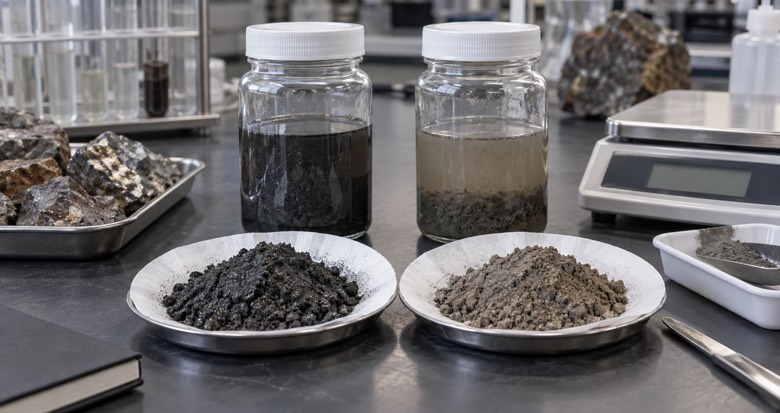
Diagnose common CMC trial failures
- Both gangue and valuable recovery fall: check over-dosage, nonselective adsorption, grind, pH, water ions, conditioning order and collector interaction.
- Candidate appears stronger only in one test: repeat with a fresh ore split and stock solution; inspect test order, air flow, scrape timing and assay closure.
- Good deionized-water result disappears in plant water: characterize hardness, ionic strength, residual reagents and preparation sequence before blaming lot quality.
- Froth looks cleaner but grade does not improve: review mass pull, water recovery, entrainment, liberation and assay precision.
- Laboratory dosage is impractical at the plant: confirm solution concentration, pumpability, addition point, available residence time and control range.
- Certificate and flotation behavior disagree: compare sample identity, moisture basis, viscosity method, CMC chemistry, ore variability and the complete test procedure.
Change one suspected cause per follow-up. Preserve raw weights, assays, instrument files and observations so the laboratory, metallurgist and purchasing team can audit the conclusion.
Move from bench selection to a plant trial
Before plant use, define a supervised trial plan with responsibilities, safe handling, stock-solution preparation, dosing equipment, sampling points, baseline period, trial duration, ore and water context, metallurgical accounting and stop criteria. Confirm that the plant can prepare and meter the selected product within the laboratory-approved window.
Compare against a stable baseline and avoid simultaneous flowsheet changes. Track concentrate and tailings assays, recovery, grade, mass pull, throughput, water balance, froth behavior and relevant downstream constraints. Plant approval should require enough stable operating time and accounting quality to separate reagent effects from normal process noise.
Connect the sample to commercial-batch release
Keep a retain sample and a complete record for the approved laboratory lot. Define the certificate fields, receiving checks, sampling plan and flotation confirmation that will apply to the first commercial batch. The sample to commercial batch approval workflow explains how to preserve identity and decision evidence through scale up.
Commercial acceptance should identify the CMC grade, lot traceability, physical form, packaging, declared addition basis, stock preparation, approved ore and water window, laboratory procedure, release limits and triggers for deviation or requalification. Do not turn one successful trial into an unsupported claim that every shipment will improve recovery.
What to include in a mining CMC inquiry
Share non-confidential information on ore type and target minerals, problematic gangue, head-grade range, grind size, pulp density, water chemistry, pH, reagent scheme, current depressant, laboratory cell and decision metrics. Include the expected sample quantity, packaging and commercial volume range. Customer names and proprietary flowsheet details are not required.
Ask the supplier for an identified sample lot, certificate with methods, moisture or loss on drying, purity or active basis, degree of substitution, viscosity method, physical form and preparation guidance. The separate CMC supplier certificate verification guide can support the document review.
Frequently asked questions
Is there a universal CMC dosage for mining flotation?
No. Ore mineralogy, liberation, water chemistry, reagent scheme, CMC chemistry and circuit objective all affect the response. Use a controlled dosage series around a relevant plant or laboratory baseline.
Can viscosity alone predict flotation depression?
No. Viscosity is a material or solution property measured under defined conditions. Selective depression depends on adsorption, ore surfaces, water chemistry, reagent interactions and operating conditions.
Should candidates be compared at equal mass?
An equal, declared addition basis is a useful first screen. Follow it with a separate dosage series for the leading grade. Record whether additions are as supplied or corrected for moisture or active content.
Why include plant water in the trial?
Plant water can contain hardness ions, dissolved salts and residual reagents that change polymer conformation, adsorption and flotation behavior. A deionized-water result may not represent the circuit.
What is the main approval metric?
There is no single universal metric. Most decisions need a defined balance of valuable-mineral recovery, concentrate grade, gangue or penalty-element recovery, mass pull, water recovery, repeatability and operating practicality.
When should the selected CMC be requalified?
Define triggers in the approval plan. They can include a material or manufacturing change, new supplier site, out-of-limit receiving result, unexplained process drift, major ore or water change, or operation outside the approved window.
Plan a decision-ready mining flotation CMC trial
SINOCMC can review a non-confidential test brief and discuss a mining grade CMC sample for your own qualification. Include the ore and gangue context, water chemistry, current reagent scheme, laboratory procedure, decision limits, sample quantity and commercial-volume range. Contact SINOCMC with the brief; final approval should follow your laboratory methods, metallurgical accounting and plant-trial evidence.
Technical sources
- Mierczynska-Vasilev, A. and Beattie, D. A. Adsorption of tailored carboxymethyl cellulose polymers on talc and chalcopyrite: correlation between coverage, wettability, and flotation. Minerals Engineering, 2010.
- Parolis, L. A. S. et al. The influence of metal cations on the behaviour of carboxymethyl celluloses as talc depressants. Colloids and Surfaces A, 2008.
- Morris, G. E., Fornasiero, D. and Ralston, J. Polymer depressants at the talc–water interface: adsorption isotherm, microflotation and electrokinetic studies. International Journal of Mineral Processing, 2002.
- Zhu, Y. et al. Flotation separation of quartz from magnesite using carboxymethyl cellulose as depressant. Transactions of Nonferrous Metals Society of China, 2022.