
Washing Powder CMC Trial: Dry Blend, Dissolution and Fabric Checks
A washing powder CMC trial should answer a production question: will the selected grade stay evenly distributed through powder handling, disperse in the intended wash, and deliver the target fabric result? A clear CMC solution or a good certificate value alone cannot answer it. The finished powder, its manufacturing route and its wash conditions all matter.
Quick answer: Compare a control with one or more clearly identified CMC conditions in the same base powder. Keep the builder, surfactant, water content, process and wash dose fixed. Sample the blend at multiple locations and after transfer; check powder flow, caking and dissolution under the intended water temperature and hardness; then run a matched cotton redeposition test. Approve a grade only against written limits for processability, package quality and fabric performance.
This guide is for detergent formulators, plant technologists and technical buyers qualifying CMC in washing powder. For a short overview of why CMC is used in detergent powder, see our existing detergent powder introduction. This article concentrates on a controlled qualification workflow, not a universal formula or dosage recommendation.
Define the manufacturing route before choosing the trial
“Washing powder” covers different processes. CMC might enter a dry-blended base, a slurry before spray drying, a post-dosed granule stream, or an agglomeration step. Each route exposes the material to different water, shear, heat, particle movement and residence time. Record the actual route and CMC addition point before comparing samples. A dry-blend result cannot, by itself, qualify a spray-dried slurry process.
Write down the finished-product job first: soil-redeposition control on a specified textile, acceptable dissolution at the intended wash temperature, low residue, stable powder flow, or a combination. Set measurable acceptance limits for each. The detergent grade CMC product page gives commercial context, but the plant’s formula and process should determine the test plan.
Identify the CMC and hold the comparison basis constant
Record supplier, grade, lot, physical form, particle-size information if available, viscosity method, degree of substitution, purity basis, moisture or loss on drying, and the certificate date. A grade name is not enough to reproduce a trial. Keep the current approved powder as the control. For a new formulation, use the same base without the trial CMC as the control and document what replaces its mass so the total formula remains constant.
Compare the candidate on a declared basis: as-supplied powder mass or active CMC solids. If two grades differ in moisture or non-CMC content, an equal bag weight does not necessarily mean equal polymer delivered to the wash. Keep the chosen basis consistent in the lab record and purchase specification. The supplier’s certificate viscosity is a quality measure under a particular solution method; it is not a direct measure of finished-powder dissolution or detergency. Our CMC viscosity-method guide explains why preparation conditions matter.
Use a small, interpretable trial matrix
Start with the current formula and one variable at a time. When comparing grades, keep the CMC addition basis constant. When finding an addition level, keep the grade constant. Choose the trial levels from the formula target and supplier advice; broad numbers from a general article are not production limits. Prepare independent repeats for the leading condition so a one-off blend is not mistaken for a robust result.
| Condition | What changes | What must stay fixed | Decision it supports |
|---|---|---|---|
| Control | Current approved CMC or no trial CMC | Base ingredients, process, wash dose | Establishes a repeatable baseline. |
| Candidate A | One identified CMC grade or level | CMC mass basis and all other ingredients | Shows process and wash response against control. |
| Candidate B | Second grade or level, but not both | Sampling and test methods | Shows whether the response is grade- or level-dependent. |
| Repeat | Independent leading-condition batch | Target settings and acceptance methods | Checks preparation repeatability. |
Document ingredient addition sequence, batch mass, blender loading, mixing time, discharge route and any post-dosing. If the base is spray dried, log the slurry and tower conditions relevant to that trial rather than claiming that a bench dry blend models the tower. Do not change builder, enzyme, perfume or water level during a CMC grade screen; those changes can confound dissolution and fabric results.
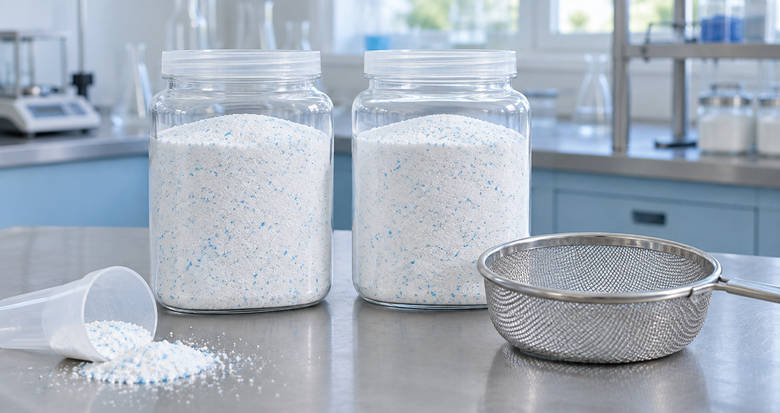
Check dry-blend uniformity and segregation after handling
A powder that looks uniform at the blender may separate during discharge, pneumatic transfer, vibration or filling. An experimental study of a model laundry-detergent powder mixture found that particle size, shape, density and cohesion influence segregation. It did not test this article’s CMC candidates; it supports checking the actual finished blend rather than assuming uniformity from mixing time alone.
Take representative samples at the blender’s beginning, middle and end of discharge and, if practical, from filled packs after normal handling. Use a validated or suitable assay for the minor ingredient or a justified surrogate marker. Record mean, spread and any location pattern. Also compare CMC particle form and size distribution with the base powder. Fine dust, granule breakage or a large particle-size mismatch should trigger a handling investigation, not an automatic claim that CMC is defective.
Measure powder handling and moisture sensitivity
Record bulk density using the plant’s defined method, particle-size distribution, visible fines, flow through the relevant hopper, dust behavior, caking after a controlled humidity hold, and package condition. Set the hold time, temperature, relative humidity and pack type before testing. These are formulation and packaging checks; a short accelerated hold cannot prove full shelf life. For shipment and storage context, see our CMC packaging and storage guidance.
If a candidate clumps, first separate incoming moisture, local wetting during processing, binder distribution and package ingress. If it segregates, inspect the particle-size and density differences and where separation appears along the transfer path. Changing mixer time alone may not correct a downstream segregation mechanism.
Test dissolution in the intended wash, not only in pure water
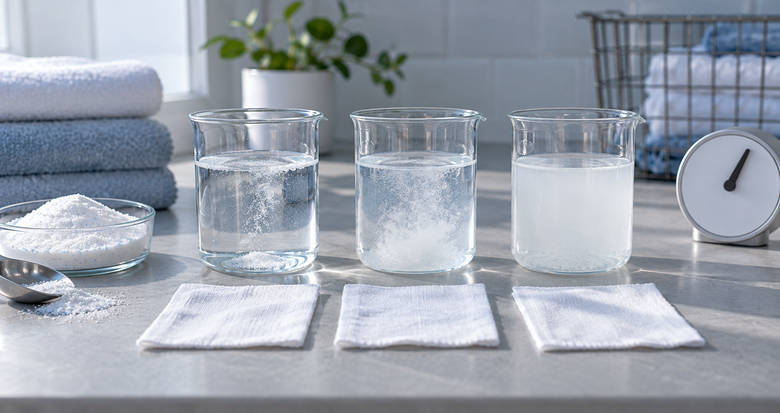
Make a finished-powder dissolution test with a fixed powder dose, water volume, temperature, hardness, agitation pattern and observation time. Include the coldest or shortest wash condition the product is expected to serve. Record floating islands, gel-coated particles, sediment, residue on a defined sieve and any deposits on a dark textile or vessel. Photograph each condition at fixed times if that helps compare results.
CMC can hydrate at the particle surface before the core wets. A published solid-laundry-composition patent describes how closely packed fine CMC particles can form a gel mass and slow dissolution. That patent is evidence of a possible mechanism, not proof that every detergent powder will behave this way. The qualification question is whether the actual grade and manufacturing route meet the product’s residue limit.
Separate two failure modes: undissolved CMC-rich gel and insoluble builder or other formula residue. Use the full formula control, ingredient inspections and, where needed, component analysis before assigning blame. A grade may dissolve well as a neat powder yet behave differently when embedded in a concentrated detergent granule.
Verify fabric performance with a controlled wash
For a laundry powder, anti-redeposition needs a fabric endpoint. Use matched cotton swatches, a defined soil donor or soil loading, the same wash liquor, powder dose, liquor ratio, wash and rinse program, and enough replicates to see variation. Compare reflectance, whiteness or color difference using the same instrument and method. Inspect visible residue separately; a brighter swatch does not excuse undissolved powder.
Published cotton-washing research with CMC examined hard and soft water and different temperatures, and measured fabric surface and whiteness outcomes. Its specific results belong to that experimental detergent and cannot be copied as a performance claim for another formula. They show why water hardness and temperature belong in a wash-performance plan. If the customer targets polyester or mixed fabrics, test those textiles directly instead of transferring a cotton result.
Diagnose a weak result without changing every variable
- Inconsistent performance between packs: check blend sampling and post-blend segregation before changing CMC level.
- Visible gel or slow dissolution: inspect CMC particle form, addition point, granule structure, cold-water conditions and local CMC concentration.
- Hard caking in storage: isolate moisture uptake, process moisture, package barrier and humidity exposure.
- Acceptable dissolution but little fabric benefit: verify the wash endpoint, textile, soil load, water hardness and active CMC basis.
- Good lab wash but poor plant result: compare the pilot and commercial addition point, blend residence, transfer path and fill sampling.
Change one suspected cause per follow-up run. Preserve retained samples and the control so the team can distinguish material variation from process variation.
Bridge the chosen condition to the commercial batch
Before placing repeat orders, freeze the approved grade and lot criteria, CMC addition basis, process route, test methods and acceptance limits. Run a pilot or first production batch that includes normal transfer and packaging. Compare beginning, middle and end pack samples, dissolution, storage screen and the specified fabric endpoint with the lab control. The sample to commercial batch approval workflow covers the wider procurement release process.
Agree which changes require requalification: new CMC grade or physical form, a different supplier or production site, a materially different particle-size range, a different builder system, changed process equipment, or a new wash-performance claim. Record what changed and which evidence supports the decision. A certificate alone should not replace the finished-product trial.
Frequently asked questions
Is a low-viscosity CMC always better for washing powder?
No. Solution viscosity is only one grade property. The powder must meet the chosen blend, dissolution and fabric endpoints. Compare candidate grades in the same finished formula and wash conditions.
Can I approve a CMC grade from a clear-water dissolution test?
No. Clear water can be a useful diagnostic, but it does not reproduce builders, surfactants, granule structure, hardness or the powder’s process history. Confirm the finished formula under the intended wash conditions.
Why sample both the blender and filled packs?
Powder components can separate during discharge, transfer and filling. Pack samples show what the customer actually receives and can reveal variation that a blender-top sample misses.
Does a cotton anti-redeposition result apply to other fabrics?
Not automatically. Cotton is a relevant cellulosic test substrate, but polyester and blends can respond differently. Match the test textile to the product claim.
Should the dry-blend and spray-drying routes use the same CMC acceptance test?
They can share final-product endpoints, but their process checks differ. A slurry or tower route needs route-specific process evidence; a dry-blend route needs mixing and segregation evidence. Both need finished-powder and wash verification.
What should a buyer request with a trial sample?
Request a specific grade and lot identity, current certificate with stated methods, physical-form and particle-size information if available, recommended handling guidance, and enough material for repeat and pilot tests. State the intended powder process and wash conditions in the inquiry.
Build a decision-ready CMC trial with SINOCMC
Share your washing-powder route, existing CMC grade, target wash temperature and hardness, powder-handling concern, and required fabric endpoint. SINOCMC can use those details to discuss an appropriate detergent grade sample and specification for your own qualification. Contact SINOCMC with the trial brief; final approval should follow your plant’s controlled tests.
Technical sources
- Asachi M, Hassanpour A, Ghadiri M, Bayly A. Experimental evaluation of the effect of particle properties on the segregation of ternary powder mixtures. Powder Technology. 2018. The study used model laundry-detergent powder components; its findings support segregation testing, not a result for this CMC grade.
- Višić K, Pušić T, Čurlin M. Carboxymethyl Cellulose and Carboxymethyl Starch as Surface Modifiers and Greying Inhibitors in Washing of Cotton Fabrics. Polymers. 2021. The reported cotton results are formula- and condition-specific.
- EP2302025A1, A laundry detergent composition comprising a highly water-soluble carboxymethyl cellulose particle. 2011. A patent disclosure describing a possible gelling mechanism in solid laundry compositions, not an independent guarantee of product performance.