
Cement Mortar CMC Trial: Water Retention, Workability and Strength Checks
A cement mortar CMC trial should prove that a candidate works in the buyer’s complete dry-mix and application process—not merely that a CMC solution reaches a target viscosity. Qualification should connect an identified sample lot to a fixed mortar formula, controlled water addition, defined mixing, fresh-mortar behavior, substrate interaction, cured performance and commercial-batch release criteria.
Quick answer: Freeze one mortar formula, raw-material lots and water source. Compare the approved control with one identified CMC candidate at the same declared addition basis. Keep water, mixing energy, rest and remix time, temperature and test timing fixed. Check flow or consistency, density and air where relevant, water retention under suction, sag or slip, open or working time, application quality and the required cured properties. Repeat the leading condition independently, then confirm it in a pilot or controlled production batch before approval.
This guide is for dry-mix mortar producers, construction-chemical distributors, formulators and technical buyers qualifying CMC in cement mortar. SINOCMC already publishes a civil engineering grade CMC product page, a broad article on the application of CMC in construction and a summary of the role of CMC in mortar. This article owns a narrower intent: how to design and interpret a controlled qualification trial. It does not prescribe a universal dosage, formula, standard classification or site-performance guarantee.
Define the mortar system and approval decision
“Cement mortar” is not one application. Masonry mortar, render, plaster, repair mortar, tile adhesive, jointing mortar and self-leveling products have different placement methods and failure modes. Record the product type, binder system, aggregate grading, layer thickness, substrate, application method, environmental window, curing route and the relevant product specification before selecting tests.
Write one decision statement. Examples include: qualify a second-source CMC without changing the water demand; improve water retention on an absorptive substrate without unacceptable air or strength loss; maintain vertical application without sag; or hold open time while preserving early adhesion. Convert the statement into numerical or observable acceptance limits. “Better workability” is not a release criterion unless the test method, timing and acceptable range are defined.
Do not combine unrelated products into one approval. A result for render does not approve a tile adhesive, and a self-leveling mortar should not be judged by a vertical sag test. ISO 13007 separates specifications and test methods for ceramic-tile adhesives, including open time, slip and adhesion. This illustrates why the end-use standard should determine the evidence plan.
Freeze the formula, raw materials and water basis
Use the current approved mortar and CMC as the control. Keep cement type and lot, supplementary cementitious materials, lime, gypsum, aggregate source and grading, fillers, redispersible polymer, starch ether, air-control agent, setting regulator and every other admixture fixed. Record dry-mix moisture and storage history. Small changes in aggregate grading or another rheology modifier can hide or exaggerate the CMC effect.
Fix the water source, temperature and water-to-dry-mix ratio for the first comparison. If a candidate requires a water adjustment, record that as a second matrix rather than quietly changing the water until the trowel feel looks familiar. Identify each CMC by supplier, grade, lot, physical form, moisture or loss on drying, purity basis, degree of substitution and certificate viscosity method. Compare on a declared basis—for example, as-supplied mass or active CMC solids.
A certificate viscosity measured in a dilute polymer solution is not the mortar’s field consistency. Cement pore solution, dissolved ions, mineral surfaces, mixing energy and other additives can change polymer behavior. The CMC viscosity comparison guide explains why concentration and method must travel with the number.
Use a trial matrix that changes one factor
Screen grades at one fixed addition basis first. Optimize addition level only after selecting the candidate grade. Changing CMC grade, water, aggregate, air-control agent and mixing time together makes the result impossible to attribute. Prepare an independent repeat of the leading condition; splitting one mixed batch into two containers does not test preparation repeatability.
| Condition | What changes | What stays fixed | Decision supported |
|---|---|---|---|
| Control | Current approved CMC and level | Dry mix, water, mixing, test timing and curing | Establishes the production reference |
| Candidate A | One identified CMC grade | CMC addition basis and all other inputs | Shows the grade effect |
| Candidate B | Second grade, or second level in a separate matrix | Formula, water, temperature and test sequence | Checks whether the response is systematic |
| Repeat | Fresh batch of the leading condition | Target settings and acceptance methods | Tests preparation robustness |
Select levels from the approved formula, supplier discussion, risk assessment and the product standard that applies to the buyer’s market. Existing dosage articles are starting context, not production limits. Record actual weighed masses and calculate the final addition basis after moisture or water adjustments.
Control dry blending, wet mixing, rest and remix
Write a batch sheet before mixing. Include batch mass, mixer and bowl geometry, dry-blend time, water-addition time, wet-mix speed and duration, scrape-down procedure, rest or maturation time, remix time, sample temperature and the timer start point. If production uses a continuous mixer, bagged dry mix or a field remix step, include a relevant simulation before approval.
Watch for CMC segregation in the dry blend, dry pockets, gel particles, wall build-up, delayed consistency development and excessive foam. A sample that reaches an attractive final consistency only after impractical mixing or rest time may fail the process. Do not add water during the test without weighing it and identifying the condition as adjusted.
Test at fixed ages from first water contact. Flow, density, air, sag and open time can change quickly, so comparing the control at five minutes with a candidate at twenty minutes is not a valid grade comparison. Record room and material temperature and protect samples from uncontrolled evaporation.
Measure consistency, density and air together
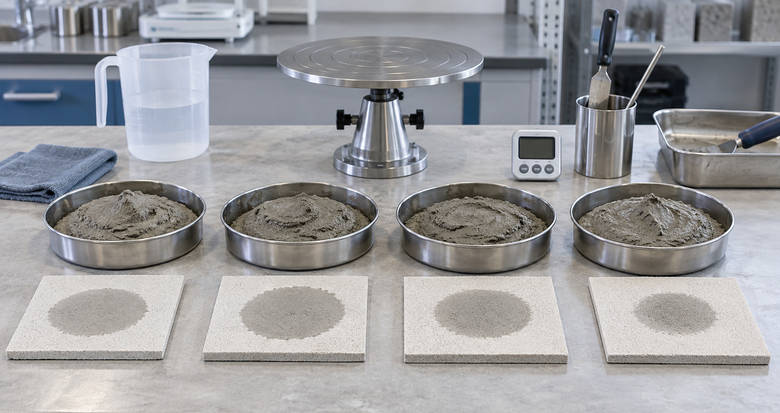
Choose a consistency method that matches the product and specification. ASTM C1437 covers flow of hydraulic cement mortar and is commonly used when a specified flow is needed for another standard test. For a proprietary product, a flow table, slump-flow ring, penetration, rheometer or application-specific spread method may be more relevant. Report apparatus, dimensions, number of drops or shear program, elapsed time and result units.
Do not interpret a larger spread as automatically better. A mortar can flow farther yet segregate, bleed, lose vertical hold or fail to rebuild after shear. Pair the consistency result with visual stability and application observations. When the product specification requires it, measure fresh density and air content at the same test age. Entrained air can improve apparent yield and handling while changing hardened density and strength, so it should not remain an unmeasured explanation.
Test water retention under a defined suction
Water retention matters when the substrate draws water from a thin mortar layer. ASTM C1506 provides a comparative method for hydraulic cement-based mortars and plasters under controlled suction. ASTM also warns that the laboratory result does not necessarily reproduce every masonry unit or base coat because field absorption rates differ. That limitation is useful: report the method as comparative evidence, then confirm the selected condition on the intended substrate.
Keep initial consistency, sample age, suction, time, apparatus condition and temperature fixed. Record both the initial and post-suction response required by the chosen procedure. If the buyer uses an internal filter-paper or substrate-panel method, validate its repeatability and state that it is an internal comparative method rather than implying formal standard compliance.
Water retention should not be optimized in isolation. Research on cellulose ethers in cement-based mortar shows that polymer molecular characteristics can affect both consistency and water retention, while the relationship between viscosity and retention is not always simple. The practical conclusion is to test the complete mortar and its cured performance, not to approve a CMC solely from solution viscosity or one suction result.
Check sag, slip, open time and trowel response
For vertical render, plaster or repair mortar, apply a controlled thickness to a defined substrate and record downward movement, edge slump, tearing, slumping after vibration and the force needed to spread the material. For tile adhesive, use the applicable product method for slip and open time rather than inventing a substitute. ISO 13007-2 lists methods for open time, slip, shear adhesion, tensile adhesion and transverse deformation.
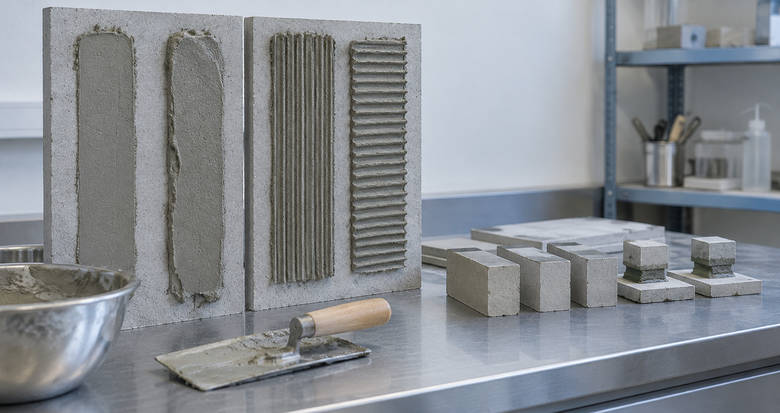
Standardize notched-trowel geometry, application angle, stroke count, layer thickness, substrate absorption, specimen mass and the time between mixing, spreading and placement. Photograph the trowel ridges at fixed times and record whether ridges stand, collapse, skin or transfer incompletely. A very high yield response may resist sag but make spreading or wetting difficult; a low response may apply smoothly but lose vertical hold.
For field-relevant working time, repeat the application check at planned intervals using the same remix rule. Do not add unrecorded water to “refresh” the mortar. If the product instructions permit a defined remix, test that exact step and treat a second water addition as a separate condition.
Cure matched specimens and verify final performance
Fresh-mortar improvements do not automatically predict cured performance. Prepare matched specimens from each condition using the specified molding, compaction, substrate, curing temperature, humidity and age. Select endpoints from the actual product: compressive or flexural strength for relevant mortar types; tensile or shear adhesion for tile adhesive; bond to a defined substrate for render or repair mortar; cracking, shrinkage, abrasion or water absorption when required.
Use enough replicates to report the mean and spread, not only the best specimen. Record failure mode for adhesion tests because a numerical value without the location of failure can hide a substrate or preparation problem. Compare early and later ages only when they support the product decision. A candidate that improves water retention but creates unacceptable air, delays setting or lowers a required cured property should not pass on the fresh result alone.
Challenge the selected condition without changing the question
After the first screen, repeat the leading condition with a fresh dry blend. Then challenge only variables that are realistic for the product: allowed water range, hot or cool mixing conditions, absorptive and less-absorptive substrates, a justified delay before application, or storage-aged dry mix. Keep each challenge traceable to the control so a failure can be assigned to a specific variable.
Use production raw-material tolerances rather than extreme conditions chosen only to force a difference. If the mortar serves multiple climates or substrates, define separate operating windows. Do not average a pass in one application with a failure in another.
Bridge the laboratory result to dry-mix production
A laboratory mixer does not reproduce silo discharge, pneumatic transfer, bag filling, transport vibration, continuous mixing or site water measurement. Run the selected condition through a pilot or controlled production batch. Sample the dry mix at defined locations and after handling when segregation is a risk. Record batch uniformity, dusting, mixer load, discharge, bag consistency, wet-mix demand, application behavior and the critical fresh and cured tests.
Freeze the approved CMC grade and lot criteria, addition basis, dry-blending sequence, water range, mixing and rest instructions, test methods, acceptance limits and requalification triggers. The sample to commercial batch approval workflow explains how to connect the laboratory sample to a representative commercial lot and routine incoming release.
Diagnose common trial conflicts
- Flow is low but sag control is acceptable: check water basis, air, mixing energy, rest time and whether the application truly requires more spread.
- Water retention improves but strength drops: review air, effective water ratio, setting, specimen preparation and curing before assigning the change to one mechanism.
- Good initial handling but rapid stiffening: compare sample temperature, evaporation, cement chemistry, soluble salts, maturation and the permitted remix procedure.
- Ridges stand but transfer is poor: check wetting, open time, substrate absorption, application pressure and whether yield response is too high.
- Laboratory repeat passes but production varies: investigate dry-blend uniformity, dosing resolution, particle-size mismatch, transfer segregation and site water control.
What a technical buyer should send with an inquiry
Share the mortar type and target market, binder and aggregate system, dry-mix process, batch and trial scale, current CMC grade and addition basis, water ratio or range, mixing and rest sequence, substrate, application thickness, temperature window, current failure mode, applicable standard and acceptance tests. Include non-confidential results for the approved control and candidate. If the formula is confidential, provide ranges and decision limits rather than customer identity or proprietary percentages.
Frequently asked questions
Can a CMC solution viscosity approve the mortar grade?
No. Solution viscosity is a raw-material control under a stated method. Mortar behavior also depends on cement chemistry, ions, aggregate, other admixtures, water, mixing, time, substrate and curing.
Should candidates be compared at equal water or equal flow?
Start with equal water to reveal the grade effect. If the product is sold to a defined consistency, run a second documented matrix adjusted to equal flow. Do not mix the two comparison bases in one result.
Is maximum water retention always the best result?
No. The required retention must be balanced with mixing, application, air, setting, adhesion and cured properties. Approve against a complete specification, not a single maximum.
Can a render result qualify a tile adhesive?
No. The formulas, substrates, application methods and product standards differ. Use separate protocols and application-specific endpoints.
Why measure both fresh density or air and cured strength?
Air and density can change workability and apparent yield while also affecting hardened performance. Measuring them helps explain why two mortars with similar flow can produce different strength or adhesion.
What should trigger requalification?
Typical triggers include a new CMC grade or production source, changed viscosity or degree-of-substitution range, different physical form, significant raw-material or formula change, new mixer or process, different substrate or application, and a changed product specification.
Plan a decision-ready cement mortar CMC trial
SINOCMC can review a non-confidential test brief and discuss a civil engineering grade CMC sample for the buyer’s own mortar qualification. Include the product type, formula ranges, water and mixing process, substrate, working window, fresh and cured test methods, current control and acceptance limits. Contact SINOCMC with the brief; final approval should follow the buyer’s controlled laboratory methods and commercial-batch evidence.
Technical sources
- ASTM International. ASTM C1437-20, Standard Test Method for Flow of Hydraulic Cement Mortar. The method determines mortar flow and supports standardized consistency comparisons.
- ASTM International. ASTM C1506, Standard Test Method for Water Retention of Hydraulic Cement-Based Mortars and Plasters. ASTM lists C1506-24 as the active version; the public scope describes controlled-suction comparison and its substrate limitations.
- ISO. ISO 13007-1:2014, Ceramic tiles—Grouts and adhesives—Part 1. The standard defines and specifies ceramic-tile adhesive classes and was confirmed current in 2025.
- ISO. ISO 13007-2:2013, Ceramic tiles—Grouts and adhesives—Part 2. The official abstract lists test methods for open time, slip, adhesion and transverse deformation; the edition was confirmed current in 2024.
- Patural L, Marchal P, Govin A, Grosseau P, Ruot B, Devès O. Cellulose ethers influence on water retention and consistency in cement-based mortars. Cement and Concrete Research. 2011;41:46–55. The study concerns specific cellulose ethers and mortar conditions; it is not a result for the CMC samples discussed here.