
CMC in Starch Adhesives: Viscosity, Pot Life and Bonding Checks
Starch adhesive can look acceptable in the mixing vessel yet fail later through unstable viscosity, poor transfer, slow setting, weak fiber tear or storage drift. When carboxymethyl cellulose (CMC) is part of the formulation, the useful question is not simply whether it “thickens.” The buyer needs to know whether a defined CMC grade, prepared by a controlled method, improves the complete adhesive system without creating new processing or bonding problems.
This guide gives distributors, adhesive formulators and converting plants a practical way to evaluate CMC in starch adhesive. It stays deliberately separate from generic CMC application pages: the focus is a matched formulation trial covering make-down, viscosity, working life, application, bond development and production scale up.
Quick answer: Freeze the starch formula, solids, water, pH, mixing energy, temperature and application method before comparing CMC candidates. Prepare each CMC consistently, measure the adhesive at defined shear and temperature conditions, follow viscosity and consistency through the intended working period, apply a controlled coat weight to the actual substrate, condition the bonded specimens, then test strength and record the failure mode. A promising laboratory result still needs a production trial because pumping, transfer, application speed, substrate absorbency and drying conditions can change the outcome.
What CMC can—and cannot—do in a starch adhesive
CMC is a water-soluble ionic cellulose ether. In aqueous systems it can change viscosity, shear response, water retention and the way a formulation recovers after mixing or application. Those effects can help an adhesive remain uniform, transfer consistently and stay on a porous surface long enough for bond formation.
Performance is formulation-specific. A peer-reviewed starch-based wood adhesive study reported that CMC addition changed initial viscosity, solids content and bond strength in that study’s starch/PVA/borax/crosslinker system. Its reported optimum belonged to that exact recipe and test method; it is not a universal dosage for wallpaper paste, paper converting, corrugated board, wood veneer or another adhesive.
CMC also does not replace every part of an adhesive formulation. It does not by itself define water resistance, curing chemistry, preservative protection, substrate compatibility or legal suitability for a particular use. Treat it as one controlled variable inside the complete system.
1. Define the end use before choosing a CMC candidate
A useful trial begins with the finished process. Record the two surfaces being bonded, their absorbency and moisture condition, the application equipment, target coat weight, open time, pressing or nip conditions, line speed, drying or cure conditions and the environment in which the bond must perform.
Paper-to-paper lamination, corrugated board, wallpaper, paper tube winding and veneer bonding do not impose the same requirements. A viscosity that transfers well through one roll coater may string, mist or starve another applicator. A bond test on laboratory card may not predict performance on a coated board or porous veneer. Use the actual substrate wherever practical.
Define acceptance criteria before looking at results. Include both process limits and bond requirements, not only an adhesive viscosity target.
2. Freeze the reference formula and process
Change only the CMC variable during the first screening stage. Keep the following constant:
- starch type, source, dry basis and batch;
- water quality and total water addition;
- other polymers, crosslinkers, borates, alkali, plasticizers, defoamers and preservatives;
- total solids and pH target;
- order and rate of addition;
- mixing vessel geometry, impeller, speed, time and temperature history;
- batch size and hold time before testing; and
- substrate, coat weight, assembly pressure, conditioning and test method.
If several ingredients change at once, a better bond cannot be assigned confidently to the CMC. The same discipline used in a sample to commercial batch approval workflow should be applied here: define the approved reference, document the variables and keep retained samples.
3. Record the CMC identity and condition
Do not identify a candidate only as “high viscosity CMC.” Record the commercial grade, manufacturer, batch, physical form, agreed viscosity method and any application-relevant specification items. Molecular-mass distribution, degree of substitution (DS), substitution pattern and concentration can influence solution rheology; pH, temperature, salt and other formulation components can change the observed response.
Check packaging and powder condition before the trial. Moisture exposure or damaged liners can affect flow, dosing and reproducibility. If bags show clumping or suspected moisture ingress, follow a controlled CMC moisture-damage investigation rather than treating the material as a normal candidate.
4. Standardize CMC make-down and addition sequence
Dry powder can form hydrated shells around unwetted cores when it is added too quickly to water. In a starch system, the order of CMC, starch, alkali and other electrolytes can also change dispersion and the viscosity-development curve.
Choose one reproducible preparation route and document it. Depending on the established plant process, that may mean separate CMC hydration, controlled dry blending with another powder, or gradual addition into a defined liquid phase. Record powder addition time, mixing speed, water temperature, hydration time and the point at which other ingredients enter.
Do not assume a fine powder, granular product and instant-dispersing product are interchangeable. Physical form can change dusting, wet-out and dosing behavior even when the chemical specification appears similar. The existing powder CMC versus granular CMC guide covers that separate selection question.
5. Use a matched screening matrix
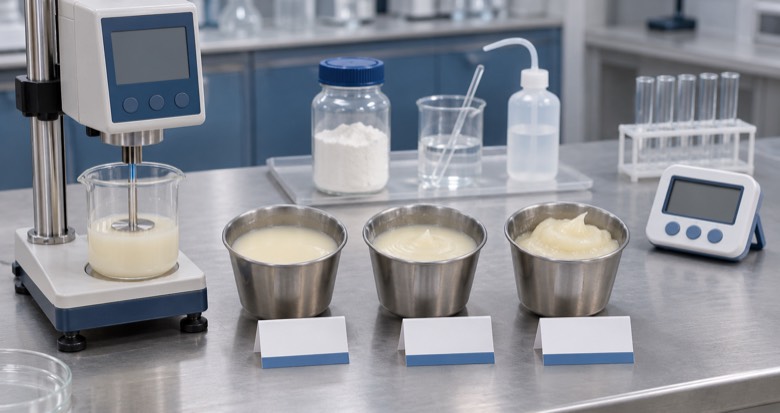
Start with a small matrix that answers one decision at a time. The percentages below are condition labels, not recommended dosages.
| Condition | CMC variable | Formula controls | Process checks | Bond checks |
|---|---|---|---|---|
| Control | Current approved adhesive | Same starch, water, solids, pH and additives | Viscosity, transfer, open time and working life | Strength, fiber tear and failure mode |
| Candidate A | First CMC grade at the planned screen level | Unchanged from control | Same elapsed-time checkpoints | Same specimen and conditioning plan |
| Candidate B | Second grade or one controlled level change | Unchanged from control | Same elapsed-time checkpoints | Same specimen and conditioning plan |
| Repeat | Selected condition in an independent batch | Reweighed and remade | Repeatability and preparation sensitivity | Result spread and failure consistency |
6. Measure viscosity as a process profile
A single viscosity number can hide important differences. Record the method, geometry or spindle, speed or shear condition, temperature, sample age and pre-shear history. If the adhesive is shear-rate dependent, a flow cup or one rotational speed may not predict pumping, roll transfer and leveling at the same time.
ASTM lists D1084 for several adhesive-viscosity methods and points shear-rate-dependent materials toward D2556. Use the edition and method required by the buyer, contract or laboratory; do not mix results from different conditions. For CMC solution comparisons, the same principle applies: concentration and preparation must be aligned, as explained in the CMC viscosity grade comparison guide.
Plot viscosity or consistency at practical checkpoints—for example after make-down, after cooling, at the start of the shift and near the expected end of use. The actual times should match the plant process.
7. Follow pot life and storage drift
Working life is more than time until the adhesive becomes unusable. Watch for continuing hydration, thickening or thinning, foam persistence, phase separation, skinning, odor change and loss of transfer quality. ASTM D1338 addresses working life by consistency and bond strength, while D1337 addresses storage life through viscosity and bond strength. Those standards can inform a plan, but the factory must still define its product-specific limits.
Store trial samples in closed containers representative of production. Record temperature, headspace, agitation before reuse and any preservative system. A short room-temperature bench check cannot establish commercial shelf life or microbial stability.
8. Evaluate application behavior at controlled coat weight
Measure the amount of wet adhesive applied per unit area or by another established plant control. Observe pickup, roll release, stringing, splashing, edge coverage, penetration into porous substrates, wet tack and assembly window. An apparently stronger adhesive can still be unsuitable if it transfers unevenly or reduces line speed.
For absorbent paper or wood, water movement into the substrate affects set and bond development. Keep substrate conditioning, surface side, moisture and lot constant. If the production line uses heat, pressure or a nip, reproduce those conditions as closely as the laboratory allows.
9. Match the bond test to the substrate and failure mode
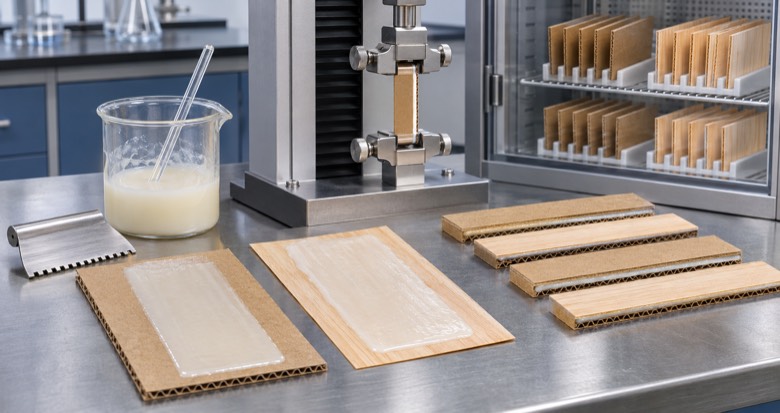
There is no universal “adhesive strength” test. ISO 11339:2022 specifies a T-peel test for flexible-to-flexible bonded assemblies. ISO 4587:2003 covers tensile lap-shear strength for rigid-to-rigid assemblies. Neither should be adopted merely because it is familiar; confirm that the specimen geometry, substrate and loading represent the product and that the current contractual or industry method is followed.
Record more than the peak force. Note whether failure occurs inside the adhesive, at an interface, through paper fiber tear, by veneer damage or through another mode. Conditioned dry strength, early bond development, humid exposure or water resistance may all matter, but use only the exposures relevant to the intended product.
Run enough replicates to see variability. Report individual results, spread and failure modes rather than hiding an unstable condition behind one average.
10. Confirm the result through production scale up
A laboratory mixer does not reproduce every commercial condition. Before approval, confirm powder feeding, dust control, dispersion time, vessel turnover, pumping, filters, transfer lines, application equipment, line speed, cleaning and finished-bond consistency in a controlled production trial.
Compare the production batch with the retained laboratory candidate using the same critical methods. If the result changes, investigate scale-dependent variables before changing the specification. Mixing energy per unit volume, addition rate, water temperature and hold time are common places to look.
Build an approval package that can be repeated
The final record should include the approved adhesive formula and revision, CMC grade and batch, incoming documents, make-down instructions, process conditions, viscosity method and checkpoints, substrate identification, coat weight, assembly and conditioning conditions, bond method, individual results, failure modes, retained samples and responsible approval.
This package becomes the comparison baseline for later shipments and formulation changes. It also gives the CMC supplier enough context to discuss an apparent performance change without guessing.
Frequently asked questions
Is there one recommended dosage of CMC for every starch adhesive?
No. Dosage depends on the starch system, other polymers and salts, solids, target rheology, substrate, application equipment and bond requirement. A published optimum from one formulation is evidence for that formulation, not a universal specification.
Should I choose CMC only by its solution viscosity?
No. Solution viscosity can help compare incoming grades when the method is identical, but the decision must include dispersion, adhesive rheology, working life, transfer, coat weight and bond results in the full formula.
Can a higher adhesive viscosity guarantee a stronger bond?
No. Excessive viscosity can reduce wetting, penetration or transfer, while a low value may cause run-off or over-penetration. The useful range is the one that supports both the process and the conditioned bond.
How should two CMC candidates be compared?
Use independent matched batches with the same starch, water, solids, pH, additives, mixing history, temperature, substrate, coat weight, assembly and test method. Change one CMC variable at a time and include the current approved adhesive as a control.
Does a laboratory bond test replace a line trial?
No. Laboratory screening removes unsuitable candidates and defines a controlled baseline. The line trial confirms feeding, mixing, pumping, application, speed, drying and finished-product consistency at production scale.
What information should I send when requesting a CMC sample?
Share the adhesive end use, starch and major components, solids and pH, current make-down method, viscosity test conditions, application equipment, substrate, coat weight, working-time target, bond test and any regulatory or document requirements. Do not disclose confidential formula details beyond what your agreement allows.
Discuss a CMC sample for your starch adhesive trial
When contacting SINOCMC, provide the application, current CMC or target behavior, complete viscosity method, powder-handling preference, trial batch size and the process or bond problem you need to solve. The team can review the available product information and discuss a sample plan; final suitability must be confirmed in your own formulation and production conditions.
Send your starch adhesive trial requirements to SINOCMC.
Technical sources
- Qiao, Z. et al. “The Effect of Carboxymethyl Cellulose Addition on the Properties of Starch-based Wood Adhesive.” BioResources 9(4), 6117–6129 (2014). Open the peer-reviewed paper.
- Dong, S. et al. “Factors influencing the adhesive behavior of carboxymethyl cellulose-based hydrogel for food applications.” International Journal of Biological Macromolecules 179, 398–406 (2021). PubMed record.
- Lopez, C. G. “Rheological Properties of Carboxymethyl Cellulose Solutions and Gels: An Overview.” Journal of Applied Polymer Science (2026). DOI record.
- ASTM International. Adhesive standards catalogue, including D1084, D2556, D1337 and D1338. ASTM adhesive standards.
- ISO 11339:2022, Adhesives — T-peel test for flexible-to-flexible bonded assemblies. ISO record.
- ISO 4587:2003, Adhesives — Determination of tensile lap-shear strength of rigid-to-rigid bonded assemblies. ISO record.