
Powder CMC vs Granular CMC: Dispersion and Selection Guide
Powder CMC and granular CMC are two physical forms of sodium carboxymethyl cellulose. The useful comparison is how each grade disperses, develops viscosity and fits your charging process. Particle form alone does not determine purity, viscosity grade or finished application performance.
This guide compares the practical selection checks. For a sample enquiry, see granular sodium CMC from SINOCMC.
1. Appearance and particle size
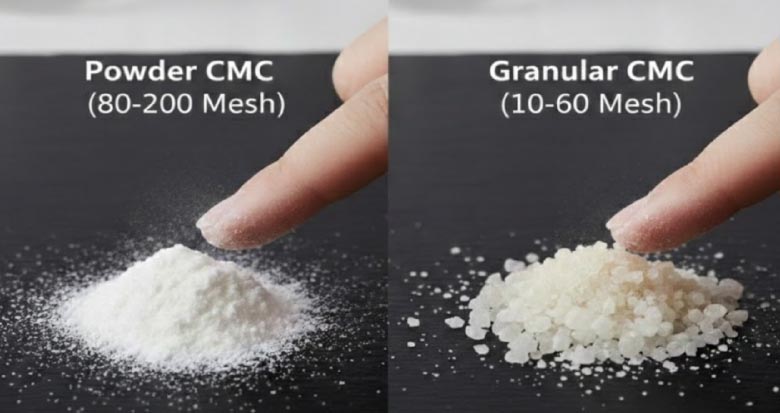
Powder grades have a finer appearance; coarse or granular grades have larger particles. Request the actual sieve specification and test method for the grade under consideration. A mesh range quoted for one product should not be treated as a universal definition of powder or granular CMC.
2. Dispersion is different from complete hydration
Dispersion means distributing particles through the liquid. Hydration and viscosity development continue after the material has been added. A batch that looks dispersed may still need further mixing and time before its viscosity can be evaluated.
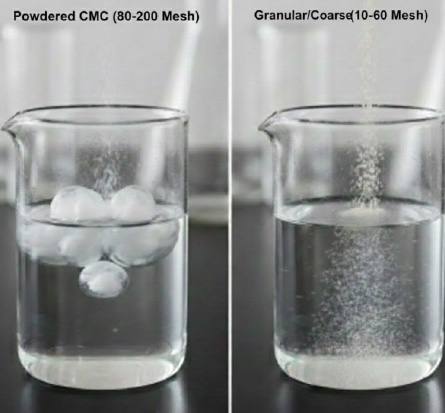
When CMC particles are charged too quickly or accumulate together, wetted surfaces can trap dry material inside lumps, often called fish eyes. Granular or specially prepared dispersible grades can help address this problem in suitable processes, but they do not guarantee lump free preparation under every mixing condition.
3. Compare preparation time under the same conditions
Keep CMC concentration, water quality, temperature, mixer, vessel and addition rate the same when comparing forms. Record the time to disperse and the time to reach the agreed viscosity endpoint separately. Check for residual lumps after the agreed preparation period.
Do not assume a fixed speed advantage, such as two or three times faster, without comparative results for the actual grades and process. For preparation steps, read how to dissolve sodium CMC without lumps.
4. Evaluate handling and total process cost
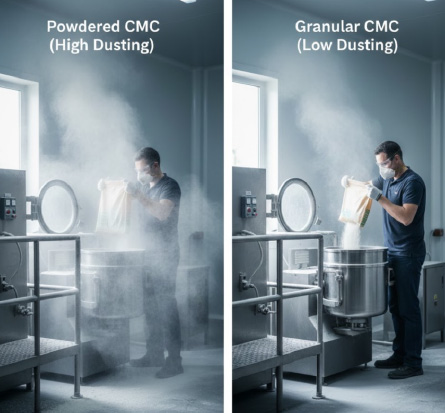
A coarser form may reduce visible dust during charging compared with a fine powder, but dust levels depend on the product, handling equipment and transfer conditions. Neither physical form should be described as universally dust free. Use the product SDS and the site’s material handling procedures.
Compare purchase price together with material loss, preparation time, mixing demand and the consistency of the resulting solution. Packaging and freight comparisons also need the actual pack size and bulk density.
5. Powder versus granular CMC: selection checklist
| Check | Powder CMC | Granular CMC |
|---|---|---|
| Appearance | Finer particles; verify the sieve specification. | Coarser particles; verify the sieve specification. |
| Charging | Evaluate controlled addition and any compatible dry blending step. | Evaluate direct charging with the proposed mixer and addition rate. |
| Hydration | Record dispersion, lumps and time to viscosity endpoint. | Use the same endpoints; do not infer hydration time from appearance. |
| Handling | Check dust and material loss in the actual transfer process. | Check whether the grade reduces dust in the same process. |
| Performance | Approve using the complete application trial. | Approve using the same application trial. |
6. Which form should you choose?
Consider powder when it fits your existing controlled charging or compatible dry blending process. Consider granular when direct liquid charging, dispersion or dust reduction is a purchasing priority. Evaluate an instant or dispersible grade separately: granular appearance alone does not establish instant performance.
Keep application requirements central. View CMC for mining or detergent grade CMC, then compare the appropriate candidate grades under your process conditions.
Request a sample comparison
Contact SINOCMC with your application, target viscosity, current grade, charging method and mixing equipment. Request specifications, a batch COA and samples for a controlled powder versus granular comparison.
SINOCMC Team