
Toothpaste CMC Trial: Hydration, Ribbon and Storage Checks
A toothpaste CMC sample should not be approved from a certificate or a beaker-viscosity result alone. The material has to hydrate reproducibly, tolerate the complete formula and mixing sequence, support filling and extrusion, and keep the finished dentifrice acceptable through the intended storage period. A controlled toothpaste CMC trial separates those questions so a buyer can see why a candidate passes or fails.
This guide is written for toothpaste factories, oral-care formulators and distributors comparing a new toothpaste grade CMC with an approved control. It does not prescribe a universal dose, formula or pass limit. Those values depend on the abrasive system, humectants, surfactants, active ingredients, process equipment, pack and destination-market requirements.
Start with the finished-toothpaste decision
CMC can contribute to binding, suspension and rheology in a dentifrice, but no raw-material number proves finished-product performance. A high solution viscosity can still create slow hydration, fisheyes, difficult deaeration or excessive extrusion force in a particular formula. A lower-viscosity candidate may perform well when its hydration and interaction with the complete system are controlled.
Write the approval question before requesting samples. A useful brief identifies the toothpaste type, abrasive family, humectant system, water quality, surfactants, salts or actives, flavor addition route, batch size, mixer and vacuum capability, filling equipment, tube or pump pack, storage program and the measurements that decide acceptance. The SINOCMC toothpaste grade CMC page provides product-family context; the trial must still be designed around the buyer’s actual formula and process.
1. Freeze the control before comparing candidates
Use one current, acceptable toothpaste batch or approved CMC lot as the control. Freeze all variables that can hide the CMC effect:
- raw-material lots or clearly documented substitutions;
- weighing basis and total batch mass;
- water temperature and water quality;
- order and rate of addition;
- mixing speed, time, shear device and vessel geometry;
- vacuum level and deaeration endpoint;
- sample age and temperature at every measurement;
- filling, package and storage conditions.
Change one planned variable at a time. If the candidate batch uses a different abrasive lot, water temperature and mixing time, the trial cannot attribute a change in ribbon shape or storage separation to CMC.
2. Confirm sample identity and comparable test methods
Before formulating, record the supplier, product name, sample lot, production or retest information where supplied, and the certificate linked to that lot. Compare moisture or loss on drying, purity or active basis, degree of substitution, viscosity result and method, pH where specified, and physical form. Do not assume that two values called “viscosity” are comparable.
ASTM D1439-22 covers specified test methods for sodium carboxymethylcellulose, including moisture, degree of etherification, viscosity, purity, sodium glycolate, sodium chloride and density. It does not set a universal toothpaste specification. It is useful because it reinforces the need to identify the method behind a number.
Solution concentration, dry or as-received basis, temperature, instrument geometry, speed and reading time can materially change a viscosity result. The separate SINOCMC guide to comparing 1% and 2% CMC viscosity explains why there is no universal conversion between methods. Use certificate data to screen samples, then let the controlled toothpaste trial decide application suitability.
3. Run a hydration and addition-sequence study
Poor dispersion can look like low viscosity, graininess or unstable paste even when the CMC grade is suitable. Record whether CMC is preblended with a dry ingredient, dispersed into a humectant, or added gradually to the aqueous phase. Also record agitation before, during and after addition, wall scraping, temperature and the time allowed before the next formula component enters.
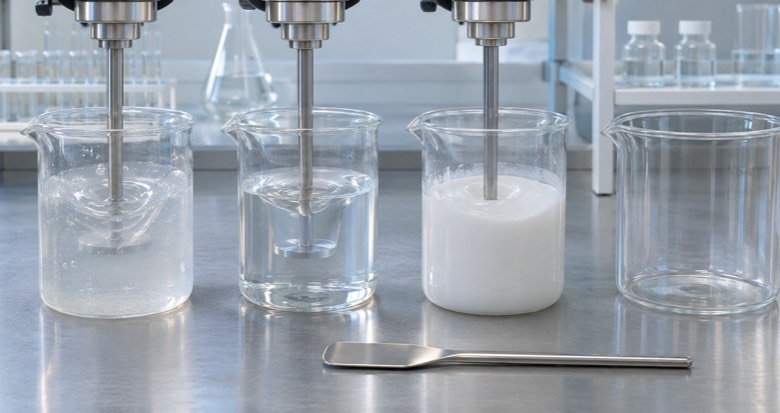
Inspect the hydrated phase for floating powder, wall deposits, fisheyes and persistent gel particles. If a pre-solution is used, the general industrial CMC dissolution guide can support a repeatable make-down record, but the plant’s hygiene, formula and equipment controls remain decisive.
Run the first comparison with the approved addition route. If both the control and candidate show a defect, investigate the process before rejecting one raw material. If only the candidate shows a defect, repeat the batch under the same conditions before changing the sequence. A one-off rescue procedure is not a robust approval method.
4. Add formula stresses in a controlled order
A hydrated CMC solution is simpler than toothpaste. Abrasives create a high solids load; salts and some actives change the ionic environment; surfactants introduce foam; flavors and other hydrophobic ingredients may change wetting and apparent structure. The trial should reveal when a difference appears.
| Trial stage | Keep fixed | Record | Possible warning |
|---|---|---|---|
| CMC hydration | Water, temperature, shear and time | Dispersion, gel particles and aged viscosity | Fisheyes or incomplete hydration |
| Abrasive addition | Abrasive lot, rate and mixing energy | Torque trend, uniformity and air pickup | Lumps, dry pockets or rapid structure build |
| Salt or active addition | Concentration and addition point | Immediate and aged paste response | Thinning, thickening or localized gel |
| Surfactant and flavor | Order, temperature and mixing time | Foam, wetting and paste appearance | Entrained air, streaks or separation |
| Vacuum finish | Vacuum profile and endpoint | Density, bubbles and batch temperature | Slow deaeration or post-vacuum bubbles |
Do not treat a salt-challenge beaker as proof that the full dentifrice will pass. Use it only as a diagnostic screen. The final decision must include the complete formula and the intended order of addition.
5. Measure rheology at the age and temperature that matter
A single apparent-viscosity reading cannot describe squeeze, ribbon stand-up and recovery after filling. At minimum, use one locked plant method at defined sample age and temperature. Where the laboratory has suitable equipment, a flow curve, yield-related measurement or thixotropic recovery check can add useful information. The same geometry, loading procedure, pre-shear history and timing must be used for the control and candidate.
Connect instrument data to observable handling. Record mixer load or torque only as a process indicator, not as a universal rheology value. Compare pump or transfer behavior, filling consistency, extrusion force, cut-off, ribbon continuity, ribbon height and shape retention. A candidate should not pass merely because it reaches a target number if it strings at the nozzle or collapses after extrusion.
6. Check deaeration, filling and ribbon stability
Air can distort density, apparent viscosity, filling weight and appearance. Use the same vacuum program and define an endpoint such as stable density, visual bubble level or a plant-specific validated criterion. After deaeration, take samples from consistent vessel locations and avoid introducing air during transfer.
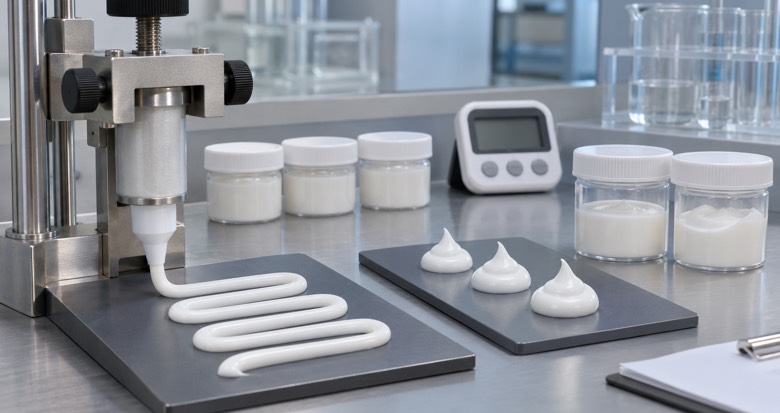
Use the intended package or a representative filling fixture. A jar sample cannot reveal every tube- or pump-related issue. Check fill-weight variation, air pockets, tailing at the nozzle, leakage, cap contamination and the paste’s ability to deliver a continuous ribbon. If the plant uses several nozzle sizes or line speeds, qualify the commercial range rather than only the easiest setting.
7. Build a storage program around the real pack
Fill matched control and candidate samples into the intended primary pack. Include retains from the same batch in laboratory containers only when they help separate formulation behavior from package interaction. Define storage orientations, temperatures and checkpoints before starting. Do not invent an accelerated-to-real-time conversion unless the company has validated that relationship for the formulation and pack.
At each checkpoint, compare appearance, phase separation, liquid bleed, hardening, odor or flavor change, density where relevant, extrusion behavior and the same locked rheology method. Evaluate product near the shoulder and crimp or seal as well as the middle of the pack. Where the formula contains an active ingredient, preservative system or claim-related component, the responsible manufacturer must apply the appropriate analytical, microbiological and regulatory program; CMC rheology testing does not replace it.
ISO 11609:2026 specifies physical and chemical requirements, suitable test-method guidance, marking, labeling and packaging provisions for dentifrices. It does not tell a factory which CMC grade or dose will work in its proprietary formula. In the United States, the FDA explains that product category depends on intended use and claims; some products can be both cosmetics and drugs. Formulation approval and compliance review must therefore remain with the responsible toothpaste manufacturer.
8. Bridge the laboratory sample to production
A laboratory pass is not the final gate. Production changes vessel geometry, powder wetting, addition time, heat transfer, shear distribution, vacuum efficiency and transfer history. Plan a pilot or first-production comparison that keeps the approved formula and raw-material identity traceable.
Record the CMC lot, actual addition route, batch timestamps, process readings, deviations, in-process samples, filling settings and finished-product results. Keep a retain from the approved sample lot and the first commercial lot. The SINOCMC sample to commercial batch approval workflow provides a broader framework for preserving this evidence through scale up.
Before routine purchasing, define the approved CMC specification, named test methods, certificate fields, packaging, change-notification expectations, receiving checks and any application confirmation required after a material or process change. A grade name alone is not a reproducible purchase specification.
Common false conclusions to avoid
- “The certificate viscosity is higher, so the toothpaste will be thicker.” The methods may differ, and the complete formulation may respond differently.
- “The CMC dissolved in water, so hydration is approved.” A water test does not reproduce humectants, solids, salts, surfactants or the plant sequence.
- “The fresh paste looks smooth, so storage will pass.” Separation, hardening and extrusion changes may appear later or only in the final pack.
- “More mixing fixed the candidate.” Extra time or shear may hide a dispersion weakness and may not be available at commercial scale.
- “One good batch proves robustness.” Repeatability across preparation and lots is needed before routine approval.
Toothpaste CMC trial FAQ
Can a toothpaste CMC sample be approved from a 1% or 2% solution viscosity?
No. Solution viscosity is useful only when the method is comparable. Approval should also cover hydration, complete-formula compatibility, deaeration, filling, extrusion, storage and production scale up.
Should CMC be added directly to water or pre-dispersed in a humectant?
Either route may be suitable depending on the formula and equipment. Compare routes with fixed materials, temperature, shear and timing, then choose the method that is reproducible in the actual plant.
Why can toothpaste thin or thicken after adding salts or active ingredients?
The formula’s ionic environment and addition sequence can change polymer hydration and the structure of the full paste. Diagnose the stage where the change appears instead of assigning the cause from one raw-material value.
What is the most useful finished-product check?
No single check is sufficient. A practical set combines locked rheology measurements with density or deaeration evidence, filling behavior, ribbon extrusion, visual uniformity and storage checks in the intended pack.
How many storage conditions are required?
There is no universal number. The responsible manufacturer should define conditions and checkpoints from the intended shelf life, distribution environment, pack, claims and internal quality or regulatory program.
When should a toothpaste factory request a commercial batch?
After the sample identity, method, laboratory formula and decision limits are documented and a realistic scale-up plan is ready. Order quantity should not move faster than technical approval and demand evidence.
Prepare a comparable toothpaste CMC sample request
Contact SINOCMC with the non-confidential toothpaste type, abrasive and humectant system, salt or active context, current addition route, CMC test method, target handling behavior, trial scale and destination market. Our team can review the comparison brief and discuss a relevant sample for your own validation. Final formula, dose, safety, shelf life, claims, regulatory status and release decisions remain with the toothpaste manufacturer.