
Fertilizer Granulation CMC Trial: Strength, Fines and Storage Checks
A fertilizer granulation CMC sample should not be approved because it produces a firm-looking granule in one bench batch. The binder enters a wet mineral system, changes liquid distribution and granule growth, passes through drying and screening, and then has to survive conveying, bagging, transport and storage without creating excessive fines or hard cakes. A useful trial must measure that whole chain.
This guide gives fertilizer producers, industrial distributors and quality teams a controlled way to compare a sodium carboxymethyl cellulose candidate with an approved control. It is not a universal formula, dosage, granule-size specification or regulatory statement. Raw materials, nutrient chemistry, granulator type, recycle load, dryer conditions, coating system and destination-market rules all change the correct test plan.
Quick answer: freeze the fertilizer formula and process, compare control and candidate on the same dry CMC basis, record granulation and drying conditions, and then measure screen yield, fines, granule strength, attrition, flow, caking and nutrient-release behavior. Repeat the preferred condition before production scale-up. Approve the grade, use level and process window together—not the CMC name or solution viscosity alone.
Why fertilizer granules need a process-based CMC trial
CMC can function as a water-soluble binder and rheology modifier in some granulation systems. Those functions are useful only when they fit the intended product. A stronger wet granule may reduce breakage before drying, but excessive binder solution viscosity can make spraying, liquid distribution or mixer discharge less consistent. A dense, durable granule may handle well yet disintegrate too slowly for the intended use. The decision therefore needs both manufacturing and use-stage evidence.
For a broader agriculture overview, see the SINOCMC article on CMC in agriculture. The separate guide to CMC in activated-carbon granulation covers different feedstocks and decision endpoints. The workflow below is limited to qualifying CMC as a fertilizer-granulation binder through a controlled factory trial.
1. Define the finished-fertilizer requirement first
Start with the product that must be delivered, not with a target CMC dosage. Write down the fertilizer type, nutrient declaration, raw-material lots, target granule-size distribution, acceptable undersize and oversize, bulk density, flow requirement, planned coating or anti-caking treatment, package, distribution route, storage period and application equipment. Where a product or market has mandatory composition, contaminant, labelling or conformity rules, keep those requirements separate from the binder trial.
The EU Fertilising Products Regulation, for example, requires relevant EU fertilising products to meet the applicable product-function, component-material and labelling requirements. It also expects manufacturing changes that can affect conformity to be taken into account. A successful CMC process trial does not by itself establish regulatory compliance.
Choose acceptance measures that match the actual distribution and application risk. A fertilizer blended with other granules may need compatible particle size and density to limit segregation. A product moved through multiple conveyors may need stronger attrition control than a locally bagged material. A water-dispersible or rapidly disintegrating product needs a use-stage test that prevents mechanical strength from becoming the only success criterion.
2. Freeze the formula, equipment and measurement basis
Record every component and its lot, moisture basis and addition order. Hold the batch size, recycle fraction, solids feed, liquid-to-solids ratio, binder concentration, granulator fill, speed, angle or mixer setting, residence time, spray location, atomization condition, bed temperature and discharge endpoint constant wherever the process permits. If an operator changes water, recycle or granulation time, record the amount and reason.
Compare CMC on a declared basis. Decide whether addition is calculated as supplied or as dry active polymer. When moisture or purity differs materially, equal bag weight may not mean equal active CMC. ASTM D1439-22 includes methods for sodium carboxymethylcellulose moisture, degree of etherification, viscosity, purity, sodium glycolate, sodium chloride and density; the purchasing specification should name the method actually used rather than relying on a bare value.
Solution viscosity is not a stand-alone binder-strength prediction. Record concentration, temperature, instrument, speed and endpoint, and compare only like-for-like data. The SINOCMC 1% versus 2% viscosity guide explains why results from different preparation and measurement conditions cannot be treated as interchangeable.
3. Build a small trial matrix that answers one question at a time
Begin with the current approved binder condition and one candidate at the same dry CMC addition. Include an independent repeat of at least one condition. Only after the direct comparison should the formulation owner consider an adjusted candidate level. Changing CMC grade, dosage, water and recycle together can create a good-looking batch without showing which change caused it.
| Condition | Purpose | CMC basis | Decision value |
|---|---|---|---|
| Control | Current approved process | Current dry addition | Defines normal yield and physical quality |
| Candidate | Direct material comparison | Same dry addition as control | Shows fit with the existing process window |
| Repeat | Repeatability check | Same selected condition | Separates a stable effect from batch noise |
| Adjusted | Optional optimization | One written dosage change | Maps the usable range after the direct comparison |
Run enough material to reach representative granulator, dryer and screen behavior. A cup-scale hand granulation can help reject an obviously unsuitable candidate, but it cannot prove spray distribution, recycle balance, residence time, dryer loading or production attrition.
4. Control binder preparation and liquid addition
If CMC is used as a solution, define water quality, temperature, powder addition rate, agitation, hydration time, concentration and hold time. Check for undispersed fisheyes, surface foam and concentration drift. If CMC is dry blended, document its particle form, distribution in the solids and the time between dry mixing and liquid addition.
Use one reproducible preparation route for control and candidate. An operator should not compensate for a difficult candidate with extra water or a longer hydration period without recording the change. Those adjustments can alter granule growth, dryer load and final moisture. The purpose of the first comparison is to determine whether the material fits the current process, not to make every condition pass.
5. Record granule growth and screen yield
During granulation, record feed rate, binder-liquid rate, recycle rate, product temperature, residence time, power or torque where available, visual growth pattern and any buildup on the pan, drum, mixer or spray system. Collect samples at fixed process points rather than taking only the best-looking material at discharge.
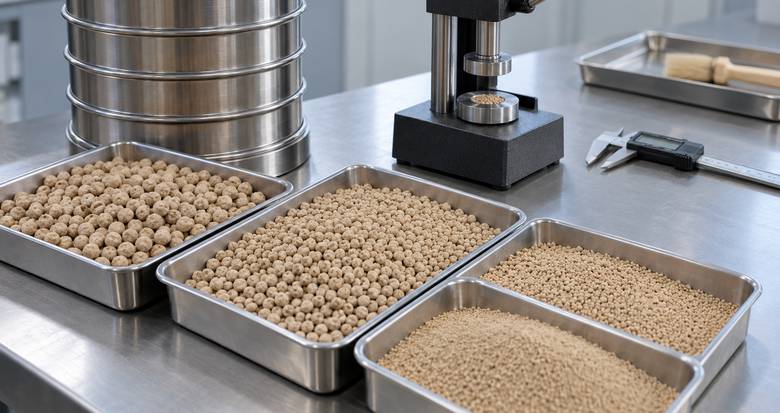
After drying and conditioning, determine particle-size distribution using the agreed sieve set, sample mass, shaking time and reporting method. ISO 8397:1988 specifies mechanical dry test sieving for solid fertilizers and soil conditioners. Use the current product specification and laboratory procedure to select sieve apertures and acceptance limits; do not copy a generic range from another fertilizer.
Report on-size yield, undersize, oversize and recycle requirement. A candidate may increase average size while widening the distribution or increasing oversize. That can reduce net saleable yield even if the foreground tray looks impressive. Keep mass balance and screen yield connected to the visual record.
6. Measure strength, attrition and handling damage
Physical quality includes more than size. The joint IFA/FAO publication Fertilizers and Their Use describes particle-size range, hardness or density, resistance to moisture and physical damage, and freedom from caking as important quality characteristics. These are useful categories for a qualification plan, not universal numerical limits.
For granule strength, define the size fraction, conditioning history, sample count, loading direction, instrument and reporting statistic. A few strong granules can hide a weak tail, so retain individual results or a distribution rather than reporting only the best value. For attrition, use a documented tumbling, conveying or handling simulation and measure new fines on the same sieve basis before and after the challenge.
Also record bulk density, angle of repose or flow through the factory’s standard funnel or hopper method when those properties affect packaging or application. A binder can change shape and surface texture even when nominal particle size is unchanged.
7. Check drying, moisture and caking as a system
Hold dryer inlet and outlet conditions, bed depth, residence time, air flow, cooling and sample-conditioning time constant. Record final moisture by the product’s approved method. A stronger granule from a wetter discharge is not an equal comparison; residual moisture can change apparent strength, flow and later caking.
Caking depends on fertilizer chemistry, moisture, temperature cycling, pressure, fines, storage time, package barrier and surface treatment. The FAO Manual of Fertilizer Distribution explains how hygroscopic fertilizers can absorb moisture, become sticky and later form crystalline bridges. Do not conclude that CMC alone caused or prevented a cake.
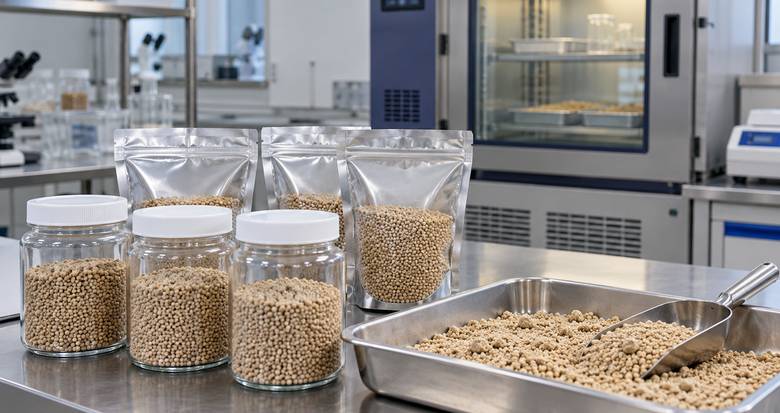
For a storage challenge, use matched sample mass, package, headspace, seal, stacking pressure, temperature and humidity history. Define inspection ages before starting. At each point, record free-flowing fraction, lump mass, force needed to break the cake where the site has a validated fixture, new fines, moisture and visual change. Then repeat the relevant hopper, conveying or spreading check.
8. Protect nutrient release and intended use
Mechanical durability is not automatically better when it becomes higher. The granule still has to disintegrate, dissolve or release nutrients as required by its product type and application method. Compare control and candidate under a written water, soil-column, dissolution or disintegration method that represents the intended use. Keep temperature, water chemistry, agitation, sample size and endpoint constant.
Do not turn a short laboratory disintegration result into an agronomic-efficiency claim. Crop response depends on nutrient form, dose, placement, soil, water, climate and crop management. Field or agronomic claims need their own qualified design and evidence. The CMC trial should answer whether the binder condition preserves the approved product behavior.
9. Repeat, scale up and lock the commercial specification
Repeat the preferred condition in an independent pilot batch. Then move to production scale with a written bridge plan covering mixing energy per mass, liquid distribution, granulator load, residence time, recycle, dryer load, screening, coating, conveying and bagging. Compare the first commercial batch with the approved pilot using the same measurements.
Link the result to purchasing controls. Record the approved CMC manufacturer, grade, lot, physical form, moisture or loss on drying, viscosity method, degree of substitution or other relevant specification, packaging, storage and change-notification expectations. Use the sample to commercial batch approval workflow to keep the laboratory sample and commercial lot connected. For shipment exposure, the CMC moisture-damage receiving and storage guide provides a separate investigation framework.
Approval checklist for fertilizer producers and buyers
- The finished fertilizer specification and use-stage requirement are written before the CMC trial.
- Formula, raw-material lots, recycle, water, equipment and process settings are fixed or every adjustment is recorded.
- Control and candidate are compared on the same dry active-polymer basis.
- Binder preparation, spray or addition conditions and hold time are reproducible.
- Screen yield, fines, oversize and recycle demand are measured by one sieve method.
- Strength, attrition, flow, bulk density, moisture and caking are separate decision gates.
- The preferred condition preserves the product’s required disintegration or nutrient-release behavior.
- An independent repeat and production-scale batch confirm the result.
- The approved grade, method, certificate fields, packaging, storage and change-control expectations are written into purchasing controls.
Frequently asked questions
Is higher solution viscosity always better for fertilizer granulation?
No. Solution viscosity depends on its test method and does not directly predict spraying, liquid distribution, wet granule growth, drying, final strength or disintegration in a specific fertilizer system.
Should the candidate use the same CMC dosage as the control?
Start with the same dry active-polymer addition to isolate the material change. Evaluate an adjusted level only as a separate, documented condition after the direct comparison.
What is the most important fertilizer granule test?
There is no single universal test. Size distribution, saleable yield, fines, strength, attrition, flow, moisture, caking and use-stage behavior answer different questions. Weight them according to the product, handling route and application method.
Can CMC eliminate fertilizer caking?
Do not assume so. Caking is affected by fertilizer chemistry, hygroscopicity, residual moisture, temperature cycles, pressure, fines, coatings, packaging and storage. Compare matched conditions and investigate the full system.
How many batches are needed before approval?
One attractive batch is insufficient. Include a repeat at pilot scale and confirm the selected condition in a controlled production-scale batch. Higher-risk products or larger changes may require more evidence under the buyer’s quality system.
What should a buyer send when requesting a fertilizer-granulation CMC sample?
Send the fertilizer type, granulator and binder-addition route, current CMC test method and use level, target size distribution, key defects, drying and storage conditions, package, annual demand and required qualification evidence. Share only information that is authorized for supplier review.
Build the decision around reproducible evidence
A reliable fertilizer granulation CMC decision connects raw-material identity to wet processing, saleable screen yield, mechanical durability, storage behavior and intended use. When the control and process history are fixed, the factory can distinguish a genuine binder improvement from extra water, longer granulation, favorable sampling or a one-batch exception.
Contact SINOCMC with your CMC test method, fertilizer type, granulation equipment, addition route and qualification plan. Our team can help organize a sample discussion around comparable data. Final formulation, compliance, agronomic claims and release decisions remain with the fertilizer producer and applicable qualified personnel.