
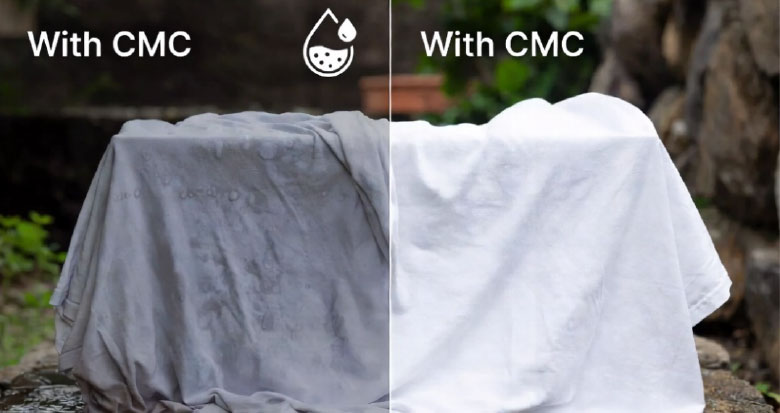
Sodium Carboxymethyl Cellulose (CMC) primarily functions as an anti-soil redeposition agent, soil suspending aid, thickener and stabilizer. It dramatically improves wash performance — particularly in hard water — by preventing detached dirt, grease and clay particles from re-settling on fabrics, helping maintain whiteness, reducing graying over time, protecting cotton fibers and enhancing overall cleaning efficiency.
Q1: What is the core role of CMC in laundry detergents?
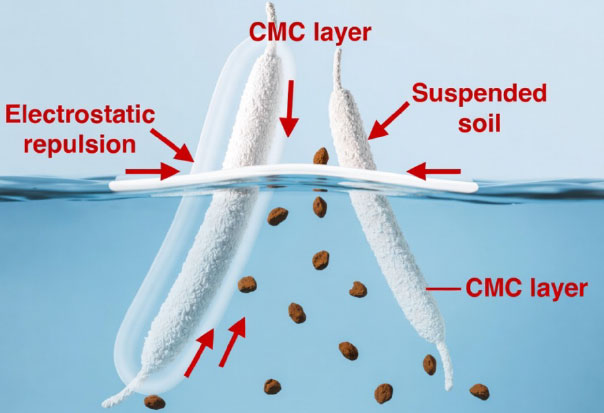
A1: CMC prevents soil redeposition. It adsorbs onto dirt particles in the wash liquor, forming a negatively charged hydrated layer around them. This creates electrostatic repulsion between the dirt and fabric fibers (especially cotton), keeping soil suspended so it is rinsed away instead of re-depositing on clothes.
Q2: Why is CMC especially valuable in hard-water regions?
A2: Hard water contains high levels of calcium and magnesium ions that form insoluble scum with surfactants, reducing cleaning power and causing graying. CMC helps sequester these ions to some degree and, more importantly, maintains the colloidal stability of the wash solution, significantly reducing redeposition even when calcium soaps are formed.
Q3: How much CMC is typically added to different detergent products?
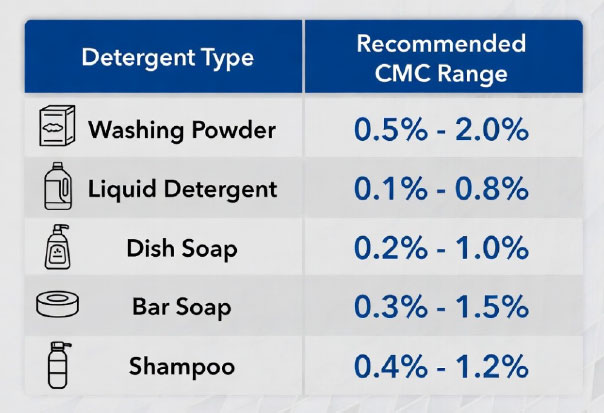
A3: Typical usage levels (active basis):
Q4: Recommended CMC Powder Types by Detergent Product Category
| Product Category | Typical Viscosity (1% sol., 25°C) | Typical DS | Recommended Dosage | Key Benefits |
| Detergent Powder | 5–40 mPa·s or 300–1500 mPa·s | 0.5–0.7 | 0.3%–1.5% | Anti-redeposition, whiteness maintenance, hard-water tolerance |
| Liquid Laundry Detergent | 5–500 mPa·s | 0.6–0.8 | 0.1%–0.8% | Stabilization, soil suspension, viscosity control |
| Dishwashing Liquid | 200–1000 mPa·s | 0.6–0.8 | 0.1%–0.5% | Thickening, foam stability, grease suspension |
| Laundry Soap Bars | 500–2000 mPa·s | 0.5–0.7 | 0.3%–1.0% | Plasticity, lather, anti-cracking, dirt prevention |
Conclusion
Detergent grade CMC is supplied and used almost exclusively in powder form and remains one of the most economical, proven and effective anti-redeposition agents available. Proper selection of viscosity grade, purity level and incorporation method allows manufacturers to achieve excellent whiteness retention, fiber protection and cleaning performance across washing powders, liquid detergents, dish soaps, laundry bars and personal care products.
SINOCMC Team