
Exploring Ceramic Grade CMC in Ceramic Manufacturing
Ceramic production involves multiple processing stages including slurry preparation, shaping, glazing and drying. Throughout these processes, maintaining stable rheology and sufficient green strength is essential for achieving high-quality ceramic products. Sodium Carboxymethyl Cellulose has become one of the most commonly used additives in ceramic manufacturing because it can simultaneously provide thickening, suspension, water retention and binding functions.
CMC in Ceramic Slurry Preparation
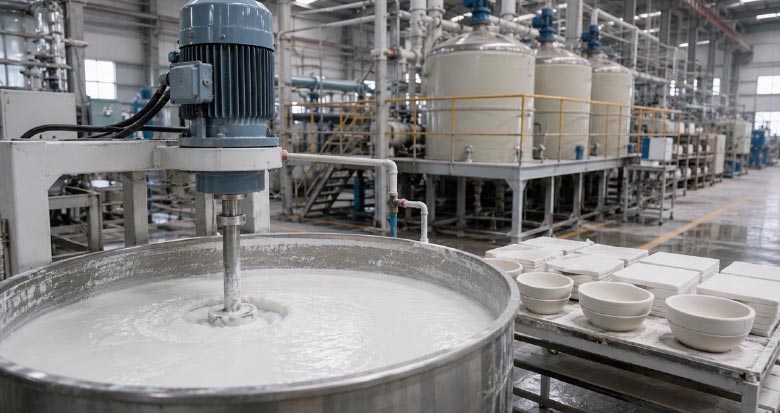
During the preparation of ceramic slurry, fine mineral particles such as kaolin, feldspar and quartz tend to settle over time. This sedimentation can lead to inconsistent composition, unstable processing conditions and quality fluctuations. CMC helps create a stable suspension system by increasing the viscosity of the slurry and improving particle distribution. As a result, ceramic manufacturers can achieve more uniform slurry properties during ball milling, pumping and spray drying operations.
Another advantage is its excellent water-retention ability. By slowing water migration, CMC helps maintain consistent moisture content throughout the production process, reducing defects caused by uneven drying.
Improving Green Body Strength
Before firing, ceramic bodies are relatively fragile and can easily crack or break during handling. CMC acts as an effective temporary binder between ceramic particles. It forms a flexible network that increases green strength and improves the integrity of pressed or extruded products.
Benefits include:
– Reduced edge cracking
– Lower breakage during transportation
– Improved dimensional stability
– Higher production yield

Application in Ceramic Glaze Systems
CMC is also widely used in ceramic glazes. Without a suitable stabilizer, glaze particles may settle quickly, causing uneven coating thickness and inconsistent appearance after firing. The addition of CMC helps maintain a homogeneous glaze suspension while improving coating performance during spraying, dipping or curtain coating operations.
Main roles include:
– Improve glaze suspension stability
– Reduce sedimentation
– Enhance coating uniformity
– Improve surface smoothness
– Increase processing consistency

Recommended Specifications for Ceramic Grade CMC
| Application | Recommended Viscosity | Recommended D.S. | Main Benefits |
| Ceramic Slurry | 300-1000 cps | 0.65-0.85 | Suspension stability, viscosity control |
| Spray Drying | 500-2000 cps | 0.70-0.90 | Improved granulation and process stability |
| Ceramic Body Binder | 1000-3000 cps | ≥0.7 | Improved green strength, reduced breakage |
| Ceramic Glaze | 300-1500 cps | 0.80-0.95 | Better glaze suspension and coating uniformity |
For samples and technical support, please feel free to contact SINOCMC.
SINOCMC Team